Decarbonising transport sector through renewable energy-based E-mobility
LIAPENG RALIENGOANE
MASERU – As the world grapples with the need to rapidly decarbonise, it is evident that solutions for transport and energy sectors are essentially linked.
It is anticipated that the newly introduced MaZero initiative will gradually move the nation towards a greener transport system over the course of the next ten years.
The National Climate Change Policy (2017) states that the transport sector accounts for the substantial share of Lesotho’s greenhouse gas emissions with an estimation of annual increase of 2.5 percent per year between 2000 and 2009.
It urges for use of improved fuel efficiency and adoption of green technologies in the transport sector with the objective of mitigating greenhouse gas emissions and using motorcycles and bicycles. Therefore, just transition is a key priority for impactful climate results.
The National University of Lesotho Energy Research Centre (NUL-ERC) Project Manager, Palesa Nkaile, says electric mobility (e-mobility) refers to the use of electricity as an energy source for vehicles instead of using fossil fuels.
“An e-mobility vehicle uses electric propulsion instead of a combustion engine. E-mobility holds a great promise for reducing emissions and cutting air pollution whilst enabling people to continue to travel for their needs Switching to electricity means significant reductions in climate-changing emissions and this transition is a necessary step to avoid the worst impacts of climate change,” Nkaile said.
At the United Nations (UN) Climate Change Conference (COP 26) in Glasgow, Scotland, the Just Transition Declaration was signed by countries from the Global North promising funding for climate action and decarbonization in developing countries.
UN describes “Just Transition” as greening the economy in a way that is as fair and inclusive as possible to everyone concerned, creating decent work opportunities and leaving no one behind.
While explaining the MaZero project, Technologies for Economic Development Director, ‘Mantopi Lebofa said the name MaZero represented ‘Ma’ for Maseru and Zero for zero emissions.
“We hope for a transformed Maseru transport sector and close to zero emissions through renewable energy-driven e-mobility. In summary, this project seeks for a shift to zero emissions,” Lebofa said.
She emphasized that the central objective of the MaZero project is to create and deploy a scalable model for renewable energy-driven e-mobility, integrating renewable energy sources for sustainable battery charging or swapping stations.
She continued that “this innovative approach marks the first implementation of sustainable e-mobility in Lesotho. It involves the development and deployment of solar Photovoltaic battery-powered charging stations, which will be used to support a fleet of e-vehicles, including MaZero-branded e-vehicles.”
Lebofa further explained that the project is centred on establishing a comprehensive smart and open-access e-mobility platform, empowering women to be active stakeholders.
It aims to engage diverse groups including students, healthcare workers, decision-makers, entrepreneurs, and the private sector, strengthening both knowledge and capability while also forming a local E-mobility network.
More stakeholders in the transport sector and beyond will be engaged as time goes on so that everyone is onboard.
On what has been done so far, from the NUL, Energy Research Centre Department of Physics and Electronics, Professor Leboli Thamae, said there are two sites selected for charging stations which will be powered by solar – one at NUL Roma Campus and another at its Institute of Extra Mural Studies (IEMS) in Maseru.
There are five charging stations so far in the country.
The good part of these e-mobility vehicles is that they can also be charged at home overnight. On top of that, when it comes to the cost of energy (charging), e-mobility vehicles are less costly as compared to their counterparts.
Professor Thamae also disclosed that NUL has approved their request to buy an electric car for the university and six e-scooters which will be donated to the health sector among others.
As part of the implementing team from Technische Hochschule Ingolstadt (THI), a university of applied sciences based in Germany, Head of the Institute for New Energy Systems (InES) Professor Matthias Huber mentioned that while piloting this project in Maseru, there will be establishment of a sub national network for renewable energy-based E-mobility and climate protection, empowerment of women as active stakeholders through training and capacity building initiatives for various target and stakeholder groups and fostering expertise.
Funded by the International Climate Initiative (IKI) MaZero, the project is implemented by Technische Hochschule Ingolstadt (THI) and the NUL-ERC in collaboration with Technologies for Economic Development (TED).
The first batch of stakeholders was engaged last Friday in Maseru.
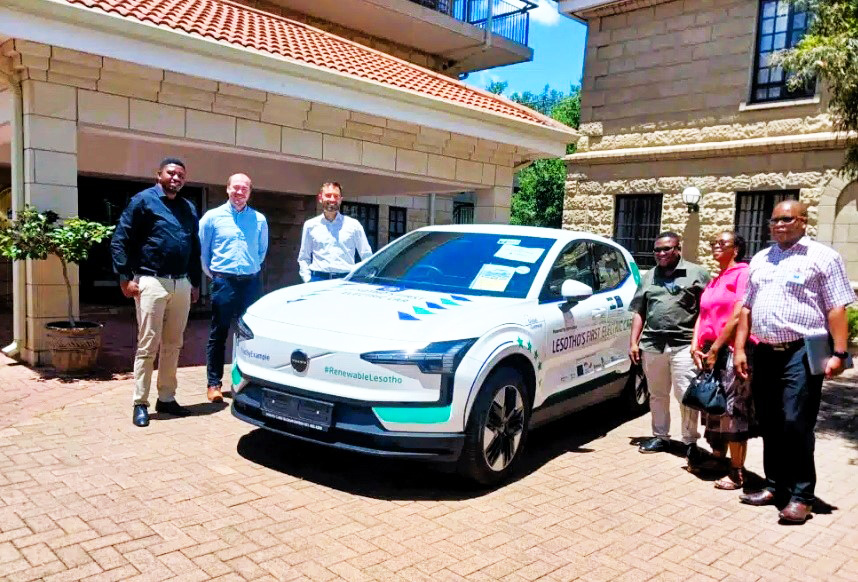
In November 2024, the country welcomed its first ever Lesotho-registered electric vehicle through the European Union’s financial assistance.
The National Strategic Development Plan (NSDP II) states that the government will promote renewable energy by harnessing energy from wind, solar, and water. The goal is a 35 percent electrification rate in rural areas from renewable sources by 2025 and universal access by 2030.
As mentioned in the Lesotho Scaling-Up Renewable Energy Programme’s Renewable Energy Investment Plan of 2017, Lesotho has the potential to produce up to 6 000 Megawatts from wind and solar, 4 000 Megawatts from pump storage, 400 Megawatts from conventional hydropower and more than 1 200 Megawatts from hydropower.
In order to stimulate job creation and inclusive growth, the government of Lesotho will base all new connections on integrated planning with a focus on growth enhancing sectors, both in grid-connected and off-grid rural areas.
The vision of the National Climate Change Policy (2017) is to build climate change resilience and low-carbon pathways including a prosperous sustainable economy and environment in Lesotho.
The policy puts forward three objectives by which to achieve the aforementioned vision. These are: Promote climate-resilient, social, economic and environmental development that is compatible with, and mainstreamed into, national development planning and national budget-setting processes.
It further calls for the exploration of low-carbon development opportunities nationally and internationally in order to promote the sustainable use of resources.
Also to strengthen a framework that: promotes efficient climate change governance; strong international cooperation, capacity building, research and systematic observations and clean technology development, transfer and use, education, training and public awareness as well as financing.
All these in a way that also benefits the most vulnerable through the implementation arrangements to be defined in the strategy.