Lesotho charts AI future

National strategy aims to harness technology for human development
MOSA MAOENG
MASERU – At the launch of Lesotho’s 2025 Human Development Report (HDR) in collaboration with the United Nations Development Programme (UNDP), a resounding message emerged – Artificial Intelligence (AI) is not a distant future but a present opportunity demanding strategic, inclusive and human-centred action.
The report, globally themed ‘A matter of choice: People and possibilities in the age of Artificial Intelligence’ found fertile ground in a nation actively positioning itself to leverage AI for transformative development.
Minister of Finance and Development Planning, Dr Retšelisitsoe Matlanyane, underscored the significance of the moment. Recalling Lesotho’s history of engaging with HDRs – focusing previously on human security, poverty, and food security – she emphasized the 2025 edition’s critical relevance.
“The 2025 HDR takes a people-centred approach that considers how ideas, knowledge, and information are central to human development,” Dr Matlanyane stated.
“The knowledge or information environment is being reshaped by innovative technologies, creating new challenges, opportunities, and societal transformation driven by digitization, including more powerful and far-reaching AI applications.”
The minister highlighted the report’s focus on navigating the tensions inherent in this new era, stating that “the HDR, therefore, uses a human rights lens to shed light on the tensions that may emerge around preserving freedoms of expression or association within a fundamentally reshaped information environment. It will also examine the implications of lack of diversity in the data used in AI algorithms.”
This launch follows Lesotho’s significant stride in 2024/25, as highlighted by UNDP Deputy Representative, Taye Amssalu, who said “Lesotho became one of the few African countries to develop a national AI policy.”
He stressed this policy’s profound importance highlighting that “this is not just a document, but a strategic compass… guiding collaboration between humans and AI, not competition. It’s about designing inclusive systems and investing in capabilities that count, including education, healthcare, and digital access.”
Amssalu echoed the HDR’s central warning and Lesotho’s chosen path: “AI can either enhance disparities or dismantle them. Lesotho is choosing the latter. Our mission is to make sure the promise of AI becomes a people’s dividend, not a privilege for a few.”
The commitment extends beyond policy documents. Amssalu announced two crucial initiatives launched just this week under the Ministries of Communication and Education focused on the community inclusion model, which is designed to bridge the digital divide by creating accessible digital learning hubs.
“This model will bring technology to where people already gather – community centres, schools, churches – facilitating practical digital skills acquisition at the grassroots level,” Amssalu explained.
Secondly, the Lesotho Digital and AI Competency Framework, a structured plan to build the essential skills base required for citizens and the workforce to engage meaningfully with digital tools and AI technologies.
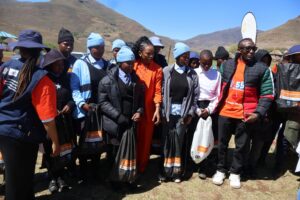
Complementing these initiatives, the event saw the certification of 40 ‘Digital Ambassadors.’ These individuals, drawn from communities, are tasked with cascading digital knowledge and fostering local-level digital transformation, embodying the government’s “whole of society” approach.
The central question, addressed during a panel discussion featuring government officials, the private sector, academia, NGOs, and youth representatives, was: How will Lesotho’s AI strategy, developed with UNDP support, translate into tangible benefits across critical sectors, driving inclusive growth and sustainable development?
Thapeli Tjabane, Director General of Information, Communications, and Technology in the Ministry of Communication, outlined the integrated policy foundation, indicating that “last year, we developed three interrelated policies: the AI Policy, the Data Management Policy, and the Broadband and Shared Infrastructure Policy. Together, these implement the broader regional digital transformation strategy.”
Crucially, Tjabane emphasized the collaborative ethos: “The strategy is a ‘whole of society’ approach. It is not just implemented by the government but by society. The AI policy supports inclusive economic participation, growth, and sustainable development…
There is a role for not just government but the rest of society. As government, we are policymakers and implementers, but there are also defined roles for different sectors.”
Lesotho’s strategy prioritizes deploying AI to address specific national challenges and unlock opportunities in core sectors in revolutionizing agriculture, predictive analytics for climate resilience, livestock management, market access and pricing transforming healthcare delivery, enhanced diagnostics, telemedicine and remote monitoring, as well as drug discovery and epidemiological tracking.
AI can personalize learning and expand access to quality education, provide adaptive learning platforms, teacher support and resource creation, skills gap analysis, boost governance and public services, facilitate data-driven policymaking streamline service delivery and assist in fraud detection and revenue enhancement.
The optimism is tempered by a clear understanding of the prerequisites for success, as highlighted throughout the HDR launch and Lesotho’s own strategy.
The UNDP reinforced the HDR’s core message of advocating for a human-centred approach where AI fundamentally redesigns development pathways for the better. Surveys indicate global readiness for this shift.
Lesotho, through its pioneering national AI policy, concrete initiatives like the Community Inclusion Model and Competency Framework, and its embrace of the “whole of society” approach, is positioning itself not merely as an AI adopter, but as a nation striving to shape the technology to serve its unique development aspirations.
The launch of the 2025 HDR in Maseru was more than a presentation, it was a declaration of intent. Lesotho recognizes that harnessing the power of AI for agriculture, healthcare, education, and governance is not a futuristic dream, but an urgent national project.
The choices made today – in investing in infrastructure, building skills, ensuring ethical deployment, and fostering inclusive participation – will determine whether AI becomes a true “people’s dividend,” lifting the nation towards greater human development and resilience, or a force that deepens existing divides.