A Qacha’s Nek community’s long walk to water ends
MOSA MAOENG
For decades, the women of Masuoaneng woke at 3 a.m. not to cook, not to tend fields, but to walk. They walked in darkness toward springs that animals had often reached first, carrying containers that grew heavier with every step, racing other villagers to a scarce and often unsafe supply.
“Those who came later often returned empty-handed,” remembers ‘Masetenane Setenane, 56, recalling mornings when the water she finally fetched was “dirty and unsafe for consumption.”
Today, Setenane no longer walks in the dark. She turns a tap. Clean water flows — and with it, a story of hope that reaches far beyond one village in Lesotho’s southeastern highlands.
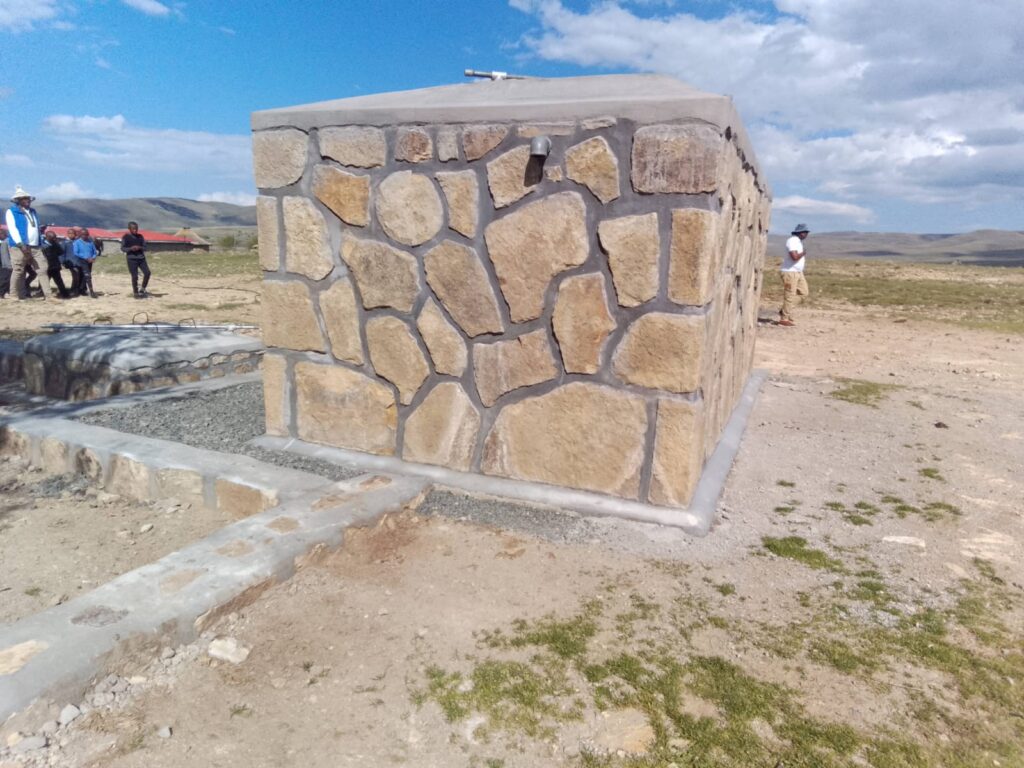
The transformation of Masuoaneng, a community under the Khomo-Phatšoa Resource Centre in Qacha’s Nek, is the result of a newly rehabilitated potable water system officially handed over last Thursday by the Regeneration of Landscapes and Livelihoods (ROLL) initiative, implemented by the Ministry of Environment and Forestry.
The rehabilitation, valued at M250 000, was made possible through the Lesotho Lowlands Rural Water Supply and Sanitation (LLRWSS) project, which focuses on extending reliable water access to rural communities where clean water remains scarce.
But the story of Masuoaneng is not simply a story about pipes and tanks. It is a story about what happens when a water-rich country finally begins to connect its most vulnerable communities to the water beneath their feet — and about the long, unfinished journey that remains for millions of Basotho still waiting for a safe drink.
A country rich in water, poor in access
Lesotho’s water paradox is one of the most striking in Africa. The country sits atop the Senqu River headwaters and receives rainfall that, on average, far exceeds national demand.
Its natural renewable water resources are so abundant that Lesotho exports approximately 780 million cubic metres of water to South Africa annually, a trade that consumes roughly half of the country’s average annual rainfall and contributes significantly to GDP.
Yet, the same country has some of the continent’s starkest domestic water gaps.
According to the 216 census cited in ROLL’s own reporting, 97 percent of urban residents had access to improved water sources, compared with only 80 percent in rural areas. National coverage for safely managed drinking water stood at just 31 percent.
More recent assessments paint an equally troubling picture. A 2024 survey found that 82 percent of households could reach improved drinking water within a 30-minute round trip, but others must travel farther or rely on unprotected sources.
Fecal contamination is present in 66 percent of rural households’ water, compared with 31 percent in urban areas, and only 46 percent of the population has access to basic sanitation services.
Nearly 85 percent of the rural population depends on traditional sources — open reservoirs, springs, and open wells — that are easily contaminated by livestock and runoff.
The consequences are measured in health and human development. Waterborne illnesses, particularly diarrheal disease, remain a severe public health problem, and repeated pathogen exposure contributes to malnutrition and stunted growth affecting 35 percent of children under five.
Rural poverty, which stands at 61 percent compared with 27 percent in urban areas, amplifies every water failure.
“It is not a question of whether water exists, but whether safe water is accessible to all,” human rights scholars have observed of Africa’s broader water crisis — a description that fits Lesotho with uncomfortable precision.
The situation in Qacha’s Nek illustrates the rural water crisis at its most acute. The district is one of Lesotho’s most environmentally fragile and socio-economically disadvantaged, characterised by steep slopes, shallow erosion-prone soils, and erratic rainfall that swings between recurrent droughts and intense storms.
In December 2024, local authorities launched a critical water assessment as shortages and rationing gripped villages including Sehlabathebe, Matebeng, Ha Noosi, Qhoalinyane, Tebellong, and the Urban Council, with some areas facing contaminated supplies.
The El Niño-induced drought of 2024 dried up wells and devastated harvests, and residents of Qacha’s Nek reported that crops, vegetables, and livestock were deteriorating due to water scarcity and degraded rangelands.
In Masuoaneng specifically, the community had relied on a water tank that served them from 1990 until 2018, when it was damaged.
Councillor Phamotse Moeti recalls that villagers were forced back to off-spring sources, where animals contaminated the water and waterborne illnesses became routine. Community members built protective walls around the tank, but children sometimes broke them, undoing their efforts.
“Although numerous challenges weigh on us, none has been as debilitating as the lack of access to clean water,” Moeti said.
ROLL and mandate to regenerate landscapes and livelihoods
The ROLL project is not a stand-alone water programme. It is a deliberately integrated response to the interconnected crises of land degradation, climate vulnerability, and rural poverty that define life in Lesotho’s highlands.
Implemented by the Ministry of Environment and Forestry with funding from the Government of Lesotho and the International Fund for Agricultural Development (IFAD), ROLL’s development objective is to ensure that rural communities adopt transformational practices for regenerated landscapes and sustainable livelihoods, leading to improved nutrition and adaptation to climate change.
The project is underpinned by four outcomes: changes in resource-use practices, reduction of environmental degradation, improved livelihoods, and the establishment of a facility and a fund to sustain integrated catchment management beyond the project’s lifetime.
ROLL operates through two main instruments — a Facility that supports landscape regeneration on the ground and a Fund designed to catalyse long-term investment — with the explicit aim that both survive the project and serve as lasting tools for sustainable catchment management in Lesotho.
The project’s design recognises that water security cannot be achieved through infrastructure alone. In Masuoaneng, community members have actively engaged in wetland conservation, deferred grazing, and gully stabilisation — the very landscape restoration practices that protect the catchments from which their water flows.
When Minister of Environment and Forestry, Thabo Mofosi, addressed the handover, he stressed that neglecting pastures and rangelands would exacerbate water scarcity, because these lands are vital water sources.
“It is essential to conserve and protect our pastures so that they serve the community as well as livestock,” he said, while acknowledging that some individuals continue to burn pastures despite ROLL’s training sessions.
The handover in Masuoaneng also reveals the practical machinery of delivery. The contractor, Trinity Builders & Road Construction, completed the rehabilitation within a tight eight-week deadline.
Contractor, Mokhachane Posholi, credited the success to cooperation with community members, who formed the bulk of the workforce alongside just three technical experts.
“We faced no significant challenges that hindered our progress,” Posholi said.
On behalf of the LLRWSS, Department of Rural Water Supply District Engineer, Lerotholi Rabukana, explained that the community had once enjoyed a functioning tank, but its deterioration over time left villagers dependent on contaminated springs.
“Despite our best efforts to repair the water tank, it became clear we needed outside assistance,” Rabukana said. “Fortunately, ROLL approached us with a viable solution.”
The LLRWSS project itself is aligned with Lesotho’s long-term water sector reforms, in which the Department of Rural Water Supply retains responsibility for rural service delivery while aligning community-managed schemes with national regulatory frameworks and integrated catchment management systems.
A right recognised, a reality denied
The Masuoaneng handover is a local milestone, but it unfolds against a broader regional and international consensus that safe water is not a charity — it is a right. In July 2010, the United Nations General Assembly adopted Resolution 64/292, recognising safe and clean drinking water and sanitation as a human right essential to the realisation of all human rights.
The UN Human Rights Council reaffirmed this in Resolution 15/9, and General Comment No. 15 of the Committee on Economic, Social and Cultural Rights specifies that water must be sufficient, safe, acceptable, physically accessible, and affordable for personal and domestic use.
In Africa, the African Commission on Human and Peoples’ Rights has explicitly linked the right to water to the African Charter’s guarantees of life, dignity, health, development, and a healthy environment.
Its 2015 resolution on the right to water obligations urged member states to “ensure the rational and equitable use of water resources through the distribution of water resources to meet, in priority, the vital human needs of the populations concerned.”
The Maputo Protocol specifically requires states to guarantee access to clean drinking water for women, and the African Charter on the Rights and Welfare of the Child protects children from unsafe drinking water.
At the regional economic level, the Revised SADC Protocol on Shared Watercourses and the SADC Regional Water Policy commit member states to ensuring sustainable access to safe water for basic human needs, recognising water as a social good essential to human dignity.
The African Water Vision 2025 — and its successor framework, the Africa Water Vision 2063 — calls for “an Africa where there is equitable and sustainable use and management of water resources” and “sustainable access to a safe and adequate water supply and sanitation” for all.
The continent’s own statistics explain why these commitments matter. Across Africa, 2 out of 5 people lack access to clean drinking water, and diarrhoea alone accounts for more than 8.8 percent of mortality.
Only 39 percent of Africans used safely managed drinking water in 2020, a disparity that reflects not water scarcity but infrastructure failure, weak service delivery, and entrenched inequality. Lesotho’s rural water profile — with contamination rates, open defecation, and long collection times concentrated among the poor — is a local expression of a continental justice gap.
The recognition of the right to water has advanced farther in law than in lived experience.
“Rights are acknowledged,” scholars note, “but existing infrastructure isn’t properly maintained, accountability is inadequate, and communities are faced with the consequences.”
Beyond the tap
The handover in Masuoaneng offers a counter-narrative to that pattern — but it also exposes how much remains to be done. Setenane is hopeful, but her hope is tempered by responsibility.
“We have also received training that enables us to engage in environmental protection efforts,” she said, adding that the community is committed to preventing waste, including discouraging washing clothes and vegetables at the taps.
ROLL Project Coordinator, Mofihli Motšetšero, urged the community to tackle malnutrition by cultivating vegetables while protecting the grazing lands and pastures that helped bring the clean water.
“It brings us joy to see the community benefiting and living healthier lives,” he said.
Yet, Moeti, the councillor, also pointed to challenges that water alone cannot solve — notably, access to better roads. The primary school, Tsatsa-le-meno, sits some distance from the village, making attendance difficult for children, particularly in rainy weather.
The broader data confirm that Masuoaneng is an island of progress in a sea of unmet need. World Vision Lesotho reports that approximately 80 percent of the rural population relies on unprotected water sources, often travelling more than 30 minutes to collect unsafe water; around 66.2 percent lack access to improved sanitation, and 33.9 percent of rural families still practise open defecation.
The Ministry of Environment and Forestry’s own minister acknowledged that Basotho often do not excel when awarded tenders, and he commended Trinity Builders for exemplary performance — a reminder that delivering water security requires not only funding but competent, accountable implementation.
Masuoaneng’s new water system will not, by itself, close Lesotho’s rural water gap.
But it demonstrates a model that works: integrated landscape restoration to protect water sources, infrastructure rehabilitation through partnerships that employ local labour, community training in environmental stewardship, and a rights-based framing that treats water as foundational to health, dignity, and livelihood.
For Setenane, the change is measured in hours reclaimed and illnesses avoided — in mornings no longer spent walking in the dark. For Lesotho, the challenge is to scale that change from a single resource centre in Qacha’s Nek to the thousands of rural communities still waiting for the promise of safe water to become real.
The water is there, beneath the basalt and the pastures. The question is whether the pipes, the institutions, and the political will can finally reach it — and reach everyone.