“I see you, keep going”: Moxxy’s journey from rejection to graduation
By Rethabile Mohono
MASERU-At five years old, Morena Letsema already knew she was different. She did not yet have the language to explain her identity, but she knew in her heart that she was a girl.
Growing up in ’Moteng, Botha-Bothe, however, meant that understanding herself was not easy. The teasing, discrimination and rejection she experienced from an early age followed her into her school years and, later, into tertiary education.
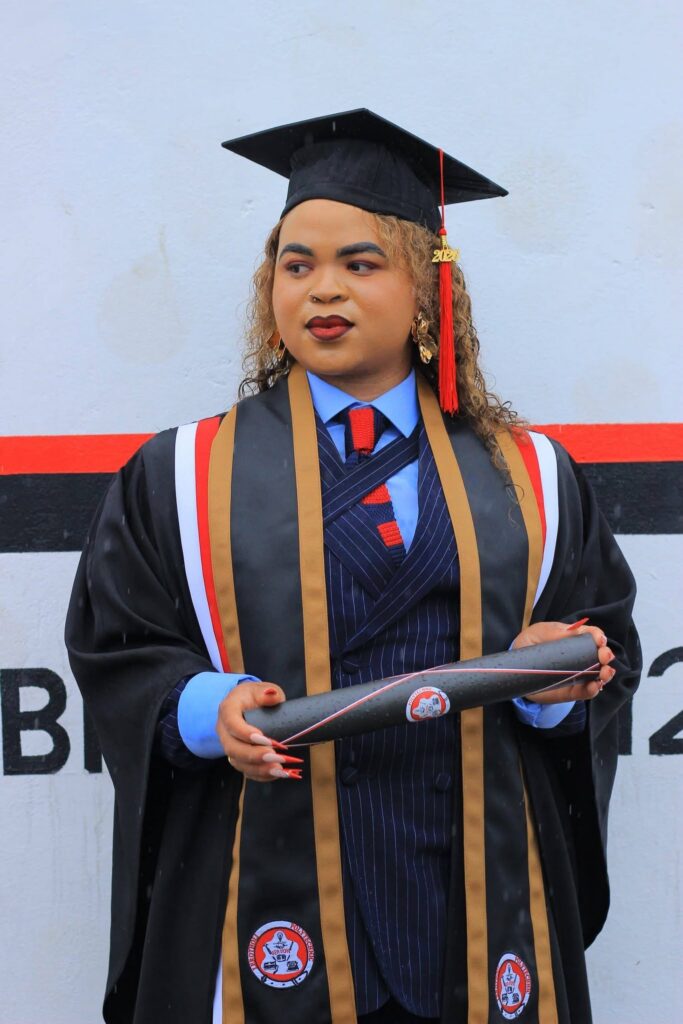
Today, known as Moxxy, the 24-year-old is a proud queer woman and a Diploma in Business Management graduate. Her achievement represents more than completing her studies. It is a story of survival, determination and the importance of having people who choose to stand beside someone when the world makes them feel they do not belong.
Raised by her maternal grandparents, whom she describes as her everything, Moxxy said her childhood was marked by rejection from people who struggled to understand her identity.
“My primary school was not easy. From as early as 5 years old, I knew I was different and people around me saw it too. I faced a lot of teasing and discrimination because I wasn’t what society expected a boy child to be. But my grandparents always pushed me to go to school,” she said.
She attended ’Moteng Community Primary School before proceeding to Khukhune High School. Despite the difficulties, she performed well academically, seeing education as a way to build a different future for herself.
“I went to ‘Moteng Community primary school, then Khukhune high school, and even though it was hard, I passed well because education was my escape. I knew I wanted more for myself,” she said.
Moxxy later pursued a Diploma in Business Management, driven by her desire for independence and entrepreneurship.
“I chose it because I have always wanted to be an independent entrepreneur, to create my own opportunities and not depend on anyone. I wanted skills that would allow me to build something of my own and help my parents, siblings and grandparents one day,” she said.
A childhood of rejection
Moxxy said she began recognising her gender identity at around five years old, although she did not know the term LGBTQ+ at the time.
“I didn’t have the word ‘LGBTQ+’ then, but I knew in my heart, in the way I played, dressed, and felt, that I was a girl,” she said.
Growing up in a rural community with limited information and representation made the experience particularly isolating.
“In Botha-Bothe, there was no information, no representation identity. I thought something was wrong with me until I grew older and learned who I am. Accepting myself was the most freeing thing I ever did,” she said.
Her family’s response was also complicated. Moxxy said her parents did not accept her identity, prompting her to leave home and live with her maternal grandparents.
Although her grandparents initially struggled with what the community was saying, they did not turn her away.
“My grandparents struggled at first because of what the community was saying, but they never chased me away. Their love was stronger than gossip,” she said.
She added that some extended family and community members continued to discriminate against her through insults, laughter and hurtful remarks. With time, however, her grandparents came to accept her.
“Some extended family and community members discriminated against me, they would talk, laugh, call me names. But with time, my grandparents started to see me ‘Morena’ happy, and they chose love,” she said.
Stares, insults and exclusion on campus
Moving to Maseru to pursue tertiary education brought excitement, but also fear. Moxxy was looking forward to studying and becoming more comfortable with herself, but worried about whether she would be accepted in a new environment.
She was particularly anxious because the institution she had chosen was known for its strict culture.
Her fears were not unfounded. Moxxy described a student experience marked by stares in corridors, whispers in classrooms, deliberate misgendering and restrictions on using facilities where she felt comfortable.
“Sometimes I was not allowed to use the facilities I was comfortable with,” she said.
Group work also became a challenge during her first year because some students did not want to be placed in groups with her.
“Group work was hard in my first year because some students did not want to be grouped with me. It makes you feel small,” she said.
The discrimination went beyond uncomfortable encounters. Moxxy said she experienced bullying and verbal harassment, including people shouting names at her around campus.
The impact on her mental health was severe. She recalled returning to her rented room in tears, isolating herself and deliberately arriving late for lectures to avoid drawing attention.
“It affected my mental health badly. There were days I would go back to my rented room and just cry. I started to isolate myself, I would come late to class to avoid attention, and my self-esteem went very low,” she said.
She also struggled with feeling unsafe, particularly when walking alone in the evening.
For Moxxy, the fear of violence carried an additional burden because of her identity.
“As a queer person, you feel double the fear. When there is violence around college, you are always thinking ‘what if they target me because I am trans?’” she said.
She became increasingly conscious of where she went, what she wore and whom she spoke to.
“I was always alert, always careful about where I go, what I wear, and who I talk to. It is exhausting to study when part of your mind is always thinking about safety,” she said.
At one point, she considered abandoning her studies.
“Many times, I thought of dropping out in my first year,” she said.
What kept her going was the memory of her grandparents and the sacrifices they had made to raise her.
“What kept me going was my grandparents’ face. They raised me with nothing, and I wanted to make them proud. And I kept telling myself: if I quit, the bullies win. I wanted that diploma for Morena from ‘Moteng,” she said.
The lecturer who told her: “I see you, keep going”
Despite the hostility she experienced from some students, Moxxy also encountered people who made her feel recognised and supported.
She said lecturers in the Business Management department respected her, called her Moxxy and treated her like any other student. She also found support among queer students and straight female friends who walked with her, sat with her in class and defended her.
One moment, in particular, became a turning point in her academic journey.
On the third day of orientation, students were invited to volunteer as class representatives. Moxxy put herself forward, although some students made remarks in response.
Limpho Phate, a lecturer who was present during the exercise, intervened.
“In this class we respect everyone,” Phate told the students before looking at Moxxy and smiling, according to Moxxy’s account.
After the class, Phate called her aside and offered words that would remain with her throughout her studies.
“I see you, keep going,” she told her.
Moxxy said the lecturer’s intervention gave her the courage to stand her ground and continue participating in student life.
“I will never forget her, that one moment kept me in school for months and made me stand my ground and work for my classmate as their representative, which I did faithfully for the whole three years,” she said.
Phate said supporting Moxxy and ensuring she was treated equally, protected and respected meant recognising her as an individual.
“The best way we can support people who are perceived as different is to not treat them like they are different. It is very important to allow people to be the individuals they are and also educate ourselves, where we do not understand, it is okay to ask rather than offend,” Phate said.
Reflecting on Moxxy’s personality and participation in student life, Phate said:
“From the onset I never saw her as anything but the beautiful personality she has. From day 1 she stood out, she was actively participating in school activities, honestly she made it so easy to love her. I don’t believe I did much, I just supported her, I listened when she needed me to but apart from that I just reciprocated her kindness,” she said.
Phate also challenged people to reject bullying and educate themselves about differences they may not understand.
“We are all different in our little ways, we all have something that someone doesn’t like. Bullying cannot be the solution to something you do not understand or dislike. Rather educate yourself, and understand that someone’s differences and preferences do not affect your life,” she said.
A friend who stood by her when others walked away
While Phate’s intervention helped Moxxy find the courage to stand her ground, friendship also played an important role in helping her navigate an often uncomfortable student environment.
Mapaseka Mohasi, a former student who met Moxxy at school and became her friend, said she refused to distance herself from Moxxy because of how other students perceived her.
At a time when some students were uncomfortable around Moxxy, Mohasi defended her, studied alongside her and made sure she was not left feeling isolated.
She said her support extended beyond words of encouragement.
“I supported Moxxy by being there for her emotionally, listening to her whenever she needed someone to talk to, encouraging her during difficult times and making sure she felt accepted, respected and included. I also stood by her whenever she faced challenges and reminded her that she should never feel ashamed of who she is,” Mohasi said.
She explained that her decision to stand by Moxxy was rooted in her belief that everyone deserves love, respect and equal treatment.
“I did so because I believe everyone deserves love, respect and equal treatment regardless of their sexual orientation. Moxxy is my friend and I believe friendship means accepting one another without judgment. I wanted her to feel safe, comfortable and confident being herself,” she said.
Mohasi added that the friendship had taught her the importance of acceptance, kindness and understanding.
“Having Moxxy as a friend has taught me the importance of acceptance, kindness, patience and understanding. I’ve learnt that people are different and those differences should be celebrated rather than judged. Most importantly I’ve learnt that true friendship is about supporting someone for who they are, not expecting them to change to fit in,” she said.
What does the law say about Moxxy’s experience?
While the support of lecturers and friends can make a significant difference, protecting transgender students should not depend solely on the goodwill of individuals. Educational institutions also have responsibilities to prevent discrimination and ensure that students can access education in a safe and respectful environment.
Advocate Relebohile Pheko, a Programmes Officer at the International Human Rights Lab (IHRL) and Project Manager under its Thuso Project, which seeks to challenge systemic barriers affecting the LGBTQI+ community, explained that Lesotho’s Constitution provides a basis for protecting people against discrimination.
Section 18 prohibits discrimination on several grounds, including race, colour, sex, language, religion, political or other opinion, national or social origin, property and birth. Although sexual orientation and gender identity are not expressly listed, Pheko explained that the reference to “other status” could be interpreted to include them.
This interpretation is supported by the 2013 High Court case of *Thabo Fuma v Commander Lesotho Defence Force and Others*, in which the court recognised that the grounds of discrimination listed under Section 18 are not exhaustive.
Section 19 further guarantees equality before the law and equal protection of the law.
Section 28 addresses the right to education and provides for higher education to be equally accessible to all on the basis of capacity. However, Pheko explained that this provision falls under the Principles of State Policy and is not independently enforceable in the same way as the fundamental rights contained in Chapter II of the Constitution. It nevertheless provides guidance on the state’s responsibilities in education.
Institutions must do more than promise equality
The Higher Education Act of 2004 also provides a framework for institutional discipline. Section 30 provides for disciplinary measures and procedures to be determined through an institution’s institutional statute.
According to Pheko, institutions should take reasonable steps when they become aware of harassment or victimisation.
These include establishing accessible and confidential reporting mechanisms, conducting fair investigations, taking appropriate disciplinary action, protecting complainants against retaliation and ensuring that all students can participate equally in institutional life.
Staff and students should also receive sensitisation on issues affecting LGBTQI+ people to help create an environment where discrimination and harassment are not tolerated.
Moxxy believes educational institutions need to introduce clear anti-discrimination policies, train lecturers and students on gender identity, provide safe toilets and hostels, and establish reporting systems that work.
“They need to learn that we are students first. We need clear anti-discrimination policies, training for lecturers and students about gender identity, safe toilets and hostels, and a reporting system that actually works. If institutions protect trans students, we can thrive academically,” she said.
Efforts to make campuses more inclusive
Karabelo Sello of Unlocking Love, an LGBTIQ+ organisation that promotes diversity, acceptance and community connection, said the organisation had been engaging tertiary institutions across Lesotho to promote the inclusion of LGBTIQ+ students in campus activities and encourage learning environments in which everyone feels welcomed and accepted.
Sello said Unlocking Love visited the National University of Lesotho (NUL) and Botho University around March 2026, focusing on mental health challenges students face both in their academic lives and outside the classroom.
“We went to NUL and Botho around March. The message was centred around mental health challenges students face, tabeng tsa lithuto tsa bona le ka ntle,” Sello said.
At NUL, Unlocking Love collaborated with the university’s Department of Student Affairs and Welfare to host a Campus Mental Health Dialogue under the theme Identity, Inclusion and Wellbeing on 27 March 2026 at the ISAS Auditorium. The dialogue aimed to raise awareness of mental health challenges affecting students, particularly LGBTIQ+ students, address stigma surrounding mental health and identity, and encourage help-seeking and awareness of available support services.
The discussion also explored how intersecting identities, academic pressure and social expectations affect students’ wellbeing, while emphasising peer-led dialogue as a way of strengthening an inclusive campus culture.
The gap in legal protection
Despite the constitutional provisions and international commitments, Pheko noted that Lesotho does not have comprehensive legislation specifically dedicated to protecting LGBTIQ+ people across all areas of life.
Pheko pointed to several international and regional human rights instruments that provide protection against discrimination.
These include the International Covenant on Civil and Political Rights, particularly Articles 2 and 26, which address non-discrimination and equality before the law; the International Covenant on Economic, Social and Cultural Rights, particularly Articles 2(2) and 13, which address non-discrimination and the right to education; and the African Charter on Human and Peoples’ Rights, particularly Articles 2 and 3, which guarantee non-discrimination and equality.
The Convention on the Elimination of All Forms of Discrimination Against Women also provides a broader framework for addressing gender-based discrimination.
Pheko’s analysis points to a gap between the protections promised by human rights principles and the lived experiences of LGBTQI+ people. Stronger legislative protections, inclusive institutional policies, effective complaint mechanisms and public awareness are needed to help close that gap.
Where can transgender students seek help?
Pheko explained that students who experience discrimination, harassment or victimisation can first use the internal complaint mechanisms available at their educational institutions.
Where the conduct involves assault, threats, intimidation, sexual violence or other criminal offences, they can report the matter to the Lesotho Mounted Police Service.
There is also a constitutional avenue for seeking redress. Section 22 allows a person who alleges that a right under Sections 4 to 21 of the Constitution has been, is being or is likely to be violated to approach the High Court for relief.
Human rights organisations can also assist through advocacy, referrals, legal support and efforts to improve access to justice.