Corruption, overpayments in palace construction
AG’s report exposes lack of oversight by Ministry of Public Works
‘MATHATO SEBOKA
One of the most damning revelations in the building of the new Royal Palace is excessive payments made to contractors despite little to no progress on the construction site.
The construction of the palace was intended to be a symbol of national pride and a testament to the country’s commitment to modernization.
However, the project has been marred by allegations of corruption, financial mismanagement, and lack of oversight, as revealed in the Auditor General, ‘Mathabo Makenete’s audit report released in the beginning of May.
The report highlights massive overpayments to contractors, incomplete work, and a failure by the Ministry of Public Works to enforce proper accountability.
The construction of the new palace was initiated to replace the aging structure currently housing the monarchy. The project was allocated significant funds from the national budget, with expectations that it would be completed within a set timeframe.
However, years after its commencement, the palace remains unfinished, with contractors receiving payments far exceeding the work done.
Makenete’s investigation uncovered alarming financial discrepancies, raising serious concerns about the integrity of the procurement and construction processes. The report points to systemic failures in oversight, particularly by the Ministry of Public Works, which was responsible for supervising the project.
Key findings of the Auditor General’s report have unearthed overpayments to contractors without justification millions of Maloti disbursed for incomplete work, with contractors receiving payments for stages of construction that were never finalized.
There were no proper verification mechanisms were in place to ensure that payments matched the actual work done. Some contractors were paid multiple times for the same work, indicating either gross negligence or deliberate fraud.
The report also highlights irregularities in the awarding of contracts. Some contractors were handpicked without open tenders, violating public procurement laws designed to ensure transparency. Contract prices were inflated, suggesting possible collusion between government officials and private firms while no proper documentation was maintained to justify the selection of certain contractors over others.
The Ministry of Public Works, as the lead agency overseeing the project, failed in its duty to ensure proper financial and operational controls.
Makenete noted in her report that “no regular site inspections were conducted to verify progress before releasing payments; and that weak internal audit systems allowed for unchecked financial mismanagement.”
There were no consequences for non-performing contractors, who continued to receive payments despite delays.
The report further uncovered suspicious expenditures, including salaries paid to workers who did not exist as well as unsupported expenses with no receipts or documentation. There has also been misuse of funds meant for construction materials, which were either overpriced or never delivered, recorded.
According to Makenete’s findings, about M7.5 million of government funds was overpaid to the contractors yet the project remains unfinished.
The report shows that all the architects’ contracts on the project for Palace Architects and Makeka Design Lab used contracts governed by the South African laws.
“Failure to use Government of Lesotho laws in Lesotho contracts poses challenges in cases of conflicts with the government seeking recourse in a foreign jurisdiction South Africa,” the report stated.
Makenete also found that the contracts the architects – Palace Architects and Makeka Design Lab – required that the copyright and ownership of project documentation remained their intellectual property, with government having only the right to use the documents for the sole purpose of their intended use on the project.
The Auditor General stated her opinion that, because of the key findings highlighted and drawn to the attention of the Minister of Public Works and Transport, the construction process of the palace project has significant deviations from the requirements of the relevant projects industry laws, principles, guidelines and contracts.
“The main building structure should be subjected to structural integrity tests for assurances and where necessary, corrective measures be taken to remedy the affected components,” she recommended.
Makenete also noted that there were significant deviations from the compliance with procurement regulation.
She went on to show that the M74 million overpay also indicated a lack of adequate contract management.
“There were reflections through deviation from contract terms, incorrect application of contract clauses, retrospective payments, payments for unexecuted works and over-valuation of quantities among others,” she said.
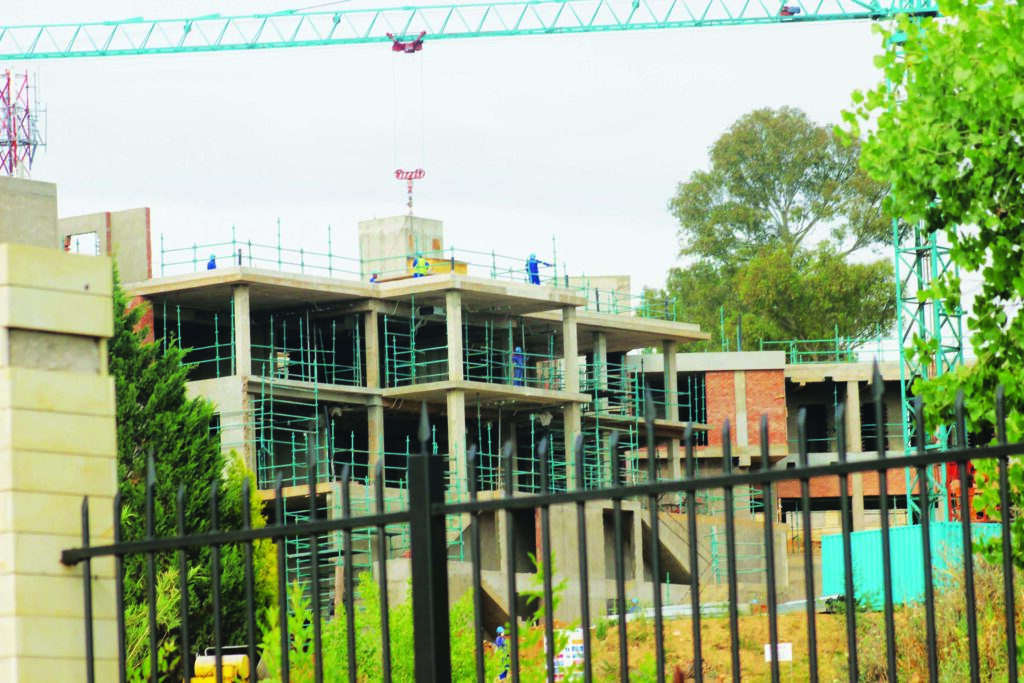
As things stand, the incomplete project remains with rotten timber installations, significant damage on the glass components and major efflorescence in the walls.
“I advise that going forward, the Principal Secretary Ministry of Public Works and Transport should ensure that Stage 2 of the construction is fully concluded and wrapped up with all overpayments recovered,” Makenete advised.
Thereafter, “kick-off Stage 3 of the construction on a clean slate with proper observance of the procurement guidelines and the contract engagement procedures and remedy the adversely affected components in alignment to the structural integrity test results.”
The mismanagement of the Royal Palace project has far-reaching consequences for the country, with erosion of public trust in government. When high-profile projects involving national symbols like the Royal Palace are tainted by corruption, citizens lose faith in their leaders.
The misuse of public funds also undermines democracy and fosters cynicism toward governance.
The millions of Maloti lost to overpayments and fraud could also have been allocated to critical sectors like healthcare, education, and infrastructure. Instead, the unfinished palace stands as a monument to wasted resources.
Failure to complete the palace on time just as much reflects poorly on government’s ability to manage large-scale projects. International partners and investors may hesitate to engage with a government that cannot ensure accountability in public contracts.
If no action is taken against those responsible, it sends a message that corruption is tolerated, encouraging further abuses in future projects.
The Auditor General’s report must serve as a wake-up call for the government to take decisive action. Key recommendations include should include criminal investigations and prosecutions. Law enforcement agencies should investigate and prosecute individuals and companies involved in fraudulent activities.
There should be uncompromised recovery of misused funds through legal means, including freezing assets of implicated parties.
The Ministry of Public Works must also be compelled to implement stricter monitoring systems, including regular independent audits while also ensuring mandatory competitive bidding for all government contracts to prevent favouritism.
The scenario, as laid bare by the Auditor General’s report exposes a culture of corruption and negligence within the public sector. The Ministry of Public Works’ failure to provide proper oversight has allowed contractors to exploit the system, resulting in massive financial losses for the country.
If government is to restore public confidence and ensure efficient use of taxpayer money, immediate action must be taken to hold wrongdoers accountable and implement robust anti-corruption measures.
The Royal Palace should symbolize integrity and national pride – not mismanagement and graft. The government must act now to rectify these failures and demonstrate its commitment to good governance.
But it remains unquestionable that corruption in public projects is not just a financial issue – it is a betrayal of the people’s trust.
Government must choose between perpetuating a broken system or taking bold steps toward transparency and accountability. The unfinished Royal Palace should serve as a reminder of what happens when oversight fails, and a motivation to do better.