Justice Winston Churchill Matanzima Maqutu
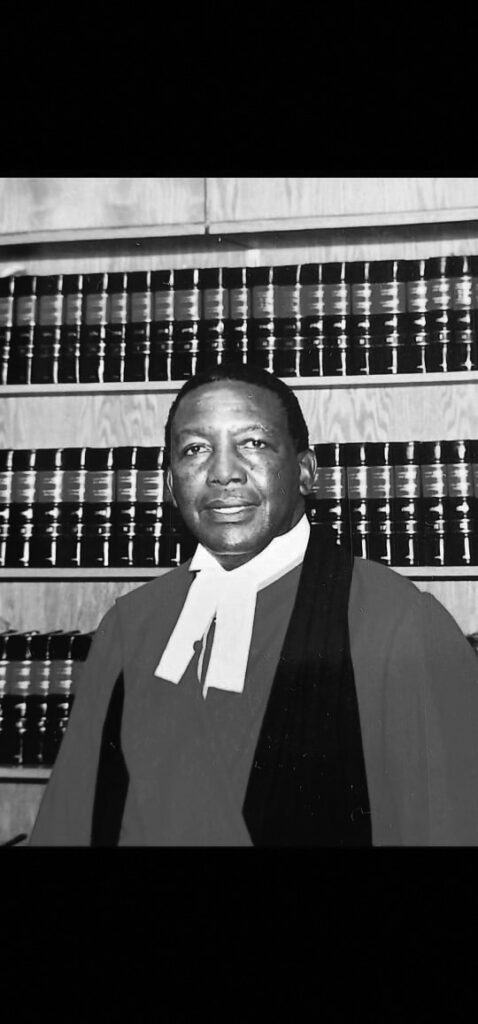
A life dedicated to justice, integrity and the rule of law
TEBOHO KHATEBE MOLEFI
The legal fraternity and the international community mourn the passing of Justice Winston Churchill Matanzima Maqutu, a distinguished jurist, scholar and advocate for justice, who passed away on Wednesday April 28.
Born in Botha-Bothe on December 11, in 1940, the second child born to Ntate AC Zithulele Maqutu and ’MaPhelo Jacobeth Maqutu, Justice Maqutu leaves behind an indelible legacy as a judge of the International Criminal Tribunal for Rwanda (ICTR), a High Court jurist and a legal academic whose contributions to international criminal law and African jurisprudence remain unparalleled.
A younger brother to Phelo and older sibling to Mlindelwa, Vuyelwa, Noyana and Guncotton Winston Churchill Matanzima Maqutu was a product of Lesotho’s robust legal tradition.
The late judge began his schooling in 1947. Following his matriculation from, the then Basotholand High School in 1960, he went on to obtain A-level certification.
After completing his early education and having completed his A-levels, he briefly enrolled for the Bachelor of Laws degree, at the then University of Bechuanaland, Basutoland and Swaziland (UBBS), a predecessor of the now National University of Lesotho (NUL).
His stay at UBBS was short-lived because in 1964, he moved his law studies to the University of Edinburgh in Scotland, where he received his LLB (Honours) degree in 1969.
During his life, he remarked that his grandfather, Billy Mthengi Maqutu, had told him that he would become a lawyer. Nonetheless, he initially took a government position with the Nutrition Division of the Department of Agriculture.
In 1970 he began as a candidate attorney serving articles under Mohokare Chambers of Mohaleroe Sello and Co. With the passage of time he opened his own full practice, WCM Maqutu and Co. He also served as a Conveyancer and Notary Public. He became a renowned attorney, known and respected throughout Lesotho and beyond.
He was known to be a formidable cross examiner and, in the event, that he lost a criminal trial, his plea in mitigation was second to none. He served as the President of the Law Society for several years during the 1980s.
He was also generous to friends and colleagues.
Former Chief Justice Mahapela Lehohla recalls that at his wedding, Justice Maqutu took the position of best-man 15 minutes before the wedding, when the appointee had failed to arrive.
While running his law practice, he joined the NUL as a law
lecturer. He was a Senior Lecturer and Deputy Dean of the Faculty of Law at the school, shaping generations of African legal minds. His academic work emphasized constitutional law, human rights and judicial ethics, reflecting his deep commitment to the rule of law in post-colonial Africa.
In this capacity he made significant and longstanding contributions to academic scholarship, particularly in Customary law. His dedication to the practice of law and his role as a law teacher entailed that he kept a punishing schedule.
His sharp legal mind and dedication to justice saw him rise rapidly from an advocate of the High Court, by 1993 he was appointed a judge of the High Court of Lesotho, a position he held with distinction. A judge of the High Court and Court of Appeal of Lesotho.
Justice Maqutu’s most prominent role came in 2001, when he was elected as a judge of the ICTR by the United Nations General Assembly, following Security Council Resolution No 1329 of 2000.
His appointment came at a critical juncture in international justice, as the tribunal sought to address the horrific crimes of the 1994 Rwandan genocide.
Alongside Justice Arlette Ramaroson of Madagascar, he was sworn in during a ceremony in Arusha, Tanzania, witnessed by key figures such as Registrar Adama Dieng, President Navanethem Pillay, and Prosecutor Carla Del Ponte.
As a member of Trial Chamber II, Justice Maqutu presided over some of the ICTR’s most significant cases, including: The Butare Trial in 2001 – One of the largest joint trials at the ICTR, involving six accused, including a former minister and prefect, charged with genocide, crimes against humanity and war crimes.
He handled the Juvénal Kajelijeli case – A high-profile case against a former Rwandan mayor accused of leading massacres, where witnesses testified that Kajelijeli orchestrated the killing of 321Tutsis in a single attack. Also the case of Jean Mpambara involving a former Rwandan official charged with genocide, where Justice Maqutu’s chamber upheld principles of command responsibility and intent in genocide prosecutions.
His judgments were marked by rigorous legal analysis, fairness, and a deep understanding of the socio-political context of the Rwandan genocide.
Colleagues remembered him as a patient, thoughtful jurist who balanced judicial sternness with compassion for victims.
Justice Maqutu’s work extended beyond the courtroom. He was a strong advocate for judicial independence and the importance of African jurists in international tribunals.
His presence at the ICTR was symbolic – an affirmation that African jurists could lead in prosecuting crimes committed on their own continent.
He also contributed to the development of international criminal law, particularly in clarifying the definition of genocide and complicity, the role of local authorities in mass atrocities and the evidentiary standards for war crimes prosecutions.
His rulings set precedents that influenced later tribunals, including the International Criminal Court.
After his tenure at the ICTR, Justice Maqutu returned to Lesotho, where he continued to engage in legal scholarship and mentorship. He remained a vocal proponent of judicial reforms in Africa, advocating for stronger institutions to prevent future atrocities.
In interviews, he often reflected on the emotional weight of adjudicating genocide cases, stating that “to sit in judgment over such crimes is not just a legal duty – it is a moral one. We must ensure that justice is done, not for vengeance, but so that history does not repeat itself.”
He retired from the bench in 2007. During his retirement he was admitted as an Advocate of the High Court of South Africa, where he made some appearances in the lower courts and superior courts of KwaZulu-Natal. He also made a few appearances in the High Court of Lesotho. He was conferred King’s Counsel King Letsie III.
He received an honorary Doctor of Laws degree (Honoris Causa) from the NUL in 2014.
Justice Maqutu was joined in Holy Matrimony with ‘Mathabo Lucy Kathleen Nonkosi Ndaba-Maqutu following a short courtship, they married in 1971. They were blessed with four children, namely, the late Thabo Vuyisele, Mpaiphele Dyson, Siphiwe ‘Maneano and Lindiwe Nomachezi.
In ’Mathabo, he had a faithful and spirited life partner, who was equal to his dominant and commanding nature. Together they
created a loving and nurturing home. They were devoted to each other and unwavering in their commitment to their children.
He was instrumental in supporting ‘Mathabo to obtain several
degrees culminating in the first woman to be awarded a PhD in the family. Indeed, his ardent love and support of his wife has often been a point of contention for many in the family who
vied for his attention.
Outside his legal career, he was a devoted member of the Anglican Church of Lesotho, where for decades he held various leadership roles and assisted with several legal matters. He served as Registrar and then later as Chancellor of the Anglican Church between 1976 and 2006.
He was first appointed as Registrar under Bishop Desmond Tutu from 1976 – 1978. He was then appointed as Chancellor under Bishop Phillip Mokuku from 1978 – 1997. He continued as Chancellor under Bishop Andrew Duma from 1997 – 1999, and finally under Bishop Joseph Tsubella from 1999 – 2006.
His legacy lives on in the judgments he authored, the students he taught, and the standards he set for international justice.
Justice Winston Churchill Matanzima Maqutu was more than a judge – he was a guardian of justice in an era where the world sought accountability for mass atrocities. His life reminds us that the law is not just a profession but a calling – one that demands courage, integrity, and an unyielding belief in justice.
He is survived by his dear wife, ‘M’e ‘Mathabo, their son Mpaiphele, two daughters Siphiwe ‘Maneano and Lindiwe Nomachezi, seven grandchildren, namely, Thembiso, Lungile, Thandaza, Mokuoane, Ndumiso, Lerato, Tshepo, and a great-grandson Sinomhlengi and his older brother Phelo.
A memorial service in his honour was held at the Palace of Justice, in Maseru, on Wednesday – commemorative session in recognition of his contributions to local and international law.
The arc of the moral universe is long, but it bends toward justice, an old saying recognises – and in bending it, Justice Maqutu played a pivotal role.