Likuena bundled out of COSAFA 2025
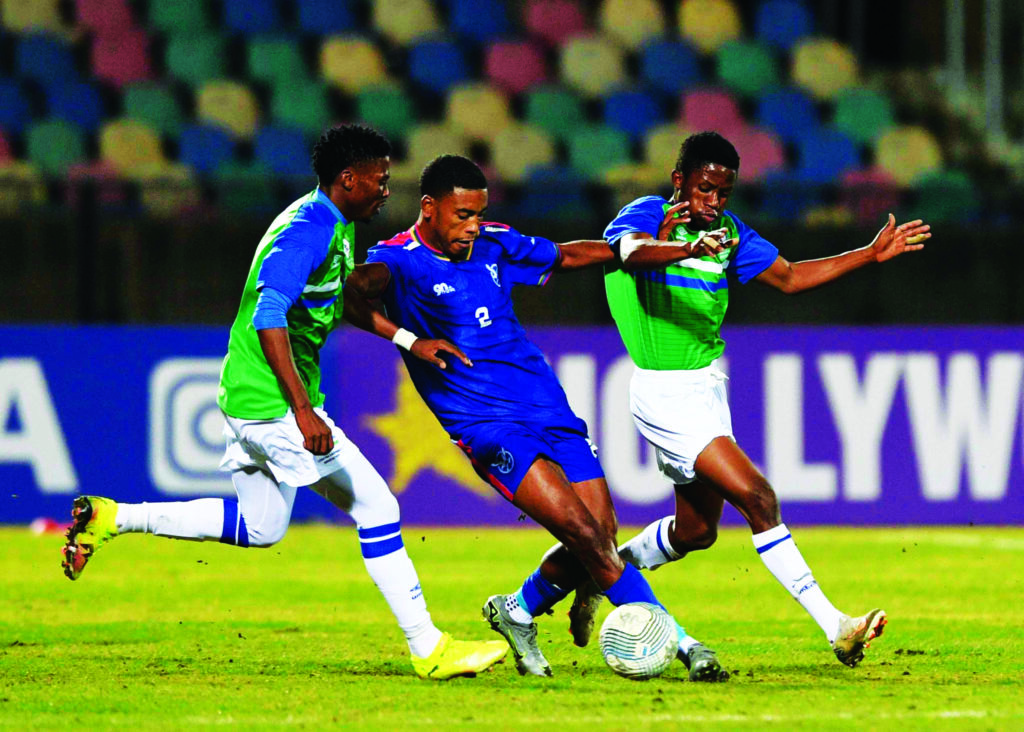
Sergio Damaseb of Namibia challenges Teboho Letsema of Lesotho during the 2025 HollywoodBets COSAFA Cup match between Namibia and Lesotho on the 10 June 2025 at Dr Petrus Molemela Stadium in Bloemfontein © Sydney Mahlangu/BackpagePix
Another chapter of disappointment for Lesotho’s football
SEBONGILE MATHE
MASERU – Lesotho’s senior national football team, Likuena, has once again failed to make an impact in the COSAFA Cup, exiting the 2025 tournament in humiliating fashion. The team’s early departure adds to a long history of underwhelming performances in Southern Africa’s premier football competition, leaving fans frustrated and questioning the future of football in the country.
Likuena entered the 2025 COSAFA Cup with cautious optimism, hoping to finally break their cycle of mediocrity. However, their campaign ended in disaster, with the team failing to progress beyond the group stage.
A combination of poor tactics, lacklustre performances and defensive errors saw them finish with a single 1-0 win against Malawi in their opening match – to go into a winless streak in the remaining two games against Angola and Namibia in Group B.
Despite the disappointing results, coach Leslie Notši remains positive. He highlighted the importance of the tournament as a learning opportunity for the many young players he brought along.
These players gained valuable international experience, playing against strong opponents.
“It is a big step for them,” said Notši.
“They have learnt what it takes to compete at this level.”
Notši acknowledged areas needing improvement. The team struggled defensively, especially against high balls. They also missed too many scoring chances.
He explained: “We need to work on our defence and make sure we take our opportunities in front of goal.”
The coach is focused on the positive. He sees the tournament as a stepping stone for the future success.
“We gave everyone a chance to play,” Notši explained, adding that “now we can see what we need to do to help these players improve…they showed a lot of potential.”
He also pointed out the experience gap between Likuena and teams like Angola and Namibia, who regularly compete in higher-level tournaments like the Africa Cup of Nations (AfCON).
“They are more experienced,” Notši admitted. “This is something we will work on, especially as we prepare for the 2026 World Cup qualifiers.”
He believes the experience gained in this tournament will help prepare the team for those future challenges.
Likuena’s early exit this year is not an isolated incident but rather a continuation of a long-standing trend. Since the inception of the COSAFA Cup in 1997, Lesotho has never won the tournament. Their best performance came in 2000 when they reached the final, only to lose to Zimbabwe.
Since then, they have failed to make a significant impact, often crashing out in the group stages or struggling against lower-ranked opponents.
Over the years, Lesotho has been labelled as one of the competition’s ‘whipping boys’, a team that other nations expect to beat. While occasional flashes of promise have emerged – such as their shock 1-0 win over South Africa in 2015 – these moments have been few and far between.
More often than not, Likuena’s campaigns have been defined by defensive errors, lack of goals and an inability to compete with the region’s stronger sides.
The reasons behind Lesotho’s latest failure are multifaceted. Critics point to poor preparation, with the team entering the tournament without adequate warm-up matches. Additionally, the lack of a cohesive playing style under coach Notši has been a recurring issue.
While Notši has tried to implement an attacking philosophy, the team often looks disjointed, with players struggling to adapt to his system – also lacking in urgency, hunger and the drive to win.
Another major concern over the years has been lack of depth in the squad, with the names of Notši’s favourites etched on the team list like the Gospel, despite age or lack of form. Unlike neighbouring countries such as Zambia and South Africa, who have players competing in top African leagues, Lesotho’s squad is predominantly made up of local-based players with limited exposure to high-level football.
The absence of a strong domestic league further exacerbates the problem, as players rarely face the kind of competition needed to prepare for international tournaments.
Fans have also expressed frustration with the Lesotho Football Association (LEFA), accusing the governing body of failing to invest in youth development and infrastructure, but efforts were made this year to inject new blood – with quite a good number of fresh faces handed their first caps.
While other COSAFA nations have made strides in modernizing their football structures, Lesotho continues to lag behind, relying on outdated methods that produce inconsistent results.
The reaction from supporters has been one of anger and resignation. Social media has been flooded with criticism, with many calling for a complete overhaul of the national team setup.
“We are tired of the same old story every year,” wrote one fan on Facebook. “How many more humiliations must we endure before real changes are made?”
Others have directed their frustration at the players, accusing them of lacking passion and commitment. However, some have come to the team’s defense, arguing that the systemic issues run deeper than individual performances.
With another COSAFA campaign ending in disappointment, the focus now shifts to the future. Coach Notši’s position is under scrutiny, and calls for his dismissal are growing louder. However, simply changing the coach may not be enough.
For Lesotho to compete at a higher level, fundamental changes must be made. Investment in youth academies, improved coaching education, and better support for local leagues are essential steps.
Additionally, LEFA must work on securing more international friendlies and exposure for the national team to build experience.
The 2026 World Cup qualifiers loom on the horizon, and Likuena cannot afford another cycle of failure. If Lesotho is to ever make a mark in African football, the time for action is now.
Lesotho’s football fans are a patient bunch, but their patience is wearing thin. The 2025 COSAFA Cup was supposed to be an opportunity for Likuena to rewrite history. Instead, it became yet another chapter in a long-running saga of disappointment.
Until the systemic issues are addressed, Lesotho will remain a footnote in COSAFA history – a team with potential but no real progress. The question now is whether those in charge are willing to make the necessary changes or if the cycle of failure will continue for years to come.
For now, Likuena’s fans can only hope that, one day, their team will finally rise to the occasion. But after another unceremonious exit, that day feels further away than ever.