Lesotho risks textile collapse amid claims government isn’t pushing us on tariffs
… Qhesi warns AGOA renewal is not guaranteed as the US administration remains unpredictable.
Trade tensions with the United States are deepening Lesotho’s economic uncertainty, raising fears that thousands of textile jobs could vanish if the government fails to engage the US administration effectively on the 50 percent reciprocal tariffs imposed in April 2025. The crisis is worsening as US buyers withhold orders, while the African Growth and Opportunity Act (AGOA) hangs in the balance ahead of its expiration come September 2025.
As part of her Bertha Foundation Impact Fund project, investigative journalist Pascalinah Kabi sat down with Private Sector Foundation Chief Executive Officer Thabo Qhesi to discuss the future of Lesotho’s textile industry as the 90-day suspension of US reciprocal tariffs ends on July 8, 2025.
Below are excerpts from the interview:
Pascalinah Kabi: Based on current U.S.-Africa trade relations and domestic U.S. politics, what is the likelihood that AGOA will be renewed beyond 2025?
Thabo Qhesi: This is difficult question because the current US administration is unpredictable. It is unpredictable. I realise that some congress men wanted the renewal but we saw with the executive orders that have been issued by the president there, everything is possible. So, can you imagine? It’s difficult to say we can see likelihood of the renewal or not due to uncertainty there.
Pascalinah Kabi: If AGOA is not renewed, what are the immediate and long-term implications for Lesotho’s economy – particularly the textile industry?
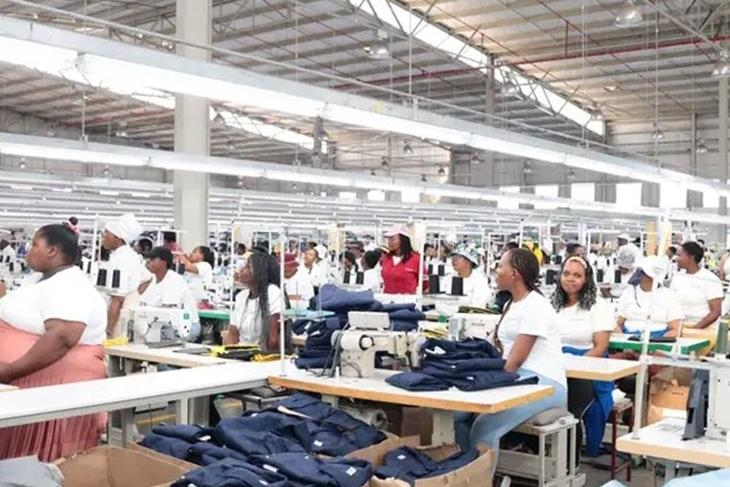
Thabo Qhesi: If AGOA is not renewed, we are going to see closure of factories, loss of jobs, both direct and indirect jobs. People tend to focus on the impact of direct jobs, losing the sight that there are a lot of indirect jobs created by this textile. So, they are going to be negatively affected, you know. You talk of public transport, retail, residential property, which are going to be affected, you know. That reality is very true.
So, if we can see the closure of the factories, we are going to see the multiplier effects in the entire value chain, which is not healthy for Lesotho.
Pascalinah Kabi: Do you suspect that the implications would include the increase in the HIV infections given that many are times we are told that unemployed women are at risk and this textile sector is predominantly employing women?
Thabo Qhesi: Yes, that is one thing for sure, HIV infections are going to increase because of those risks. Chances are that they are going to increase and the third part in that regard is that PEPFAR which we know is has been supporting health programs, including HIV treatment and prevention, already, the US government has withdrawn the support in that regard. So, yeah, there is that risk again.
Pascalinah Kabi: Even before AGOA expires, U.S. buyers are withholding orders because of the global trade war imposed by the US administration. What does this signal about global buyer sentiment and Lesotho’s vulnerability to policy uncertainty?
Thabo Qhesi: Yeah, that thing is also a complicating because one assumes that with this great period of three months, which is going to end on the 8th of July, the government of Lesotho will take an opportunity to mend relations with the US, like we saw with South Africa.
South Africa sent a huge team to the US trying to mend the relationship. And I know South Africa was so passionate about the automotive industry. They demonstrated vividly that they want their vehicle exports to the US market to get into that market duty-free. I know they were compromising that they would buy US gas, you know. So, such efforts, they were encouraging. But so far, I haven’t seen the effort of Lesotho trying to engage the US government vigorously. This is my concern, that I haven’t seen those efforts or attempts to mend the relationship. Even last week, I was talking to those who were in charge in that sector. Yeah, they were worried that they don’t see any effort from the government.
Pascalinah Kabi: Why do you think is that? Why is our government not putting enough pressure in trying to get on the table with the US administration?
Thabo Qhesi: Okay, you know, I have tried to engage various people in government. Nobody will give me a concrete answer. Even to those that I talked to, they’re also puzzled, you know. They’re also puzzled. So, yeah, hopefully, and maybe when the PM, because in the business association, we are still seeking an appointment with the Prime Minister.
So, we hope that upon his return from the Spain trip of that FFD4, hopefully, we will get the views of the PM in that regard because these are serious issues. Hopefully, after that discussion, we’ll be in a position to know exactly why didn’t we see efforts to mend relations with the US government.
Pascalinah Kabi: In the past, when the clothing industry and AGOA were buzz words in Lesotho, we were told that many of these investors are here because Lesotho enjoys the preferential treatment of tax-free export to the US. Now with the tariff imposition, do you think this could reshape the country’s competitive edge compared to countries like Bangladesh or Vietnam?
Thabo Qhesi: Yeah, absolutely. Because remember, we were hit by a 50 percent tariff. So, that 50 percent will take you out of the business. There’s no way you can make a profit because when you look at the countries like Kenya, and they are so strong in the textile industry yet they are given 10 percent as opposed to 50 percent.
So, clearly, Lesotho would not compete. There is no way that Lesotho can compete with, you talked of Bangladesh but I am talking about Kenya which is closer to us, which has been given 10 percent. So, there is no way that we can do business with the US. July 8 is almost a week, next week. I can see a lot of countries laying off employees. It’s so uncertain, really. Even this one of reciprocal tariffs, we are still not sure if the US government will maintain that 50 percent or they will make some changes. We are not sure.
Like I said, the current US administration is unpredictable.
Pascalinah Kabi: Lesotho is probably caught between the geopolitical tensions between the US and China. China has indicated that the African countries can export to China on zero percent tariffs. But, given how that country is very rigorous in terms of production and manufacturing, is that realistic in terms of the sort of export into China?
Thabo Qhesi: It won’t be easy. It will take time to create new markets. It cannot happen over night because when you look at our neighbours, South Africa, and you look at top 10 countries exporting textile and clothing products to South Africa, China is number one. China is so efficient, they are able to produce a high quality with minimum cost.
You cannot compete with China. So, it’s highly unlikely that we can see our export going to China. China is interested in raw materials, like wool, mohair and diamond, not particularly the finished product. And we know the finished product; it is where the jobs are being created. Once you transform the raw material, you are creating jobs.
Pascalinah Kabi: If AGOA is renewed under stricter or revised terms, what conditions should Lesotho advocate for to safeguard its industrial base?
Thabo Qhesi: I think we should use Kenya as an example. Kenya will give in 10 percent. Lesotho should advocate getting that 10 percent also. As I get the sentiments of the guys in the industry, they will be comfortable with 10 percent, not 50 percent. So, if AGOA was to be renewed, Lesotho should advocate for 10 percent like their counterparts in East Africa, the likes of Kenya.
Pascalinah Kabi: Tariffs and AGOA are different, right?
Thabo Qhesi: Yes, but automatically, those tariffs have impact on AGOA exports. Initially, in AGOA we didnt pay duties. But with these reciprocal tariffs, regardless whether you trade under AGOA, you have to pay those tariffs. That is why some countries opted to negotiate bilaterally with the US government, like South Africa. They really want the automobile products to get into the US market duty-free. Why were they doing that? It’s because these reciprocal tariffs are biting.
Pascalinah Kabi: In the event that AGOA is not renewed, what would be the most beneficial or viable transition strategy that Lesotho can adopt, particularly for manufacturers and displaced workers?
Thabo Qhesi: I learnt that shops the likes of Mr Price, Foschini, PicknPay Clothing representatives were here in Lesotho, saying, guys, we heard your case, your situation with the US. We are ready to buy the products from Lesotho because we are impressed with the quality.
So I think one of the fallback positions is to explore South African market because I was looking at the clothing imports in South Africa. There are more than 12 countries which are exporting textile and clothing products to South Africa.
I have already spoken about China, Vietnam, Madagascar, India – they are exporting to the South African market. Funnily enough is that despite the fact that South Africa is the largest importer of clothing and textile products in the region, it is also a major exporter.
They are importers and exporters at the same time.
When you go to Zambia, most of the shopping malls in Lusaka are South African chain stores. This means that even though South Africa is not manufacturing some of these clothes, fact that they are being sold via them, South Africa is able to make a commission out of that. This makes South Africa a viable market.
So, I think what we have to pay focus on is to explore the South African market. Fortunately, there was a study commissioned by one consultant engaged by LNDC. In that report, we made a recommendation that we should explore collaboration with Tunisia. Tunisia is also a country which is exporting textile to South Africa. So, if we are to have a relationship with Tunisia, it means we can convince them to come and do production in Lesotho and service the South African market.
It will work better for Tunisia because when we export to South Africa, Lesotho does not pay duties. At the same time, Tunisia is one of the largest exporters to the EU market. So it will also give us an opportunity to export, to explore the secured market to EU, where we are targeting Europe. So there is still a hope that we can do something, if we can put our eggs together.