Govt prioritizes youth skills development to boost economic growth
MOSA MAOENG
MASERU – Government has emphasized the importance of investing in skills development for young people, equipping them to actively participate in shaping the country’s economy.
This initiative aims to modernize and fuel sustainable economic growth in Lesotho.
By focusing on youth empowerment, the government seeks to bridge the skills gap and create a more competitive workforce. The long-term goal is to drive innovation, increase productivity, and strengthen Lesotho’s economic prospects. Officials highlight that a skilled youth population is essential for national development and attracting investment.
This strategy aligns with broader efforts to reduce unemployment and ensure that young Basotho are prepared for emerging opportunities in key sectors. The government calls for collaboration with educational institutions and private stakeholders to achieve this vision.
This, the government aims to achieve through Technical and Vocational Education Training (TVET) to particularly close the skills mismatch and produce employable, job ready youth.
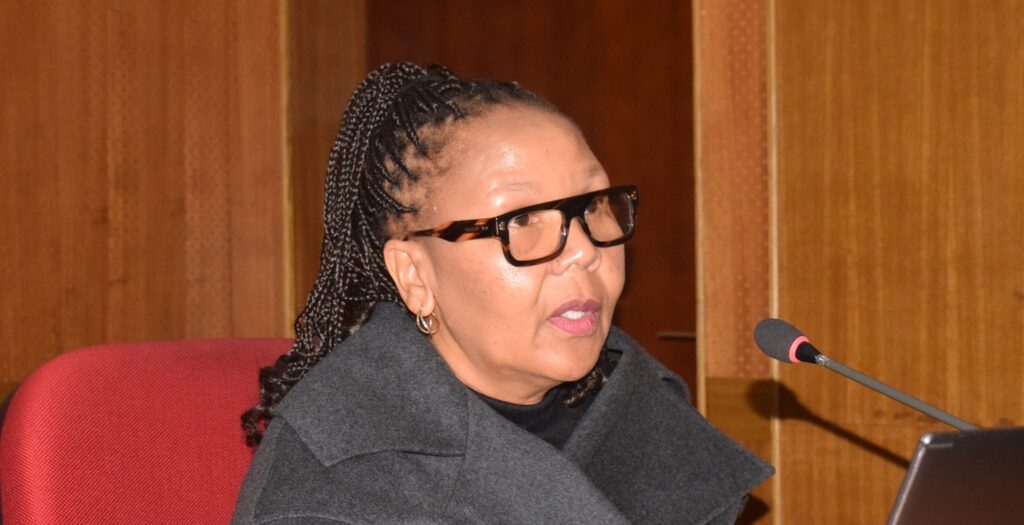
Finance ministry Principal Secretary, Nthoateng Lebona, noted this during the virtual launch of the African Economic Outlook 2025 Country Focus Report for Lesotho on Monday this week.
The Country Focus Reports (CFRs) foster policy dialogue on macroeconomic performance and outlook and provide insights on mobilizing private sector and natural capital finance to drive the continent’s climate resilience and green growth policies.
The Lesotho report specifically explores how to make the country’s capital work better for its development.
Lebona mentioned that aligning with the theme; it is befitting to look at capital, not in the narrow sense, but human, natural, financial capital and technological advancement.
She said the challenges have been exacerbated by the recent developments of a shift global trade policies and the abrupt slash of foreign aid.
She said these shocks have had “profound effects on our economy and people, increasing the cost of living, constraining the fiscal space, disrupting trade flows and increasing the cost of capital.”
She said Lesotho, like many African nations, is blessed with natural endowments.
She indicated that “our high quality diamonds and abundant water resources support our economy and generate revenue through exports and royalties.
Yet these blessings, while significant, are finite, therefore they must be utilised in the manner that translates into the equivalents productivity.”
Lebona said beyond natural resources, Lesotho recognises the transformative potential of its renewable energy landscape, particularly in hydropower and wind energy. She said harnessing this potential is not only a national imperative but also a regional opportunity.
She said as Africa advances toward a green economy, Lesotho is positioned to contribute meaningfully to regional energy security and climate-friendly development.
She said Lesotho’s macroeconomic outlook is increasingly precarious due to recent shocks. She noted that the fiscal position is projected to maintain a stable position in 2024/25.
She continued that government will continue to allocate more resources to investment spending, underscoring the government’s commitment to infrastructure and economic transformation in the short to medium term.
“The economy recorded modest growth of 2.5 percent in 2024/25 and is projected to progress to 3.4 percent in 2025/26, mainly driven by the construction sector. We need to close the productivity gap and move to higher value addition, implement at accelerated pace the investment climate reforms, economic and market diversification.
Make use of digital technology in agriculture, manufacturing, education, e-government, e-health, and integrate into international markets,” said Lebona.
She concluded by stating that the need for a multi-pronged approach and increased financing to invest at scale and in the right sectors, while dealing with threats of global shocks and climate change to accelerate Lesotho’s growth is well noted.
According to the report, Lesotho’s economy grew modestly at 2.4 percent in 2024 driven by infrastructure projects like the Lesotho Highlands Water Project Phase II (LHWP-II) which boosted activity in the services sector. Inflation eased to six percent due to lower food and fuel prices, while the fiscal balance recorded a surplus of 8.4 percent of Gross Domestic Product (GDP), driven by a strong Southern African Customs Union (SACU) receipts and water royalties.
Despite these gains, the economy remains vulnerable. Growth is projected to slow to 1.1 percent in 2025 and 0.5 percent in 2026, with fiscal and external balances expected to weaken as SACU revenues decline, Official Development Assistance (ODA) shrinks, and capital spending rises.
Key risks include climate vulnerabilities, sluggish growth in key trading partners, escalating trade tensions, ODA cuts and the aftermath of the cancellation of the Millennium Challenge Corporation Compact II (MCC II).
To mitigate these risks, Lesotho should prioritise economic diversification by shifting toward higher value added sectors, while expanding trade partnerships to reduce reliance on a few key markets. Strengthening institutional quality and governance is key to improving capital mobilisation and public spending efficiency.
Reforms should enhance transparency, accountability and fiscal discipline by curbing illicit financial flows, corruption and informality.
“Encouraging private sector participation through regulatory reform will attract investment, foster innovation, improve service delivery and reduce the fiscal burden on the government, driving sustainable economic growth,” states the report.
The African Development Bank Group has launched the CFRs across 13 Southern African Countries from June 27 this year.
These annual reports reflect the theme and analysis of the bank’s flagship African Economic Outlook (AEO) at the country level, delivering critical economic analysis and policy options tailored to each of Africa’s 54 nations.
The countries include Sao Tome and Principe, Mozambique, Zambia, Angola, eSwatini, South Africa, Zimbabwe, Malawi, Mauritius, Botswana, Lesotho, Namibia and Madagascar.