SOE reform sabotaged
Officials accused of delaying policy to maintain cash cow bonanza
TEBOHO KHATEBE MOLEFI and
MOTSAMAI MOKOTJO
MASERU – Deep-seated frustration and allegations of self-interest are mounting as senior government officials, particularly Principal Secretaries (PSs), face condemnation for the inexplicable delay in formalising and implementing a critical draft policy aimed at reforming the management of State-Owned Enterprises (SOEs).
The long-awaited policy remains in bureaucratic limbo, years after its initial drafting.
Critics allege this delay is not mere inefficiency, but a calculated tactic by powerful figures within the civil service who benefit financially from the status quo.
At the heart of the controversy is the accusation that certain PSs and other high-ranking officials treat key SOEs as personal cash cows.
Evidence suggests a pattern where these entities, vital for national infrastructure and services, are exploited through lucrative contracts, board manipulation, opaque procurement and political patronage.
Most PSs are suspected of awarding inflated contracts or consultancies to companies directly linked to the officials, their families, or close associates, placing pliant individuals on SOE boards who facilitate questionable financial decisions and appointments and exploiting weak governance to steer procurement processes towards favoured, often overpriced, suppliers.
Some go as far as using SOE resources and positions for political patronage, further entrenching networks of dependency and benefit.
“The deliberate foot-dragging by the Principal Secretaries responsible is nothing short of scandalous,” stated a senior government official who spoke to Public Eye on condition of anonymity.
“We have a draft policy designed to bring transparency, accountability and commercial discipline to our struggling SOEs. Yet, those who stand to lose their illicit revenue streams are the very ones blocking its progress. It’s a blatant conflict of interest.”
The consequences of this delay are severe. Many SOEs continue to operate at significant losses, burdening taxpayers with bailouts while failing to deliver efficient services. Investment is stifled, and good governance principles are flouted, all while connected individuals allegedly profit.
“The phrase ‘dilly-dallying’ perfectly captures their inaction,” the official at Qhobosheaneng said.
Calls are growing louder for the Prime Ntsokoane Matekane Minister and the Minister of Finance, Dr Retšelisitsoe Matlanyane, to intervene directly, bypassing the obstructive bureaucracy, to urgently enact the SOE governance policy. Transparency campaigners demand thorough audits of SOE contracts and board appointments linked to senior officials during this period of deliberate delay.
“Every month this policy isn’t enacted is another month our SOEs are milked dry for private gain, instead of serving the Basotho nation. The Prime Minister and the Minister of Finance must demand immediate action and hold these delaying officials accountable.”
The continued failure to formalise this critical policy not only represents a failure of governance but reinforces the perception that Lesotho’s state apparatus is being manipulated for the enrichment of a privileged few at the expense of the nation’s development and its citizens.
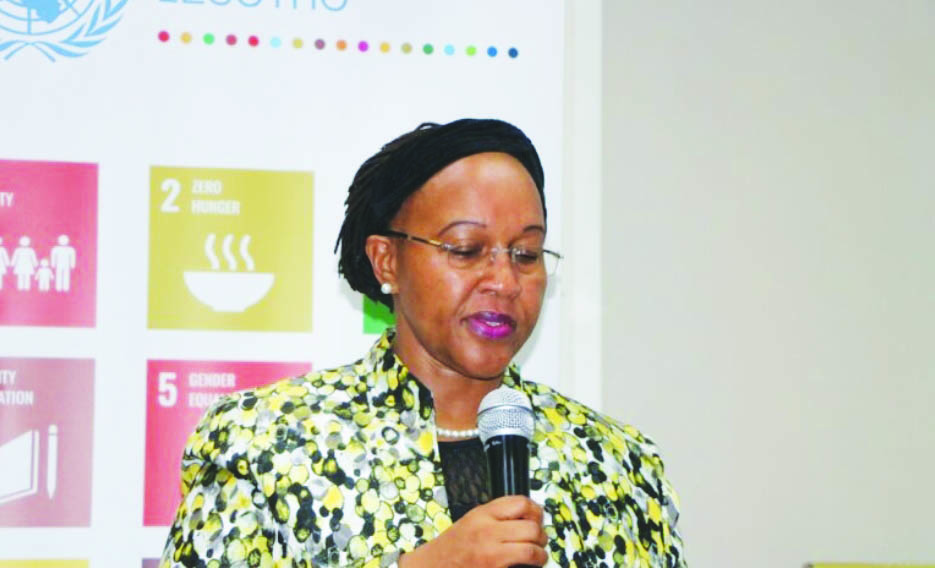
When questioned about the stalled draft policy for SOEs, reportedly delayed within government corridors at Qhobosheaneng, Government Secretary (GS) Teboho ‘Mokela declined to engage on governance issues or alleged resistance from PSs.
She redirected inquiries to the Ministry of Finance, stating: “I don’t know about such a policy, you need to ask the finance minister. What I know is that if this is a draft, it hasn’t reached cabinet.”
In a separate interview, former GS, Chaka Ntsane, criticized finance minister Matlanyane for inaction, emphasizing her responsibility to oversee SOE governance.
“Section 105 of the Constitution mandates a National Planning Board, but successive finance ministers have trampled on it. They admitted during the National Reforms Plenary meetings that they wilfully suppressed it. Minister Matlanyane is following her predecessors’ path – she must activate this board to resuscitate SOEs.”
Ntsane further asserted that accountability rests with ‘Mokela and cabinet leadership, saying that “the GS coordinates PSs. Consider the Lesotho Flour Mills, where the Ministry of Agriculture holds a stake. Without oversight from the Prime Minister, the relevant minister and the PS, governance failures – like those plaguing the enterprise – will persist.”
Basotho National Party legislator ‘Masetota Leshota, in a candid interview, argued that SOEs fail due to monopolies, corruption and absent oversight.
“SOEs lack competition. The Lesotho Electricity Company imposes steep tariffs because they know consumers have no alternatives and government won’t hold them accountable. Monopolies breed neglect and poor service. Worse, the executive designs policies to shield these inefficient entities.”
She also addressed Matlanyane’s criticism of MPs’ competence: “When the minister dismissed MPs as incompetent, she might have been right, we don’t submit CVs for these roles. Even our advice on SOEs comes from the same ministers overseeing them. We need bold parliamentary committee chairs willing to crack the whip on underperforming SOEs.”
Napo Moshoeshoe, Movement for Economic Change secretary general and MP, similarly highlighted a disconnect in SOE operations. He said “SOE salaries mirror the private sector, but their accountability resembles the lax public sector. This misalignment fuels inefficiency.”
Governance failures, financial strain at BEDCO subsidiary – The Furniture
A stark example of poor governance in an SOEs is unfolding at The Furniture, a subsidiary of the Basotho Enterprises Development Corporation (BEDCO).
Registered in 2023, The Furniture was established to manufacture cutlery, hand tools, and general hardware, while also engaging in wholesale of construction materials, hardware, plumbing, and heating equipment; retail sales of electrical household appliances, furniture, and lighting and rental and leasing of machinery, equipment and tangible goods.
However, investigations by Public Eye reveal severe governance deficiencies.
Despite corporate structures mandating subsidiary oversight, The Furniture operates without its own board.
Instead, it reports directly to BEDCO CEO, Tšepang Tlali, who – alongside BEDCO chairperson, Tšireletso Mojela, (also Deputy Principal Secretary in the Ministry of Trade) – allegedly make unilateral financial decisions for the subsidiary.
A source within The Furniture disclosed: “Despite the structure requiring the subsidiary to report to its board, Tlali and Mojela procure equipment at exceptionally inflated prices. Transport costs that should be M20 000 inexplicably surge to M200 000 for transport from Johannesburg to Maseru.”
When contacted by Public Eye, CEO Tlali refused to address the claimed operational and governance concerns: “I will not comment. You have one-sided issues. I know your source – write only what is factual.”
The Furniture’s Managing Director, Polello Mokhothu, similarly redirected inquiries to Tlali, declining to respond.
Documents obtained by Public Eye expose The Furniture’s dire financial state.
In a March 10 letter to Tlali, Mokhothu highlighted critical issues, strategic paralysis, abandoned financing as well as cash flow crisis.
The subsidiary postponed a 2025 consultancy for its strategic plan and organizational structure – documents essential for budgeting, work plans, and leadership direction. Management halted a M500 000 working capital loan application after BEDCO offered a M1 000 000 pre-approved loan, Mokhothu noted pursuing two loans simultaneously was “not feasible” without a strategic plan.
It has also emerged that client organizations failed to pay invoices for The Furniture’s home-fitting scheme – launched in November 2024 – and large-scale office/school furniture projects. Operational growth further strained finances.
Consequently, as this paper has been made to understand, employees have not received May and June salaries due to “financial constraints.”
Attempts to get chairperson Mojela to react to these claims and challenges have proved futile until going to print.
Lesotho Electricity Company (LEC) Lesotho Electricity Company Communications (LECC) ‘working outside its core mandate
Public Accounts Committee (PAC) member labelled the company, which was registered in 2015, as a “cash cow” and working outside the scope of LEC’s “core mandate of providing electricity”.
The puzzle, as per the Articles of Incorporation, particularly under ‘Activities of the company’, lists it as engaging in “6110 Wired telecommunications activities: and “6120 Wireless telecommunications activities”.
Amazingly, LECC Company Secretary Nthabiseng Motjolopane withheld monies paid to staffers, maintaining that it was private.
But PAC Chairperson ‘Machabana Lemphane-Letsie was having none of it, casting Motjolopane by indicating that LECC is a subsidiary of LEC which draws money from the public purse.
“I am warning you again; I cannot call Econet or Vodacom to ask them about their salaries; those are private entities… Here I will call and subsequently ask you (about yours),” Lemphane-Letsie fumed.
In a stunning revelation, it has come to light that the Company Secretary receives significant compensation for various roles despite the company’s financial struggles.
For each preparation of meetings, the secretary earns M500 preparations for meetings; M500 for writing minutes; M750 for a board meeting; M750 for report writing; and M1,800 as a seating allowance for three committees including technical, finance, and human resources.
Furthermore, attendance at board meetings adds M4,500, alongside a monthly airtime allowance valued at M1,000. These hefty sums total up to nine payments annually.
PAC has learnt that the Chairperson of the board takes home M6,000 per sitting, while other board members collect M5,500 each.
This is particularly alarming given that LECC has not declared any dividends since its inception, as documented in a letter to the Lesotho Communications Authority back in 2014.
The rationale for founding the LECC was to “lease excess dark fibre and provide authorization to attach fibre optic cable to the LEC electricity distribution system” while aiming to redeploy revenues to grow the business and cover operational costs.
The document further highlights that these initiatives require organic growth due to a lack of initial capital injection, leading to all operational surpluses being reinvested into infrastructure development and expansion activities. Compounding the company’s struggles, a staggering M28 million loan owed to its parent company, LEC, has significantly constrained its liquidity, limiting available working capital.
Yet, despite using public funds to operate, the company is determinedto keep related documents confidential in an apparent bid to protect itself from possible legal action.
This brings into question the integrity of financial practices at LECC and raises concerns over the sustainability of its operations in the face of mounting financial challenges.