How Mojapela grew to the forefront of national consciousness
BOKANG MOSHOESHOE
MASERU – From a hard past, Teboho Mojapela has grown into a man of reason and an unparralled politician of note. Born in the arid highlands of Mokhotlong, in the rural and mountainous terrain of Lesotho’s northeast, Mojapela was born into a family whose values would shape the very foundation of his life. He grew to become not just a father, a businessman, and a politician, but a voice of reform and an embodiment of resilience in a country still struggling to define itself.
Born in 1969 as the youngest of four children of the late Abiel S Mojapela and ‘Mamatela Alinah Mojapela, his is not just a story about personal triumph but an unwavering commitment to principle, discipline, and nation-building.
His journey traces back to a family legacy rooted in Thaba-Tseka, where his siblings were born and raised.
However, he was born in Mokhotlong, a result of his parents’ relocation in 1967 in search of better opportunities. It was in this rugged district that the foundation of his remarkable life was laid.
A seed in harsh soil growing up in Mokhotlong, Teboho’s early life was characterized by simplicity and struggle.
“My childhood was just like any other child’s, but perhaps with a sharper sense of questioning,” he says.
He began his formal education in 1975 at Molumong LEC Primary School and later transferred to Mokhotlong LEC Primary School, completing his Standard 6 and 7.
A significant figure during his school years was his teacher, Mafatlane Mafatlane, whom Mojapela remembers with reverence.
“He saw something in us as boys and pushed us towards it,” he says.
To this day, Mojapela believes much of who he is started in that classroom. These early experiences helped shape a young man who was as academically gifted as he was spirited.
He was always a curious and an active learner, though his strong will often earned him the label of being “stubborn”, a trait that later became the backbone of his resilience.
His high school journey began at St James High School, where he quickly distinguished himself as an “A” student.
But excellence came bundled with a mischievous streak.
“I was not the quietest child in the room,” he chuckles.
“But I learnt fast.”
He later moved to Thabeng High School, only to find his education disrupted by a year-long strike.
The experience was eye-opening.
“That was when I learnt how fragile our futures can be and how quickly small issues can become life-altering,” he reflects.
A crossroads, books or bread Mojapela had to make a choice.
After finishing high school, Mojapela faced a pivotal life decision: to pursue higher education or to join the workforce.
In 1989, he was accepted into the National University of Lesotho (NUL) to study Law, a dream many in his community admired.
However, the realities of life forced a detour.
He had also applied to work in the South African mines.
When both opportunities materialized at the same time, he made the hard decision to choose employment over education.
He explains that it was not because he did not value education, but because the immediate need to survive outweighed the luxury of waiting for a degree.
His years in the mines were gruelling.
Faced with dangerous conditions, long hours, and physical exhaustion, Mojapela endured not because he had to, but because he refused to let hardship define him.
“It was never about the job. It was about pushing through pain and never giving up,” he says.
In 1991 Mojapela left the mines and returned home. That same year, he was hired as a truck loader at Highlands Company, another demanding job that tested his endurance.
It was during this period that an entrepreneurial seed in his mind began to germinate. Witnessing the financial struggles of his colleagues, Mojapela began lending small amounts of money to help them from one ciris to another.
From that humble act of kindness, his first ever company – JP Finance was born in 1992, founded with a mere M50.00.
“People thought it was just pocket change, but to me, it was a vision,” Mojapela recalls.
One year later, in 1993, he got married at the age of 23 and became a father at 24. That same year, unable to abandon his dream of becoming a legal professional, he enrolled once again at the National University of Lesotho to study Law.
However, fate had other plans this time also.
In 1996, as JP Finance began to grow and demanded more of his attention and he withdrew from university to focus on the business.
“Education is important, but timing is everything,” he says.
The business was his calling at that point, and he heeded it. When JP Finance had matured, he returned to his studies and from 2002 to 2004, he completed his LLB degree.
Mojapela affirmed that getting that degree was more than academic; it was symbolic – proof that delay is not denial.
Mojapela would later join politics in his quest to make a mark – a transition he says was not born of ambition but necessity.
In 2017, disillusioned by the state of Lesotho’s governance and inspired to act, he joined the All Basotho Convention (ABC) with hopes of contributing to meaningful change.
However, what he found deeply troubled him.
“Politics in Lesotho had become a game of greed. I realized that about 90 percent of people in power were not there to serve but to exploit,” Mojapela declared.
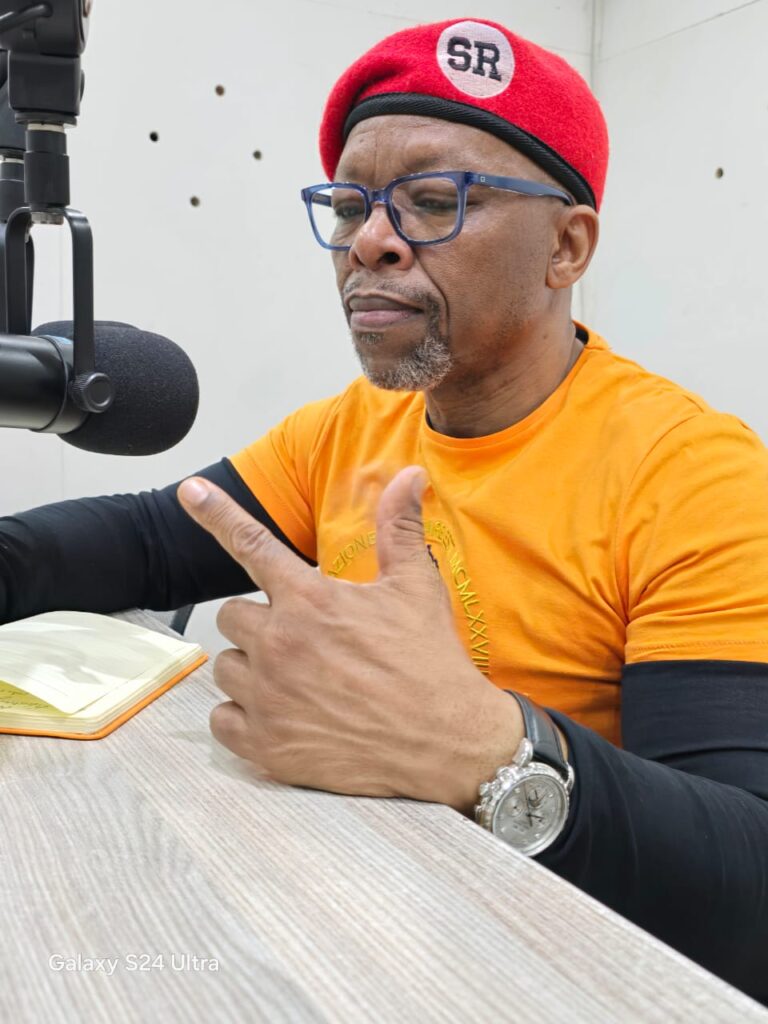
That same year, he broke away and founded his own political party, Socialist Revolutionaries (SR) a party built on integrity, discipline, and a bold vision for national reform.
“This party is not about me. It is about Basotho. It is about cleaning the moral rot in our political system,” he explains.
In 2020, determined to ground his political ideals in academic rigor, Mojapela enrolled at Port Elizabeth University to study Politics.
His vision – to understand politics not just as power, but as a philosophy. His political ideology is deeply influenced by faith and conscience. He laments this by stating that politics should be godly and also teach one responsibility, foster peace, and awaken the conscience.
He often quotes from one of his favourite books written by an known economist: “Politics is the distribution of wealth in an equitable manner.” To him, politics is a sacred responsibility, not a personal privilege.
His vision for Lesotho is that Lesotho’s greatest battle is not poverty, but mind-set.
Basotho need to change how they see politics, leadership, and themselves. He envisions a nation with a Truth and Reconciliation Commission, and ultimately a Government of National Unity, where ministers serve as moral stewards, not political opportunists.
“The problem is not that we lack resources, but that we have lost ethical leadership. I see discipline as the guiding principle for my party and my life as without discipline, even the best ideas fail,” he explains.
On Mojapela’s list of inspirations models, Bantu Stephen Biko ranks highly. This is because Biko was more than a freedom fighter; he was an intellectual force who challenged systems with ideas.
Biko’s philosophy of Black Consciousness resonates with Mojapela’s own call for national self-awareness.
However, above Biko, he holds his parents in the highest regard especially his father. The man taught him sacrifice, humility, and vision; he gave his all for his family.
His mother, too, is remembered for her soft heart and quiet strength. He believes his upbringing gave him a foundation stronger than any institution could provide.
Despite being in the public eye, Mojapela treasures criticism.
He states that he loves being challenged, as it sharpens him, makes him reflect, and helps him grow.
To him, the only judgment that ultimately matters is that of God, not the court of public opinion.
A balanced life, balancing politics, business, and family are no easy task, but Mojapela makes a deliberate effort to maintain an equilibrium.
“I make time to unwind, reflect, and breathe; you cannot pour into your country if you are empty inside,” he says.
Him being a man of purpose Mojapela’s life is not just a story, it is a testimony. A testimony of how a child from the mountains of Mokhotlong can rise to influence national discourse; how a mine worker can become a lawyer, an entrepreneur, and a political leader; and how one man’s discipline and courage can spark the moral revival of a nation.
He is not without flaws, and he does not pretend to be perfect. But what sets him apart is his relentless pursuit of truth, his uncompromising principles, and his refusal to be defined by circumstance.