A Hollow Crown
Why Matekane’s ‘victory’ is a premature celebration masking a national embarrassment
TEBOHO KHATEBE MOLEFI
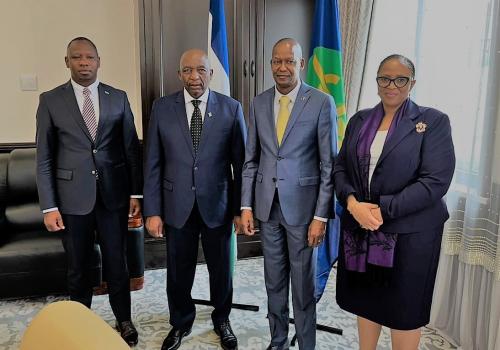
Prime Minister Ntsokoane Matekane returned from the recent SADC Summit in Madagascar to a fanfare that felt curiously orchestrated.
The news, trumpeted by his administration, was simple, Lesotho has been “graduated” from the oversight of the SADC Troika, a mechanism instituted to shepherd our nation through a long-overdue process of constitutional and security sector reforms.
The government would have us view this as a diplomatic triumph, a testament to progress and a restoration of sovereignty. But to any citizen who peers beyond the pomp and ceremony, this so-called victory smells less like a triumph and more like a carefully constructed illusion – a political sleight of hand that risks being one of the greatest embarrassments in our recent history.
Let us be unequivocal, this is not an achievement to be celebrated – it is a danger to be scrutinised. The removal of oversight is not a graduation certificate earned through merit, but rather a probationary period ended prematurely, with the most difficult exams still ahead.
The very fact that the government is throwing a party for being left alone to do its homework reveals a profound misunderstanding of both the purpose of SADC’s involvement and the gravity of the tasks that remain.
The central pillar upon which SADC based its decision appears to be the passage of the 10th Amendment to the Constitution. This legislation is indeed a piece of the reform puzzle. However, to present it as the culminating achievement that justifies the end of oversight is a breath-taking misrepresentation.
The reforms were never about passing a single law, they were about a fundamental rewiring of our governance to end the vicious cycles of political instability, military meddling and assassinations that have plagued our nation for decades.
Even as Prime Minister Matekane was accepting plaudits in Antananarivo, the ground was shifting back home. The very legislation being touted as a success is now the subject of a severe legal challenge.
Renowned local rights group, Section 2, has signalled its intention to take the government to task, arguing that the 10th Amendment was rushed through Parliament in a manner that violated due process. This is not the sign of a settled, widely-consensus-driven achievement – this is the hallmark of a contentious and deeply flawed process.
How can we celebrate an international endorsement based on a law that is not yet even legally secure in its own country? It is like celebrating a building’s completion while its foundation is actively being sued for cracks.
This legal challenge exposes the government’s strategy, a focus on form over substance, on speed over completeness. The Matekane administration, perhaps feeling the heat of its own pre-election promises on economic revival, seems desperate for a quick win. A protracted, inclusive and thorough reform process is messy and politically inconvenient.
It requires building consensus with opponents, civil society, and the very institutions – like the military – that are most resistant to change. In contrast, ramming through a single piece of legislation and using it as a ticket to escape regional scrutiny is a politically expedient shortcut. But shortcuts in nation-building lead to cliffs.
The government’s narrative conveniently ignores the vast swathes of the reform agenda that remain untouched or incomplete. Where is the comprehensive security sector reform that addresses the politicisation of the army and the police?
The ghosts of Lieutenant General Maaparankoe Mahao and countless others demand more than just a changed judicial appointment process; they demand an army that is permanently subservient to civilian rule, not just to the politician of the day.
Where is the robust legislation to ensure the operational and financial independence of oversight institutions like the Directorate on Corruption and Economic Offences and the Ombudsman? Where is the electoral reform that guarantees every vote truly counts and strengthens our democracy?
By celebrating the end of oversight, the Matekane government is effectively saying, “We can handle the rest ourselves.” Recent history suggests this is a perilous act of hubris. SADC’s presence, for all its imperfections, provided an external accountability mechanism – a watchdog that reminded our political class that the world was watching.
Its removal risks unleashing the very factionalisms and vested interests that the reforms were designed to tame. Without that external pressure, what incentive remains for a political establishment, historically addicted to short-term gain, to see through the difficult, unglamorous work of genuine transformation?
We are left to trust the same actors who have perpetuated the crisis to now be its sole architects of solution. It is a staggering abdication of the principle of checks and balances.
Furthermore, this “victory” must be viewed through a regional lens. Compare Lesotho’s “graduation” to the painstaking, detailed, and externally verified processes that other nations undergo for similar international milestones. It feels less like a reward for a job well done and more like SADC’s quiet admission of fatigue.
The regional body, perhaps preoccupied with more intense crises in Mozambique and the DRC, may have simply decided that Lesotho’s perpetual low-grade instability is a problem it can no longer afford to prioritise. Our “success” might be nothing more than a diplomatic demotion in SADC’s order of priorities.
To celebrate this as an achievement is to celebrate a teacher passing a failing student because they are tired of marking their resubmitted papers.
Prime Minister Matekane, a political outsider who rode to power on a wave of frustration with the old guard, now risks becoming the ultimate insider – a leader who chooses the path of least resistance, cloaked in the language of change.
True leadership would have been to stand before the nation and say, “We have taken a small step. SADC has acknowledged this. But our work has only just begun, and we will not rest until every reform is implemented to the letter and spirit.”
Instead, we have a victory lap that feels like a betrayal of the very mandate for deep, systemic change that he was given.
We deserve more than symbolism. We deserve lasting peace, true justice and a functional state that serves all its citizens, not just the political and military elite. The removal of SADC oversight is not a milestone on that road, it is the removal of guardrails on a mountain pass we have not yet navigated.
The applause that echoed from State House is not for the nation, it is for a government that has successfully negotiated less scrutiny for itself. The real work remains, and it is an embarrassment that we are being asked to celebrate its abandonment.
Now, we must go beyond the pomp, take on our duty as a nation to demand real reforms.
The government’s premature celebration of escaping SADC oversight is a dangerous distraction. For the reform process to become more than a political facade, all pillars of society must act to hold the government accountable.
The nation must move beyond apathy. Citizens must engage through civic organizations, demand transparency at village gatherings, and use the power of the vote to punish leaders who prioritize pomp over tangible progress. Public pressure is the ultimate check on power.
Rights groups like Section 2 are now more critical than ever. They must relentlessly pursue legal challenges against flawed processes, publish independent monitoring reports and mobilize public opinion. Their role as litigators and watchdogs is the nation’s primary defense against backsliding.
Opposition parties must offer more than criticism. They must present a unified, coherent alternative vision, scrutinize every piece of legislation in parliament and forge cross-party consensus on essential reforms. Their duty is to provide sober scrutiny, not just partisan point-scoring.
The media must be the unwavering amplifier of truth. Investigative journalism must probe the gaps between government rhetoric and reality. The press must provide a platform for diverse voices, especially critics and fact-check every claim of success, ensuring the public is informed, not misled.
Collectively, we must shift the narrative from celebrating a single step to demanding the completion of the entire journey. The goal is not the removal of oversight but the achievement of lasting stability and justice.
The true test of this government’s commitment will not be measured in summits or headlines, but in its actions in the months to come, now that it believes no one is watching. The nation, however, must watch more closely than ever.