Chinese Ambassador outlines vision for fairer global order, invites a local perspective
MPHO RAMOLULA
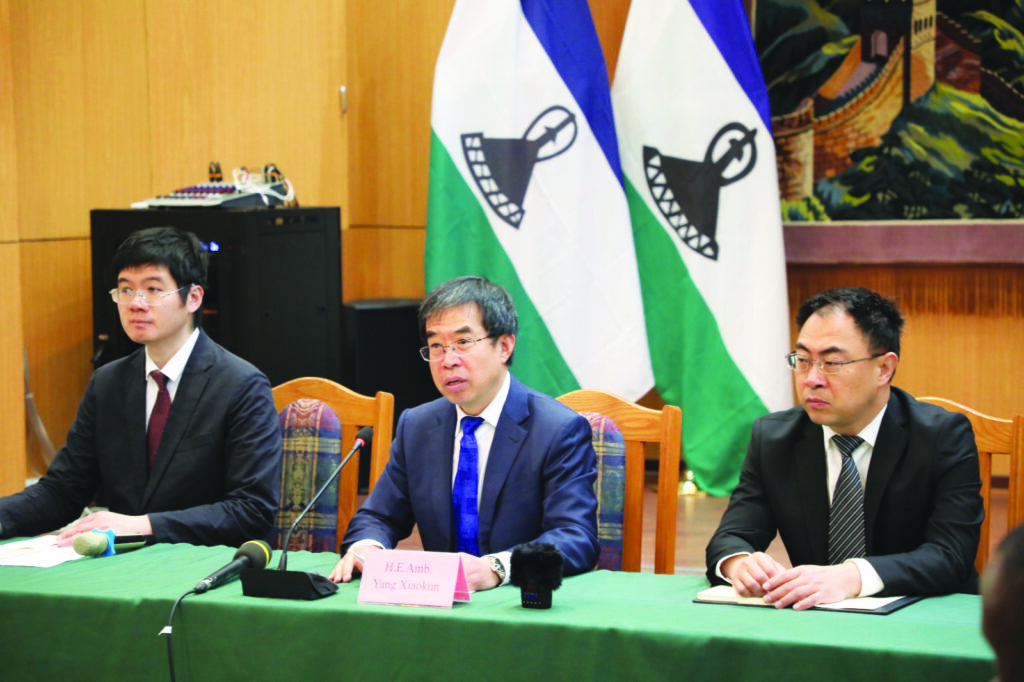
MASERU – Ambassador Yang Xiaokung has detailed China’s Global Governance Initiative (GCI) at a briefing in Maseru, emphasizing sovereign equality and multilateral reform.
In a comprehensive briefing held at the Chinese Embassy last Friday, Ambassador Yang presented China’s GGI to local journalists, framing it as a blueprint for a more just and effective international system.
The engagement offered a deep dive into a Chinese vision for world politics that champions the rights of all nations, regardless of size or economic stature, to have an equal voice in shaping their shared future.
The concept of global governance – the complex web of institutions, rules, and norms that guide international cooperation – is at a crossroads. From the United Nations and the World Bank to treaties on climate change and trade, this system is widely recognized as struggling with outdated structures, power imbalances, and questions about its effectiveness in addressing 21st-century challenges.
It is within this context that China has introduced the GGI, not as a tool to dismantle the existing order, but to reform and strengthen it for the benefit of all humanity.
Ambassador Yang began by situating the GGI within China’s broader framework for international engagement, which includes parallel initiatives on Development, Security, and Civilization.
“The Global Governance Initiative addresses the very framework within which all these efforts unfold,” he stated. “Together, these four initiatives complement each other, addressing the four pillars of a stable and progressive international order.”
This interconnected approach is ultimately aimed at realising the goal of building a “community with a shared future for humanity.”
The ambassador detailed that the GGI is built upon five core principles designed to guide international relations.
Sovereign equality, declared the “foremost premise” – this principle asserts that all countries, including smaller nations like Lesotho, possess equal rights to participate in international affairs and decision-making, free from coercion or dominance by larger powers; and international rule of law, which serves as the “fundamental safeguard,” emphasizing that international law and rules are common standards that must be jointly formulated, upheld, and implemented by all, without exception.
He also highlighted multilateralism, indicating that the GGI strongly advocates for collaborative solutions through multilateral platforms, rejecting unilateral actions that can destabilize global cooperation.
“Global governance is a matter for all countries and concerns the vital interests of each country,” Yang emphasized.
Then there is a people-centred approach, at its heart, the initiative is about empowering people and turning their aspirations for a better life into reality. It posits that the ultimate measure of global governance should be its ability to improve the lives of ordinary citizens worldwide.
Lastly, Yang talked of the achievement of tangible results, the initiative prioritizes practical action and concrete outcomes over empty rhetoric, focusing on delivering real solutions to pressing global concerns.
For a nation like Lesotho, these principles translate into a promise of a more inclusive seat at the global table. The GGI’s emphasis on sovereign equality directly speaks to the challenges faced by smaller states whose voices are often marginalized in international forums.
By advocating for a reformed system where rules are applied fairly and all nations can contribute, the initiative proposes a pathway for countries in Africa and the Global South to gain greater agency over their economic and political destinies.
Crucially, Ambassador Yang clarified that the GGI is not about overturning the current system.
“Reforming global governance is not about… creating a parallel system,” he said. “The GGI aims to firmly uphold the authority and central role of the UN.”
The focus is on reforming specific areas within the existing multilateral framework. Key priorities include modernizing the international financial architecture to be more equitable, and establishing robust governance for emerging frontiers like Artificial Intelligence (AI), cyberspace, and outer space, alongside perennial issues like climate change and trade.
“What we need is not confrontation, but cooperation; not exclusion, but inclusion; not walls but bridges,” the Ambassador concluded. “The GGI is China’s proposal for building such bridges for fairness, inclusiveness, effectiveness and shared progress.”
The long-term success of the GGI will ultimately depend on its practical implementation and the broad-based cooperation it garners from the international community. Its relevance will be tested by the tangible outcomes it delivers for people in Lesotho and across the world.
However, by presenting this detailed vision, China has initiated a significant conversation, inviting nations like Lesotho to be active participants in shaping the future of global governance, rather than passive subjects of its rules.