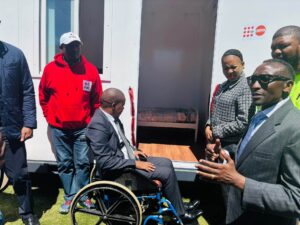
Disabled Basotho face ‘triple blow’ as taxi fare hike exposes deepening inequality

RETHABILE MOHONO
MASERU – Disabled people are facing a “triple blow” following a proposed increase in taxi fares, with advocates warning that the move further entrenches exclusion and discrimination.
This was said by Lesotho National Federation of Organisations of the Disabled (LNFOD) Director, Moeletsi Rabasotho, who stressed that the increase will disproportionately affect persons with disabilities who, in most cases, cannot walk as an alternative.
“For disabled people, to use vehicles is not a matter of convenience, it is a need and a must, unlike others who can easily choose to walk,” he said.
Rabasotho described the proposed increase of more than 80 percent as “a slap on the face” to disabled people, explaining that the impact is multiplied.
“When I say three times, I mean 80 percent for the disabled individual, their assistant and for their wheelchair,” he said.
He added that persons with disabilities are compelled to travel regularly for essential services such as rehabilitation, physiotherapy and to collect medication or eye drops, making transport unavoidable.
“What I mean is that disabled people are obliged to go to rehabilitation services and physio and so to collect medication or eye drops which they can’t miss, for their well-being,” he said.
While acknowledging rising costs, Rabasotho urged the government, taxi board and Ministry of Transport to “go back to their drawing board” and rethink fares to ensure affordability for disabled people.
The transport crisis comes amid broader concerns about the exclusion of persons with disabilities from government support systems.
Rabasotho noted that fewer than 3 000 disabled people currently receive disability grants out of an estimated 56 000 in the country.
“The last budget they promised to increase the number of people to obtain disability grant to 4 000,” he said.
He expressed disappointment that although 800 more people qualify, they have not been added due to government claims of insufficient funds.
“That is discrimination at its best, because old age grant is obtained by everyone who is 70 plus without any discrimination but for us it is a different story,” he said.
Echoing these concerns, radio presenter and disability rights activist, Ntebaleng Mokhali, popularly known as Noxi, said the increase will deepen financial strain on an already marginalised group.
Disabled people already rely on costly transport arrangements, she said, often paying M70 per trip, amounting to M140 for a return journey.
“For someone who is earning M650 grant per month it is already a lot. We are a marginalized group struggling to obtain employment and most did not attend school due to the educational system that does not cater for people living with disabilities. Very few have made it to school,” she said.
“For disabled people not working, the increase proposed is too much.”
The fare hike, set to take effect on May 1, was announced by the Maseru Region Taxi Operators (MRTO) following a meeting at its offices, without government approval.
MRTO chairperson, Mokete Jonase, said local fares will increase from M13 to M23, while long-distance routes will add M9.00 for every 10 kilometres.
“We have had to review fares in order to keep services running, given the continuous increase in operational costs,” Jonase said, citing rising fuel prices, vehicle maintenance and spare parts.
The increase is expected to affect daily commuters across Maseru and beyond, with concerns already raised about affordability amid broader cost-of-living pressures.
The development comes against the backdrop of widespread criticism of the 2026/27 national budget, which LNFOD says fails to prioritise persons with disabilities.
Despite commitments to inclusive growth and human capital development, the organisation said the budget is “conspicuously silent on disability,” leaving persons with disabilities “effectively invisible” in spending priorities and programme design.
While social grants for other groups were increased, persons with disabilities received no increment this fiscal year.
“Even more concerning is the limited coverage of the disability grant. Only about 3 000 persons with disabilities currently benefit from the programme, despite an estimated 55 000 being eligible, a coverage rate of approximately 5.5 percent,” LNFOD stated.
“In contrast, other vulnerable groups such as older persons enjoy near-universal grant coverage. This disparity reflects systemic discrimination rather than administrative coincidence.”
The organisation also warned that recent recognition of sign language as an official language risks becoming symbolic if not backed by funding for interpretation services.
“Rights without resources cannot be realised,” LNFOD said.
It has since called on the Ministry of Gender, Youth and Social Development to urgently reconsider its approach and at minimum double the number of grant beneficiaries.
“While the budget signals broad investments in health, education, infrastructure, and economic transformation, inclusion without explicit disability measures risks leaving thousands of persons with disabilities behind,” the organisation stated.
“We urge the government to do better.”