Bolae Lekoetje: The Amazing award-winning Paralympian with big dreams

SEBONGILE MATHE
Meet Bolae Lekoetje, a visually impaired award-winning Paralympian breaking new ground in track and field athletics and accessible technology for people with visual impairment.
Track and field athletes with visual impairment like Lekoetje are paired up with guides during races – sighted runners who match them step for step as guides, calling out potential obstacles and keeping the athletes informed of how far they have left to go.
The guides and runners are connected at the wrist by a small piece of rope called a tether, which helps the visually impaired runner stay aligned in his or her lane.
Lekoetje, who also has albinism, strongly believes that a person with disability has the potential to live their life and accomplish their dreams just as anyone, whether visually impaired, deaf to mention a few.
He says he thrives on challenging public perceptions of what a person’s limits should be.
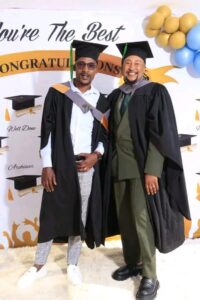
The runner, who originally hails from Lisolane in the Leribe district, but currently resident at Ha Tšosane, attended school at St Bernedette Primary School before moving to St Catherine’s High School – both schools cater for learners with visual impairment. He late enrolled with the National University of Lesotho to study Teaching in English Language and Special Education, between 2006 and 2022.
He says he studied Special Education because of the numerous challenges he faced in his life growing up indicating that he wanted to offer a helping hand, to help others living with the same disability as his to overcome such challenges and many others in their educational and life journeys.
Growing up in Leribe was a bit challenging to him, Lekoetje recalls, revealing that most of his peers and a number of grown-ups detested him because of his physical appearance. But notes that his relocation to Maseru brought about a change as within his new environment he found people with a different outlook towards life, he never experienced abuse hurled at him for how he looked.
Lekoetje started running when he was in primary school, and because of his excellence on the track he went on to be invited by other schools to represent them at competitions – he says this allowed him to enhance his God-given talent and to explore the many aspects of track and field athletics.
He says he focused on running out of pure passion and love for the sport, despite the many challenges he came across.
“We competed with able-bodied runners who had no visual complications like me at all,” he narrates. “…and as you can imagine it was hard for me to see across the breadth of the playing grounds on which we ran.”
He recalled that at times even if he stood the chance of winning a race, he faced the problem of navigating round the field and “I was forced to position myself behind one or two people in front of me using them as markers or guides…I couldn’t outrun them.
This held me back and limited my pace, but strangely I never got frustrated or gave up my love for track running. I loved what I was doing.”
Even after completion of his primary schooling at arriving at St Catherine’s High School, Lekoetje kept nurturing his love for athletics even though his new school was not taking part in school sports.
“That’s where I started participating in the Under-20 Youth Games representing Lesotho in the African and World Paralympic Championship Games in 2012,” he said.
He laments, though, what he calls the shoddy treatment given out to them as Paralympians by the governing bodies, saying this lack of support contributes immensely to their poor showing in international events.
Lekoetje said this challenge is basically lack of support for the Paralympic Games.
“Visually impaired athletes receive minimal funding despite the high costs associated with participating in these competitions.”
Lekoetje, who has also represented Lesotho in several international competitions, including the 2019 World Para Athletics Championships in Dubai, said it becomes challenging to scout for blind athletes as they are categorised based on their level of vision impairment – something that can only be accurately determined by a doctor specialising in visually impaired athletes.
He said as a result, they are unable to train blind athletes with potential.
He further said: “As visually impaired individuals, we require financial support due to our unique needs. We need greater attention and assistance compared to those without disabilities.”
Therefore, Lekoetje urges those in charge to take responsibility and allocate sufficient funds for visually impaired athletes, as many possess the talent and potential to succeed on the international stage.
“Lack of financial support is one of the factors contributing to our underperformance.”
Lekoetje also highlights another challenge of low participation rate of visually impaired women in the sport.
“The low participation rate of visually impaired women in the sport is a serious issue, and we need more women to get involved. Even the International Paralympic Committee has expressed concern over the low number of women and girls taking part in the Paralympic games,” he says.
Sharing his journey in the Paralympics games, Lekoetje says in 2016 he participated in an event in Angola and brought home a Silver Medal in 400 meters.
Later, he was chosen to be an Athlete Representative under the National Paralympics Committee of Lesotho (NaPCol), which he takes as a big achievement in his sports journey. He works together with the national athletes’ commission helping and offering help to the players.
He also works hard and see that challenges that were faced, are slowly coming to an end. He even highlighted that, since Lesotho Paralympics team was offered training by the International Paralympics Committee, there seems to be a better progress regarding the performance compared to years back, and he is proud of that.
“In 2019, we even got an invitation to go and participate in the World Championship Games, since our performance was improved after the offering of much training,” says Lekoetje.
Still a member of NAPCoL, Lekoetje works at the State Library in Maseru as a Technology Device Assistant in the visuals section. He helps visually impaired persons where they get their assistive technologies for use to access information and be able to take part in social media platforms, and he has about a joyful and peaceful year working in that office.
“I enjoy my work, because I have dedicated my life to help the visually impaired, making them to also feel comfortable and believe they are not different from others, that we are all human beings,” he confidently says.
Lekoetje is a friendly person, who loves and feel comfortable around people who understands that even if one is visually impaired, they are still human beings. He is single and has no children.
“Maybe in the next two or three years, I might be ready to get married, from there I will see about having kids,” he says.
Lekoetje is worried that most of people think less of those living with disability, the deaf and visually impaired persons assuming that there is nothing important or of value that the can do. He urges for the public to find value in people living with disability as there are some who are smart and intelligent despite their physical shortcomings.
Lekoetje’s life only revolves around his work, he says, enjoying his own time though he still likes being around people, sharing their experiences about life, giving each other advices and living a happy and peaceful life.
He says he has made it his mission to work hard for those who are visually impaired to be treated with respect like everybody else, he wants to walk their journey with them make them feel comfortable.
“I know the pain of being detested by others for something you did not choose to be.”