Journo Alumni speak on EUVP benefits.
‘MATHATO SEBOKA
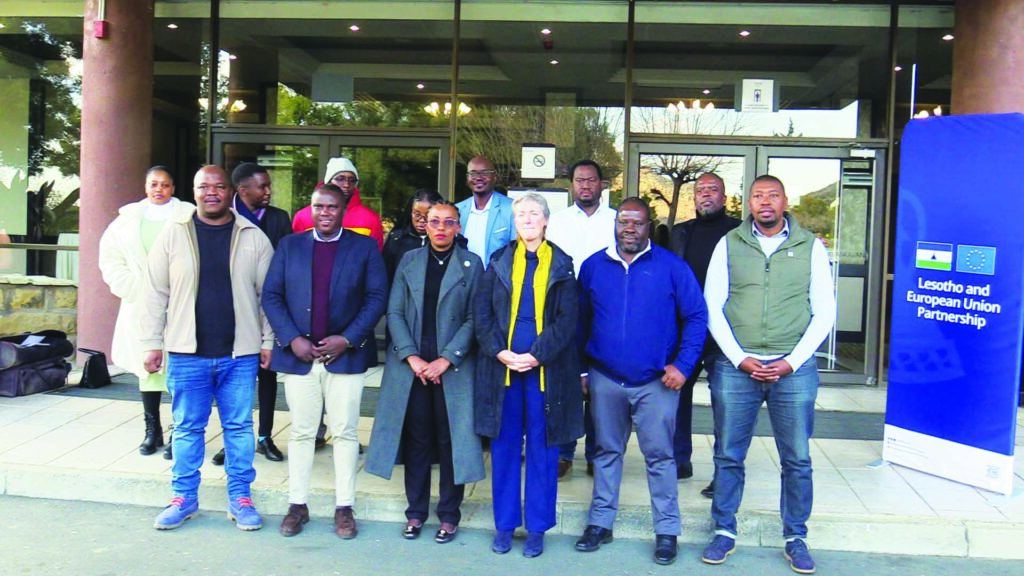
MASERU – The European Union (EU) hosted a luncheon on Wednesday this week, a gathering which untied alumni of the European Union Visitors Programme (EUVP) and participants from recent regional journalism seminars in Brussels.
The gathering offered a unique opportunity for networking, sharing experiences and celebrating EU-Lesotho partnerships where selected Alumni shared the benefits of the programme.
The beneficiaries of the EUVP included Legislator Mope Khati and Principal Secretary of the Ministry of Natural Resources Relebohile Lebeta, who are EUVP alumni alongside journalists Khotsofalang Koloi, Kabelo Mollo, Thoboloko Nšonyane and Rapelang Radebe from varying media houses who participated in the regional journalists’ seminar.
EU Ambassador, Paula Amadei said that since the establishment of EUVP in 1974, Basotho have never been beneficiaries.
“The Programme has been set up since the 70s; it is until two years ago, no Basotho have ever been the beneficiaries. I found it rather odd,” Amadei said.
Rapelang Radebe said that he found the EUVP to be valuable programme and learnt that it was based on the mutual agreement between EU and Africa.
“When I was in Brussels, the statement that caught me was where they said, they are in an era where it is no longer about aid but trade with Africa as equal partners,” Radebe said.
He further said it was such a hectic and pact programme but very valuable adding that he was appreciative that the EU is trying to resuscitate and to maintain a respectful relationship with Africa.
Principal Secretary Lebetsa said that she had lot of questions she wanted to answers from, when she went to Brussels, of her interest especially about the ministry that she serves.
“This is a very prestigious programme and I learnt from it. When I left for Brussels I had a number of questions that I was interested to get answers for. They included how the EU handles water resources management, the issues around the water investment and financing, issues around the climate change and I was interested to know how they capacitate countries like Lesotho and other related matters. I got to meet different organisations on these issues,” Lebeta said.
She appreciated the strong relationship and support that the EU gives the Ministry of Natural Resources – the support in the water sector through the project of ReNoka and the recent Metsi a Lesotho success.
“Through that collaboration we already had a strong relationship and we are grateful for the continued support from EU specifically in the water and energy sector as well as governance in Lesotho,” Lebeta said.
Khotsofalang Koloi stated appreciated that they have found ways as journalists of covering any government officials on business trip at the European Union countries “without the journalist being physically there”.
“As a journalist I find it very interesting, the opportunities that the programme has opened for us, especially to cover Lesotho as it goes abroad, in particular, when it goes to Europe. Our media houses cannot afford to fly us to follow the Prime Minister, the King or Ministers even when they are going to discuss issues of national interest,” he said. “We were able to establish relations that are very useful – when Lesotho is in Europe, we would be able to nicely, adequately and accurately cover it,” Koloi further said.
EUVP is the key strategic tool of the EU’s public, people to people diplomacy enhancing the EU’s smart power, global impact and outreach. It was established in 1974, jointly managed by the European Parliament and the European Commission.
EUVP’s distinguished Alumni include many former and current national political leaders, high-ranking government officials, academics and business people.
The EUVP provides tailor made study visits to meet members of the European Parliament officials from EU institutions and other EU stakeholders. The visits comprise both individual and joint meeting and activities with fellow EUVP participants.
Joint meeting and activities are organised on the basis of visitors’ thematic interests or by bringing together visitors from neighbouring countries or regions.
The EU is an economic and political union of 27 European countries; it has been a partner of Lesotho since 1976.