Case management: A “conditio sine qua non” for the effective and timely delivery of justice in Lesotho
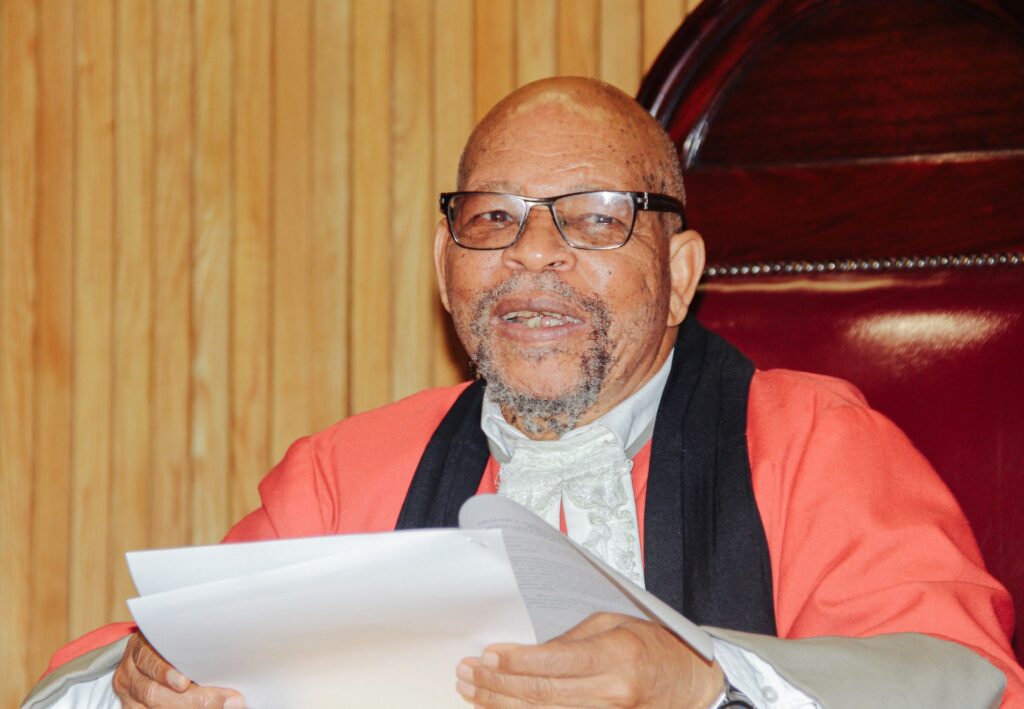
TŠELISO RAYMOND BALE
Imagine a football game of two teams, with a referee, spectators and everything, but no 90-minutes time limit. All Players without fixed positions, without fouls and no whistle, and above all, all players playing to score wherever and whenever they like.
In the past, almost all Judiciaries of the world operated like that until only in the 1990’s when the term Case Management was coined for the first time. Lesotho was no exception.
The courts were so sacrosanct that even to ask when judgment will be handed down was almost a taboo. Judicial officers alike, would only attend their court sessions when available, and only deliver judgments when ready to do so.
Just like the Sesotho “’Muso ha o tate” expression referring to governance, Justice was then known and accepted to be slow.
Cases would drag to eternity without anyone knowing what to do, who to blame, and who to complain to. It is all thanks to the serendipitous fact that the courts, at long last, globally realized the need for proper and effective Case Management systems and that we have arrived at this conjuncture.
In Lesotho, the only time limits for cases were only found in the prescription sections of our Statutes. For Criminal offences, all prescribe in 20 years with the exception of Capital Offences, to wit Murder, Treason and Sedition. As for the civil causes of actions, prescription is two years.
Without any impetus for the courts to speedily or timely dispose cases off, litigants remained at the mercy of sheer luck, to expensively bear the fruitless costs, or end up empty-handed without any known fate.
Case management was only introduced in Lesotho around 2007 with the help of the United States of America’s Millennium Challenge Account, together with their counterparts the European Union, by hosting several trainings and further funding the introduction of manual and automated allocation, tracking and reporting systems.
It is this system, which led the Judiciary to have the ability to clean its own house. For the first time in Lesotho history, judicial officers were held to account. What is, therefore, this Case Management?
Judicial Case management is defined as the process of organizing and overseeing the various aspects of a legal case to ensure that it proceeds efficiently and effectively to finality, through the judicial system. It is, easily put, a system used by the courts to manage the progression of cases, from the time they are registered until they are disposed of by the court.
Cases are life and death situations and are to be approached in a serious way.
The Rationale for proper case management is to promote a more active and effective method of allocating, tracking and reporting. It incorporates streamline processing, encourages early settlement, where possible, and on the overall, to dispose the cases more efficiently. It also reduces delays and costs for the clients, lawyers and the government.
The problems inherent in the old system were clearly experienced in the form of very long delays and uncertain end to litigation, a very expensive and complex litigation afforded only by the fortunate affording few. This resulted in the disillusionment of the public, plausibly leading to the current culture of self-help.
This arguably translated into the high rise of murder rates in the country, since people were frustrated by the non-affordability of dispute resolution remedies ideally provided by the courts. There was, further, a scourge of intractability and disappearance of Cases due to a large pool of cases, heaped together without any proper filing, compartmentalization and clear, distribution.
There was also lack of responsibility and accountability resulting in a wide collective negligence, hence the terms “backlog” and “Hlou-hlou” The system was also marred by a legitimized form of forum shopping by litigants and lawyers, in that litigants would actually lobby for their cases to be handled by known and preferred judicial officers for assurance of desired results in their favour.
The common causes and symptoms of the status quo were, among others, non-allocation of cases to individual judicial officer upon each case entering the system, as a result its non-progression could not be pinned on anybody. Any judicial officer could hold in abeyance or abandon a case for laziness, fear of its complexity or bias, without any justification what-so-ever.
In case the case landed on a new judicial officer, that other would have to start grappling with understanding the dispute afresh and struggle to give direction towards resolution of the matter. Lawyers were also burdened with having to explain the case afresh each time it landed on a different judicial officer.
The new era
In the mist of the vogue of strategic planning, the Lesotho Judiciary, like other arms of government, had to develop its strategic plan. Its mission was declared as, “to have an independent, effective and transparent judiciary in the administration of Justice.”
The Administration of the Judiciary Act, 2011, in its preamble, similarly proclaimed; “to provide for an autonomous and accountable system of the Judiciary”. One of the key the objectives was outlined as the effective and timely disposal of cases. Under these objectives, the Lesotho Judiciary made Case Management its top priority.
To expedite this, the learned Acting Chief Justice Monaphathi issued a Practice Directive No 1/01 of 2014, which introduced the operation of the Individual Docket System in order to make the Lesotho Judicial system judge owned and driven from allocation to disposition.
In 2016, Chief Justice Nthomeng Majara also supplemented by issuing Practice Directive No 1 of 2016 which ensured the courts’ readiness for every case that has been set down for hearing and to have all pleadings and documents in their proper order. That directive, further, restricted postponements of cases and ensured authenticity of court orders.
In the same year, she made the High Court (Amendment) Rules, 2016, which, inter alia, introduced the maiden pre-trial procedures.
The year 2021, saw another milestone when Chief Justice Sakoane promulgated the Superior Practice Directive No 2. The instrument, which facilitated the use of technology in the mist of Covid pandemic, changed the level field, for good, in terms checklists to be followed in ensuring that are cases ready for hearing when brought before our courts.
Those were followed by The Superior Courts Practice Directions No 3, 4 and 5, which dealt with procedures in matrimonial causes, withdrawals by Legal |Practitioners, streamlining of cases on pre-trial remand pending investigation, and the method of subpoena for Criminal trials under Section 199-202 of the Criminal Procedure and Evidence Act No 7 of 1981 respectively.
A further improvement was the introduction on Practice Directive No 1 of 2024, which set out guidelines to ensure that courts adjudicate urgent applications in an orderly manner, and correspondingly that papers are not filed haphazardly and are ready for adjudication.
With the implementation of these important case management tools, benefits such as reduction on litigation costs would soon be realized, since the system now ensured that cases continued to progress in a timely fashion. The efficiency of preparation by both the lawyers and judicial officers now increased.
There was, now, less time having to be spent by Judges and Lawyers refreshing their memory on any given matter after an unnecessary delay. The necessity to adhere to timetables focused practitioners’ mind on the essential issues.
The length of litigation is decreased by the encouragement of earlier and more frequent settlements, which in turn bring down litigants’ expenses.
The new phenomena of case management is governed, among others, by the following principles.
First is cooperation and expectations. This entails a thorough preparation, not only by lawyers, but by all role players. Apart from the ordinary consultations, drafting, filing and exchange of papers, there has to be preliminary conferences where they iron out issues amongst themselves, as well as before the judicial officer who also has to understand, by perusal, the docket at hand.
This calls for attendance by all, to all the stages, so that expectations are pre-known by all.
Second, is leadership and transparency.
This involves the active role played by the court in ensuring that all attend the process, and do all that is required to achieve the intended end, which is disposal of the matter to finality. The court drives the process, and does not wait for the parties to knock at its door once it is seized with the matter. This, the court does without detracting from impartiality.
The third important principle is a culture of developed Attitudes and Standards, such as non-tolerance of unnecessary adjournments. This is assisted by setting timeframes for the duration of various specific types of cases, and delivery of judgments. The fourth is Local Controls.
Here we deal with the provision, and adherence to the provided Rules and Practice Directives and Procedures, as well as timeframes provided therein.
The last and final leg, is the Management of Information. This is where the statistics or data production, management, and analysis thereof, becomes essential. It reflects the performance of each judicial officer against the set time frames. It provides feedback and serves as a monitoring tool to guide the managers in decision-making. It dictates the proper placement of resources, human and material.
This would complete an ideal picture where the judiciary then has respond to the challenges to develop and maintain systems manually, where need be, to manage cases which can be digitalized upon advancement.
The most practical and pivotal stage then becomes the implementation of the case management strategies used in order to best achieve the mission and objectives of the judiciary. These are classified into three major stages, the pre-trial, mid-trial and post-trial stages.
In the pre-trial stage, focus is on the gatekeeping process; – which involves the requirement, in criminal proceedings, that all cases should only be registered and remanded into the system only when investigations are complete, and in civil proceedings, when the pleadings are closed.
Second, is allowing the alternative dispute resolution mechanisms (ADR’s) to be explored. It is an important component helping in the reduction of influx of cases into the mainstream. This is where cases are subjected to community, family, police, and the prosecution mediation efforts, as well as the court-annexed mediation.
Where parties no longer prosecute their cases for various reasons, such are instantly subjected to dismissal procedures, in order to clear them from the courts system.
Another pivotal pre-trial component is allocation. This is either a manual or automatic, but systematic, transparent and equitable allocation of cases to judicial officers. It should essentially eliminate forum shopping, it also eliminates workload imbalances and frictions.
Most importantly, in juxtaposition with the old tradition, where all the accumulating cases were a collective responsibility of all judicial officers, it alternatively, introduced the Individual Docket System (IDS). Here, every judicial officer knows his cases, manages and drives them, and his performance is able to be assessed clearly with numbers, and enables him/her to make her own SMART (Specific, Measurable, Achievable, Relevant and Time-bound) objectives and assessment. It is also meant to boost public confidence.
Pre-trial conferences are another useful procedure that helps to eliminate trivialities and separate peripheral from core issues. It, also, gives the court and the parties the leeway to settle issues that are of common course, and leave the court to deal with identified core issues.
This stage also encompasses the court’s scrutiny, and verification of charges in criminal proceedings, including quashing where necessary. It empowers the court on the control of the pace and direction of the case (setting the stage), that is, the evidence needed, together with the relevance of each piece of evidence and witness.
Trials themselves need to be handled in a manner that makes them time-sensitive and cost-effective. Judicial officers, as referees, have to stick to, and enforce the scheduled times and dates for hearing to the best of their ability.
They also need to control the trial, as active, instead of passive participants, interjecting where frivolous and redundant questions, as well as conduct deemed only dilatory in nature, is used in the mist of trial.
Judicial officers are enjoined to oversee strict adherence to trial advocacy principles, minimizing gallery performances at all costs. Witnesses or the evidence led, should be in line with the purposes of each, in concord with the outlined summary in the trial introduction summary or court papers.
Use of modern recording and transcription systems, can reduce courts time across all courts to avoid the “bird water drinking”, handwriting method currently used in most lower courts. Zero tolerance to unreasonable adjournments, the use of written heads and their submissions within specified timeframes, and time setting towards judgment delivery should also be compulsorily applied.
Finally, timely delivery of judgments and filing of the same in publicly accessible archives should courteously seal the process.
The third and ultimate component of this process, is the Post-trial stage, engulfing management of case information. It entails clear and complete information collection for use by the management and the public. It facilitates the assessment and decision making by the authorities regarding placement, empowerment, and transfers of human as well as material resources in their strategic planning exercises.
It also enables self-reflection by individuals, informs institutional performance assessment, and ultimately serves as a major accountability and reporting tool to the public.
The last part, which need not be equally ignored, is execution. The courts need to know of the fate of their judgments. There are provisions for signature by judicial officers, of documents signifying that their judgments have been executed.
These include the judicial officer actual signing of committal, in case of a prison sentence, or writs of execution in satisfaction of judgment debts.
In conclusion, major challenges still remain regarding stakeholder’s sensitization and garnering of will and support from stakeholders. First, to the Judicial officers themselves to champion the cause in enforcing case management.
Second, to the legal fraternity, by weaning from delaying strategies and culture of, inter alia, relying on excuses such as non-receiving of full payments, as well as common deliberate strategic delays upon apprehension that client’s cases are weak.
Thirdly, one would humbly call for a cooperative adherence to the newly promulgated Rules and Practice directives by all stakeholders without any undue resistance. The Police and other supporting structures, in the same disposition, can play their part by bringing only completely investigated cases to courts, while the prosecutors sanction the same.
A clarion call is also, finally, made for robust and continuous training of stakeholders in trial-advocacy skills, case management and the development of proper ethical regimen in line with this whole conception.
- Tšeliso Raymond Bale – is a Senior Resident Magistrate, Lesotho Judiciary – trbale.bale6@gmail.com