Indigenous seed exchange cultivates food security, climate resilience
MOSA MAOENG
QACHA’S NEK – The Southern Mountains Association for Rural Transformation and Development Programme (SMARTD) has reaffirmed its commitment to safeguarding Lesotho’s agricultural heritage, in a powerful response to the dual challenges of climate change and food insecurity.
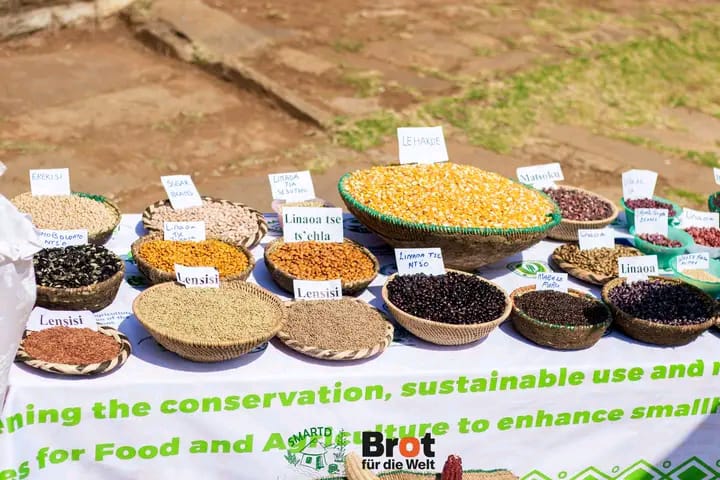
The organization hosted its 11th annual Indigenous Seed Festival last Friday, transforming a local event into a vital national conversation about biodiversity, knowledge sharing, and sustainable food systems.
Under the resonant theme, “Discovering the treasure of African indigenous seed and food through agro-ecology”, the festival served as a dynamic confluence of farmers, seed producers, researchers, and development organizations. It underscored a growing movement to revalue the deep-rooted wisdom held within locally adapted seeds.
SMARTD Programme Manager, Fako Fako, articulated the festival’s critical objectives, which extend far beyond a simple seed swap.
“This platform is foundational for biodiversity conservation,” he stated. “We are encouraging the preservation of local indigenous seed varieties, which have evolved over centuries to be remarkably resilient to our specific climate conditions, pests and diseases. This isn’t just about planting, it’s about protecting a living library of genetic traits essential for our future survival.”
The benefits of this initiative are multifaceted, and Fako elaborated on several key areas that covered knowledge exchange, community engagement, sustainable agriculture, improved food security and direct seed access.
The event facilitated the crucial sharing of agricultural knowledge, techniques, and experiences between generations of farmers and with formal research institutions.
It fostered community participation by empowering local farmers and validating their expertise, moving agriculture away from a top-down model to a collaborative one – and identified sustainable agriculture as a core principle is the advocacy for agro-ecological practices that enhance soil health, reduce dependency on expensive chemical inputs, and maintain a healthy ecological balance.
By promoting diverse cropping systems, indigenous seeds directly enhance household and national food security, creating a more resilient buffer against crop failure, and perhaps most practically, the festival provided farmers with direct access to a variety of seeds that are often unavailable through commercial channels, which typically prioritize hybrid or non-native varieties.
The role of academia in this ecosystem was powerfully highlighted by Relebohile Mojaki, a representative from the Faculty of Agriculture at the National University of Lesotho (NUL).
She reframed the continent’s wealth, noting, “The treasure of Africa is not only in its minerals or landscapes, but in its biodiversity, carefully preserved by farmers and rural communities for generations. These seeds are more than just planting materials. They embody our heritage, culture and innate resilience.”
Mojaki passionately outlined the actionable role institutions like NUL must play, moving from theoretical study to active partnership.
“Universities are not isolated ivory towers,” she asserted.
“We are, and must be, active participants and partners with farming communities.”
She detailed a multi-pronged approach for researchers, being documentation and research, participatory collaboration, curriculum development and policy influence.
She said these entailed systematically studying and documenting indigenous knowledge and seed varieties before they are lost, while working directly with farmers on initiatives like participatory plant breeding, where researchers and farmers co-develop new varieties that combine traditional resilience with improved yields.
Training future agronomists, extension officers, and students to value and understand agro-ecology, ensuring the next generation of professionals carries this wisdom forward, and using research data to inform government policy, creating frameworks that protect, promote and ensure farmer access to indigenous seeds is key, she continued.
“The future is not about choosing between indigenous seeds and modernity,” Mojaki concluded.
“It is about blending the two with respect. Indigenous seeds and agro-ecology are the dignified path forward for Basotho, securing household food security and national sovereignty. I urge farmers, researchers, the Ministry of Agriculture, and civil society to invest in seed diversity, promote these practices, and inspire our youth to see agriculture as an opportunity for innovation and pride.”
The tangible impact of this work was evidenced by ‘Malintle Thapo, Chairperson of the Senqu & Senqunyane Nutrition Seeds group. She shared her group’s success story, which began with SMARTD’s incubation support in 2022.
“We have grown tremendously,” Thapo said.
“Under SMARTD’s guidance, we are now able to collect, preserve, and produce our own indigenous seeds.”
This empowerment, however, is met with the stark reality of a changing climate. Thapo noted that unpredictable weather patterns often hinder their ability to produce in satisfying quantities. Yet, their persistence shines through.
“We try to produce even with these challenges,” she said, listing beans, maize, soya, and sunflower seeds for animal feed among their successful yields.
Looking forward, the group is constructing a dedicated seed collection site.
“This will let people know where we are located when they want to buy seeds,” Thapo explained, highlighting the growth of their initiative from a community project to a small-scale enterprise serving clients from Maseru and Qacha’s Nek.
“We were behind in many things and lacked knowledge, but to date, we have grown extremely. We are grateful.”
The 11th Indigenous Seed Festival stands as a testament to a collective vision. It is a vision where the deep knowledge of the past is not discarded but is instead amplified by modern research. It is a future where Lesotho’ food security is grown from seeds nurtured in its own soil, capable of weathering the storms of tomorrow.
The call to action is clear, for the sake of the nation’s plates, ecosystems, and economic resilience, the treasure of African indigenous seeds must be nurtured to thrive not only in the soil but also in the policies, markets, and collective memory of the nation.