Village health workers forge path to safer motherhood

LIAPENG RALIENGOANE
THABA-TSEKA – In Lesotho’s remote highlands, where clinics are a day’s walk away, a quiet revolution in maternal health is being waged by its frontline – the village health worker.
These dedicated individuals, almost always women, are the frontline of the country’s healthcare system, bridging the critical gap between remote communities and clinical services.
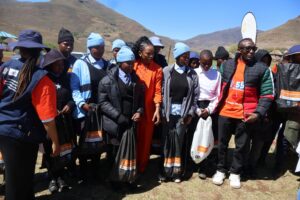
For ‘Manthabeleng Mokone and ‘Masebotsa Pitso of Ha Shoaepane, a typical workday involves traversing rocky, mountainous terrain to visit expectant and new mothers. They are educators, distributors of contraceptives, birth attendants in emergencies, and trusted confidantes.
Yet, their lifesaving work is often met with suspicion and fear, sometimes branding them with the painful label of witches.

“For us it is painful,” confesses ‘Manthabeleng, her voice steady despite the stigma.
“When we go to consult people about their health, instead of listening, some call us witches. But we do not stop, because we know we are helping.”
This unwavering commitment is the bedrock of primary healthcare in rural Lesotho. Village health workers are typically selected from their communities and receive basic training from the Ministry of Health.
They are the embodiment of the national health system’s reach, tasked with implementing crucial programmes on the ground, from family planning and HIV prevention to maternal and child health.
A primary battleground is family planning. While the Lesotho Demographic and Health Survey (2014) notes that knowledge of contraception is nearly universal, acceptance is hampered by deep-seated myths.
“‘Male condoms are taken without hesitation, but female condoms remain untouched,'” explains ‘Manthabeleng, who distributes contraceptives.
“People here are receptive to contraceptives, but myths remain. Some women say family planning makes their bodies wet.”
The consequences of such misconceptions are starkly visible. She recalls a woman who, despite repeated counsel, refused contraception.
“She already had seven children when I first spoke to her. I encouraged her to consider family planning, but a year later she had her eighth child. Today, she has nine.”
This challenge is echoed at the district level. Thaba-Tseka District Administrator, Tlali Mphafi, points to persistent myths among parents who believe contraceptives cause infertility.
“In some cases,” he notes, “young girls end up becoming pregnant to ‘prove’ their ability to bear children, thereby increasing their perceived eligibility for marriage.”
The perilous journey to care
For her colleague, ‘Masebotsa Pitso, the most immediate threat is the dangerous delay in reaching care. Lesotho, according to 2016 Census data, suffers from a very high maternal mortality ratio. The long, arduous journey to a clinic can mean the difference between life and death.
“I once had a woman call me when she was already in labour,” ‘Masebotsa recounts. “We walked for three to four hours. I was so scared she might deliver on the way, and I would be forced to help her there in the open. Luckily, she made it to the facility and gave birth safely.”
The village leadership recognizes the indispensable role these women play. ‘Malingaka Molefe, speaking on behalf of Chief Nkau Shoaepane, affirms their value.
“At times, women go into labour at night and need to be rushed to the clinic, which is very far,” she says. “That is why we value the work of our village health workers. They are also given opportunities to provide health education during public gatherings.”
A partner in progress
Bolstering these local efforts is the support of the United Nations Population Fund (UNFPA), the UN’s sexual and reproductive health agency. UNFPA is a key partner to the Government of Lesotho, aligning with its National Strategic Development Plan to strengthen the health system.
UNFPA’s mission in Lesotho is to help achieve transformative results: ending preventable maternal deaths, unmet need for family planning, gender-based violence, and harmful practices like child marriage. In the remote districts of the country, this translates into direct support for the work of village health workers.
The agency works to ensure a continuous, reliable supply of quality contraceptives, a critical need in areas where stock-outs can shatter community trust. Furthermore, UNFPA is helping to “capacitate village health workers to distribute less skill-intensive methods like pills and condoms,” effectively expanding access right to the village doorstep.
To improve long-term family planning methods, UNFPA supports high-impact initiatives such as Postpartum Family Planning in pilot hospitals and targeted integrated outreach services. These services focus specifically on hard-to-reach areas like Thaba-Tseka, ensuring that even the most isolated communities are not left behind.
This comprehensive approach aims to prevent maternal deaths, reduce early and unintended pregnancies, and empower young people with accurate information.
Despite the formidable challenges of distance, stigma, and persistent myths, the resolve of ‘Manthabeleng and ‘Masebotsa remains unbroken. Their motivation is simple and powerful: the sight of a healthy new-born, the relief of a mother who has survived childbirth, and the slow, steady shift as families begin to embrace health education.
“Even if some people doubt us and call us witches, we know the truth,” says ‘Manthabeleng, her gaze fixed on the mountains she must cross.
“The truth is that we are saving lives.”
In the dusty footpaths and highland villages of Lesotho, these unsung heroes are ensuring that the journey to better health, step by arduous step, continues.