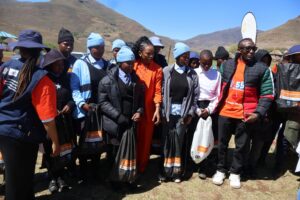
Certificates bring new hope to highlands communities
NKAMOHELENG MOLOISANE
THABA-TSEKA — A wave of pride and renewed optimism swept through Katse this week as community members affected by the Lesotho Highlands Water Project (LHWP) received formal recognition through the Skills Testing and Accreditation Programme, an initiative designed to validate practical skills long overlooked by the formal education system.
For years, residents of the districts of Mokhotlong, Thaba-Tseka and Leribe have borne the weight of displacement, loss of arable land, and disruption to traditional livelihoods as a result of the massive water transfer scheme. While the Lesotho Highlands Water Project has brought significant national revenue and regional water security, affected communities have often struggled to regain economic stability.
Many possess generations-old skills in construction, tour guiding, and artisan trades, yet without formal certification, they have remained largely excluded from the formal job market and public procurement opportunities tied to the very project that reshaped their surroundings.
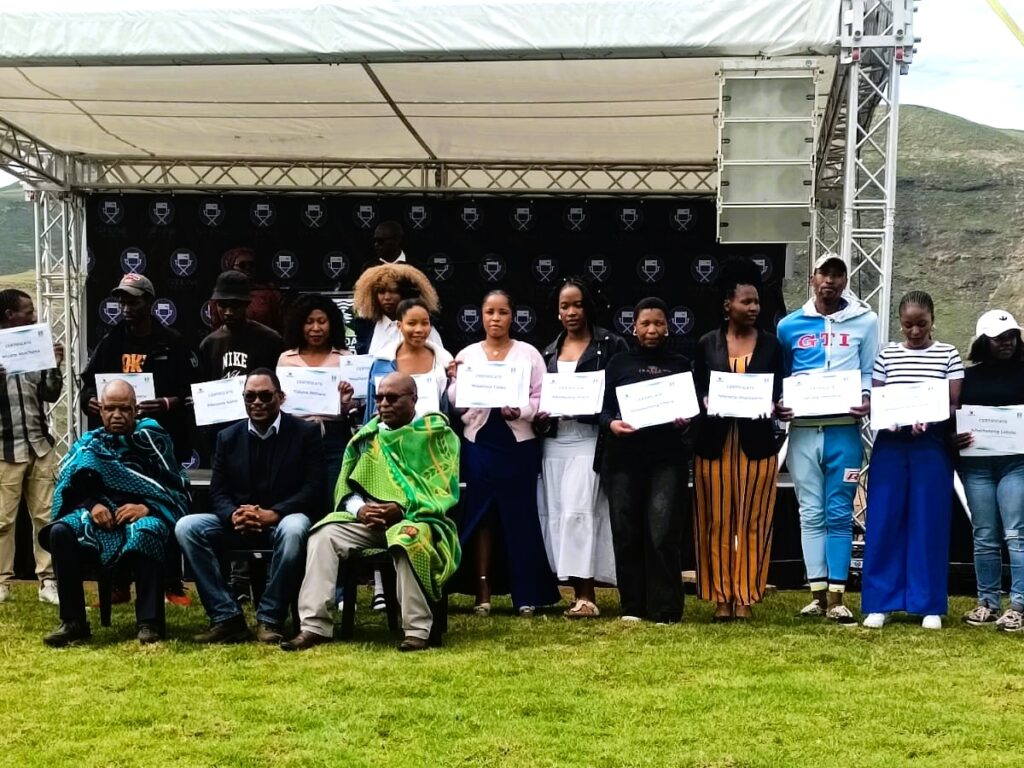
It is this gap that the Skills Testing and Accreditation Programme, implemented by the Lesotho Highlands Water Development Authority (LHDA) in collaboration with the Ministry of Education and Training, seeks to close. The ceremony marked a milestone in those efforts, as dozens of men and women walked away with certificates that, for many, represent the first official acknowledgment of their capabilities.
Speaking at the event, Polihali Unit Project Manager, Limpho Moeko, underscored the programme as part of a broader commitment by the LHDA to improve livelihoods among project-affected communities.
“We realised that many Basotho have valuable skills but lack the certificates needed to advance themselves and contribute meaningfully to the country’s development,” Moeko said.
Since its inception in 2021, the initiative has trained and certified more than 1 800 individuals, equipping them with both validated competencies and renewed confidence to seek employment or self-employment.
The programme is one of several recent efforts by the LHDA to move beyond infrastructure development and address long-standing socio-economic grievances. In addition to skills accreditation, the authority has intensified local enterprise development initiatives, promoted the inclusion of affected households in project supply chains, and expanded scholarship schemes for youth from impacted areas.
These interventions come amid growing recognition that sustainable development of the Highlands region depends on ensuring that those who sacrificed land and livelihoods become direct beneficiaries of the project’s legacy.
Thabang Mokhotjo from the Technical and Vocational Department (TVD) reinforced the value of such certifications in today’s competitive environment.
“These certificates are essential in today’s job market; they also empower individuals to become self-reliant and create their own employment,” he said. His words resonated with the graduates, many of whom had long relied on informal work, their skills going unrecognised by employers and government tendering processes alike.
For Kape Tota, who spoke on behalf of the graduates, the ceremony represented far more than a piece of paper. “This is a great honour for us; it gives us hope that we can now find jobs or even start our own businesses,” he said.
Among the day’s outstanding graduates was Selemela Molise, who distinguished himself in roofing training. Being singled out as a top performer, he said, had transformed his self-belief.
“This shows that I am capable of building something for myself, and getting this certificate is just the beginning of my journey.” Molise encouraged others to consider vocational training, especially in a country grappling with persistently high unemployment.
“With these skills, you can even start your own business and employ others,” he added.
Bokang Letšela from Ha Lebopo in Mokhotlong, who trained in tour guiding, said the programme had brought him significantly closer to a long-held ambition of promoting his homeland.
“I have always wanted to market Lesotho, but I lacked the support. Now, with this certificate, I see more opportunities,” Letšela said. He plans to use social media platforms to showcase the country’s tourism potential, capitalising on the growing global interest in authentic, community-led travel experiences.
Community member Relebohile Mosoping from Khohlo-Ntšo described the initiative as groundbreaking for the three districts.
“This is the first time we see such an effort. It shows that more can still be done; not only in these districts, but across the whole country,” he observed.
His remarks reflected a wider sentiment that while the certification programme is a significant step, its expansion could unlock similar opportunities in other regions where infrastructure development has left communities in transition.
For many in attendance, the ceremony was more than a celebration of individual achievement – it marked a symbolic shift in the relationship between the LHDA and the communities that have long shouldered the impact of one of Africa’s largest bi-national water projects.
Against a backdrop of past grievances over compensation and livelihood restoration, the gathering in Katse stood as a quiet testament to what targeted skills development can achieve when delivered in partnership with those most affected.
As the newly certified graduates dispersed into the afternoon light, their certificates held close, there was a palpable sense that for these communities, a new chapter had begun – one built not merely on the flow of water to downstream neighbours, but on the untapped potential of the people who live at its source.