‘Letsema’ strategy launched to rescue Lesotho’s ailing industrial sector, targets 50 000 new jobs
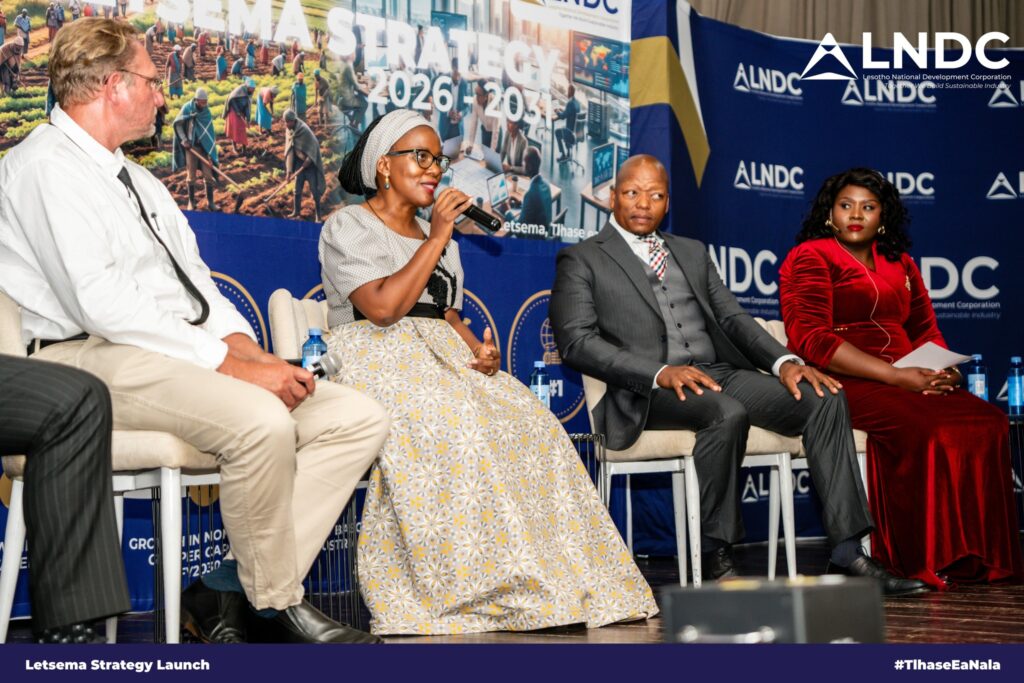
LNDC unveils ambitious five-year plan to break import dependency, create 100 homegrown industrialists, and end ‘cut, make, trim’ stagnation
MOSA MAOENG
MASERU – For decades, Lesotho’s economy has been trapped in a cycle of short-lived booms followed by prolonged slowdowns, leaving thousands of citizens without sustainable work. Last week, the government unveiled a bold new roadmap to break this pattern.
Deputy Prime Minister, Justice Nthomeng Majara, officially launched the Lesotho National Development Corporation (LNDC) Strategic Plan 2026-2031, dubbed “Letsema” — a Sesotho word symbolizing collective effort. The plan promises to create 50 000 net new jobs and nurture 100 Basotho industrialists by 2030, marking a radical departure from past strategies.
But the launch also laid bare a sobering reality: Lesotho is falling dangerously behind its Southern African Customs Union (SACU) partners, crippled by excessive imports and a manufacturing sector that adds almost no value to what it produces.
The LNDC was established by an act of parliament to initiate, facilitate, and promote manufacturing, mining, processing, and commerce. Its core mission is to raise income and employment levels across the kingdom. Yet, for years, the corporation has struggled to fulfill this mandate amid limited export diversification, heavy reliance on foreign goods, and productive capacity concentrated in just a handful of industries.
Speaking at the launch event in Maseru last Thursday, Majara did not shy away from these failures.
“This strategy offers an honest and instructive diagnosis,” she said.
“It recognizes that our challenges are not simply about policy effort or institutional will. Rather, they are rooted in deeper structural realities.”
She pointed to geopolitical uncertainty threatening development gains worldwide, but noted that Lesotho’s problems are uniquely self-inflicted: “Limited export diversification, high dependence on imports, and productive sectors concentrated in only a few industries.”
Perhaps the most striking critique came from LNDC Chief Executive Officer Thabo Khasipe, who delivered a blunt assessment of Lesotho’s industrial status quo. He explained that Lesotho’s flagship textile industry operates almost exclusively on a “Cut, Make, Trim” (CMT) basis.
“We receive materials from the client, do the job, and send it back to their markets,” Khasipe said. “There is no value added. That means Lesotho does not generate export earnings that can sustain growth.”
He further warned that Lesotho’s excessive import dependency drains the country’s currency reserves, leaving the economy vulnerable to external shocks. Compared to other SACU members — including South Africa, Botswana, Eswatini, and Namibia — Lesotho lags far behind in industrial complexity and per capita income.
To reverse this, the Letsema strategy sets five concrete targets by 2030:
· Create 50 000 net new jobs directly facilitated by LNDC.
· Develop 100 new Basotho industrialists (from near zero today).
· Establish five new LNDC-facilitated industries.
· Rank number one in SACU on a key industrial performance index.
· Achieve 7 percent GDP per capita growth.
Khasipe outlined four strategic pillars designed to move Lesotho beyond fragmented, short-term interventions:
1. Driving industrial transformation – Shifting from CMT to full-scale manufacturing and value addition.
2. Unlocking capital for growth – Mobilizing domestic and international investment.
3. Orchestrating the national industrial ecosystem – Coordinating government, private sector, workers, and development partners.
4. Building internal capabilities – Ensuring the LNDC has the skills and systems to deliver results.
“These pillars position LNDC as a central coordinator of industrial development,” Khasipe said, “leveraging partnerships across government, private sector, and development institutions to achieve impact at scale.”
Central to the strategy is the concept of Letsema — a pan-African idea of pulling together. Majara noted that in isiZulu, the same spirit speaks to a community solving shared challenges; in Swahili, it is Harambee, meaning “all pull together.”
“Industrial transformation cannot be achieved by government alone, nor by any single institution,” she said. “It requires coordinated action among government, entrepreneurs, investors, financial institutions, workers, and development partners. This strategy is therefore an open invitation to all stakeholders to join hands in addressing the most pressing challenges: unemployment and poverty.”
LNDC Board Chairperson, Palesa Matobako, reinforced the message, stating that the strategy “will challenge what has been business as usual and open doors that we must collectively dare to step into.”
She emphasized alignment with national priorities: industrial diversification, capital mobilization, development of local industrialists, and coordinated action across the entire industrial ecosystem. “Industrial development is complex,” Matobako said. “It requires capable institutions, policy coherence, and strong partnerships.”
According to LNDC officials, the Letsema Strategy represents more than a policy framework — it is a binding call to action. It signals a decisive shift from fragmented, short-lived projects to coordinated, large-scale impact.
As the plan moves into implementation starting 2026, its success will hinge on whether government, investors, factory workers, and development partners genuinely embrace the spirit of Letsema. The targets are steep: 50 000 jobs, 100 new industrialists, and a complete overhaul of a century-old import-dependent model.
But for a nation that has watched its young people queue for scarce jobs and its factories perform only the simplest tasks, the strategy offers something long absent: a credible promise of structural change.
“This is not only about the future of the LNDC,” Majara concluded.
“It is about the future of Lesotho itself.”