LHDA opens Polihali Project to media
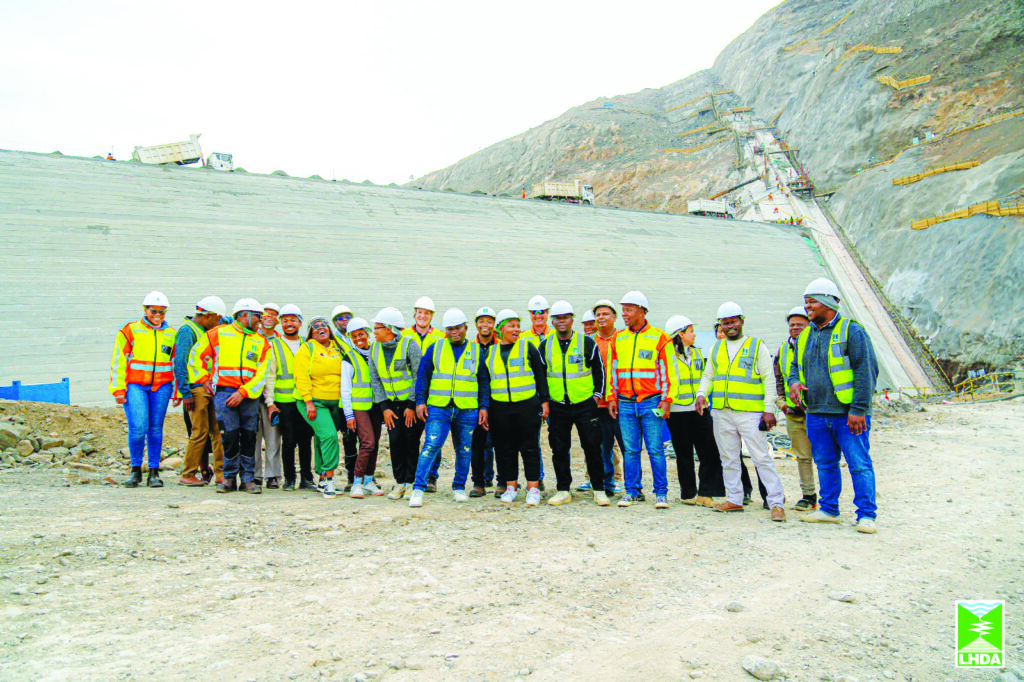
- Showcases multi-Million Maloti investment in community upliftment
- Demonstrates how Phase II dam project is empowering locals
MAKOKO MAEKA
MOKHOTLONG – In a move to counter misinformation, the Lesotho Highlands Development Authority (LHDA) this week concluded a comprehensive four-day media tour for senior local and South African journalists, showcasing the progress of the multi-billion Maloti Polihali Dam and, crucially, its extensive Corporate Social Responsibility (CSR) mandate to uplift surrounding communities.
The tour, which ran from Monday to Thursday, was designed to provide a transparent view of the engineering feats and the human stories behind Africa’s largest bi-national water project. LHDA officials emphasized that their mission extends far beyond construction, deeply embedding community development into the project’s core.
“The most challenging part of this project is disinformation and misinformation,” said LHDA Public Relations Manager, Mpho Brown.
“This is precisely why we invited the media – to equip them with correct and valuable information to share with the public.”
The project has become a significant economic driver. Chief Engineer, Ivanoc Iganvich, reported that over 2 200 workers are currently employed, the vast majority being Basotho nationals. This influx of employment and procurement has provided a substantial boost to the local economy in Mokhotlong.
The scale of investment is historic. The Polihali Dam project, Phase II of the Lesotho Highlands Water Project, carries a total price tag of M53.3 billion, with M18.9 billion already expended.
A central pillar of the LHDA’s Corporate Social Responsibility (CSR) mandate is moving beyond mere financial compensation to creating lasting, sustainable livelihoods for communities affected by the dam’s construction.
Thus far, the Authority has paid M154 million in compensation, with 95 percent of all compensation processes completed. However, LHDA Senior Public Relations Officer, Malakeng Hloma, explained that outstanding payments are often held to ensure funds reach the correct beneficiaries, especially where family disputes arise.
The Authority’s true focus is on long-term empowerment. Impacted communities have been supported to establish and run various sustainable farming projects, including fisheries, large-scale potato production, broiler chicken ventures, and bee-keeping.
A standout example is the Sekokong Nutrition Club. Comprising five women and one man, the group generated over M99 000 in revenue from potatoes alone last year – a harvest they described as “not their best” due to dry spells. Under a 70:30 profit-sharing model with the LHDA, where the community retains the majority share, such initiatives are designed for self-sufficiency.
“The LHDA’s mandate is to help communities improve their livelihoods. It is vital that when compensated, they are helped to manage their benefits for the long term – 95 years and beyond,” said Boitumelo Mmote, LHDA Crop Production Supervisor for Sekokong.
The LHDA’s community support initiative (CSI) also includes a massive environmental drive. Likamatso Koetle, the Authority’s Environmental Officer, stated that a staggering 15 860 casual community workers have been employed to rehabilitate degraded land, replant grass, and uproot invasive species, earning over M45 million in wages collectively.
Furthermore, the LHDA is innovating to support traditional practices. Acknowledging that many locals survive on sheep farming, the Authority is procuring superior semen to help farmers improve their breeds – a cost-effective method to enhance yields and income.
The Authority expressed cautious optimism about the choices of the new generation of beneficiaries. Unlike Phase I recipients, who largely opted for grain compensation, Phase II beneficiaries – often younger, tech-savvy, and economically alert – are influencing elders to choose lump-sum cash payments, which can be quickly depleted.
While the LHDA acknowledges it cannot force choices, it continues to advocate for prudent financial management to ensure the benefits of the project endure for generations.
The media tour included visits to key sites like the Polihali Operations Centre, the emerging Polihali Village, and the impressive Senqu Bridge – a M3.3 billion, earthquake-proof structure that will connect communities separated by the new reservoir.
Water collection in the Polihali Dam is anticipated to begin in November 2026, with the entire project set for completion in late 2028. Once operational, it will significantly increase water transfers to South Africa, from which Lesotho earns substantial royalties, currently estimated at M5 million monthly.
The tour served as a powerful testament to the LHDA’s dual mission, not only to engineer one of the region’s most complex water transfer systems but also to ensure it leaves a legacy of prosperous and resilient communities in its wake.