Breaking taboos and building futures for girls in rural Lesotho

A quiet revolution is underway as initiatives tackle menstrual poverty, stigma and the barriers that keep girls from the classroom
MOSA MAOENG
Limpho Lefosa, 17, speaks with a wisdom that belies her years. In a classroom at Senkoase High School, nestled in the rugged highlands of Mokhotlong district, she dismantles centuries of stigma with simple, powerful logic.
“Menstruation is nature and should not be considered a sin,” she states, her voice firm. “It does not mean that when a girl is on their period they are not privileged to attend school, because other students will make the girl feel less of herself.”
For Limpho and countless adolescent girls across rural Lesotho, a period is more than a biological process; it is a monthly test of resilience, access, and dignity. It is a challenge that can dictate whether they attend school, participate in community life, or retreat in shame.
But a wave of change, driven by focused initiatives from organizations like the United Nations Population Fund (UNFPA), is beginning to turn the tide, aiming to replace silence with support and stigma with science.
The challenges of menstrual hygiene in Lesotho are a complex web of poverty, infrastructure deficit, and deep-seated cultural taboos. For many girls, the journey to womanhood is marked by anxiety and deprivation.
The most immediate barrier is the lack of access to affordable and safe sanitary products. When a packet of pads can cost a significant portion of a family’s weekly income, girls are forced to resort to desperate measures. ‘Mampho Mathaba, a teacher at Senkoase High School, paints a grim picture of the realities at her boarding school.
“So many girls do not have access to sanitary pads and sometimes even use the very same mattresses for padding,” she reveals. This practice is not only undignified but poses serious health risks, leading to infections and other gynaecological issues.
This “period poverty” is compounded by a widespread lack of adequate Water, Sanitation, and Hygiene (WASH) facilities in schools and communities. Many schools lack private, gender-segregated toilets with running water and disposal mechanisms, making it nearly impossible for girls to manage their menstruation safely and discreetly.
The consequence is inevitable, school absenteeism. Litšitso Matlanyane, the Head of Senkoase High School, confirms this, noting that while it may not be a “huge case” statistically, the phenomenon is persistent.
“There are still girls who miss classes due to not being able to buy sanitary towels,” he says. These missed days accumulate, leading to academic gaps, decreased performance, and ultimately, a higher risk of dropping out. This educational setback creates a vicious cycle, limiting future opportunities and perpetuating poverty.
Beyond the classroom, the social stigma surrounding menstruation is a heavy cloak to bear. Girls are often subjected to mocking, harassment, and isolation from their male peers, reinforcing a sense of shame about a natural bodily function. As Limpho pointed out, this social pressure can be as debilitating as the physical lack of supplies.
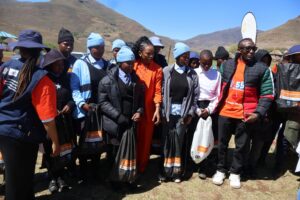
In response to this multifaceted crisis, a beacon of hope was ignited in Senkoase recently. The UNFPA launched a pioneering sanitary pads model, a pilot project specifically designed to remove the stigma and alleviate the burden of menstrual health for adolescent girls.
The project, a direct collaboration with the government of Lesotho, will supply 2 275 adolescent girls across three districts – Mokhotlong, Maseru and Mafeteng – with quarterly dignity kits for 13 months, starting from December 2025. Each package contains three packets of pads and a bar of soap, simple items that represent a profound restoration of autonomy and comfort.
For recipients like Limpho Lefosa, this intervention is transformative.
“I am glad I am one of the girls taught on menstrual health and hygiene because this will reduce the taboo and also give us a chance to understand… to avoid teenage pregnancy to mention a few,” she concluded.
The launch event was more than a distribution drive; it was a powerful statement of intent. John Kennedy Mosoti, UNFPA Country Representative, framed the issue in the starkest and most universal terms.
“Without menstrual health none of the people would be here,” he stated.
“Menstrual health is life. Menstrual health is human nature.”
He emphasised that the project is the culmination of a long journey of studies, validations, and meetings with the government, specifically the Ministry of Gender. The initiative is not merely about providing products but about catalyzing a cultural shift.
“The packages will be beneficial for our girls… especially for boys who need to understand menstruation health. We need to demystify period,” Mosoti asserted.
This educational component is critical. The project includes community dialogues that bring boys and men into the conversation, fostering empathy and respect.
Mathaba, the teacher, observed the immediate impact: “The UNFPA’s dialogue has given boys an overview of menstrual health and from now on, they need to take steps in supporting girls during their menstruation and not harass them.”
The Lesotho government has recognised that menstrual health is not a niche women’s issue, but a national development priority. Minister of Gender, Pitso Lesaoana, noted that Prime Minister Ntsokoane Matekane had tasked his ministry two years ago to educate the public and combat the stigma that leads to adolescent girls being mocked.
Minister Lesaoana cautiously welcomed the pilot project, acknowledging it as a test case. “This is a pilot project that can fail or pass hence the three districts that have been selected,” he said.
“If the project is successful, it will then proceed to the remaining districts.”
He stressed the need for collaboration with all relevant stakeholders to remove any barriers to success, highlighting the fundamental goal: “to give girls the right to free periods and attend classes without being belittled or harassed by their peers.”
While UNFPA’s new pilot is a significant step, it operates within a broader ecosystem of organizations battling menstrual stigma in Lesotho. UNICEF and local NGOs like Help Lesotho have been instrumental for years.
Help Lesotho, through its Pearl Programme and Young Mother Programme, educates women and girls about their bodies and safe menstrual management. Crucially, their initiatives also target boys and men, teaching them about menstruation to foster a more informed and supportive community.
Their work, alongside UNFPA’s recent community dialogue in Mphaki which focused on negative gender norms, is essential for dismantling the deep-rooted cultural barriers.
These collective efforts underscore a fundamental truth, menstrual hygiene is not just a health issue; it is a matter of human rights and dignity. When a girl cannot manage her period with dignity, her rights to education, health, equality, and non-discrimination are fundamentally compromised.
Back in Senkoase, Limpho Lefosa carries her menstrual hygiene package, a tangible symbol of a shifting narrative. She is part of a generation that is no longer willing to be silent. The knowledge she has gained empowers her not only to care for her body but to challenge the misconceptions that have held back her peers for generations.
The path to a #PeriodFriendlyWorld in Lesotho, as championed on the most recent Menstrual Hygiene Day, is still long. The challenges of infrastructure, cost, and deep-seated stigma will not vanish overnight.
But through the combined force of government commitment, international partnership, local advocacy, and the courageous voices of girls like Limpho, a new future is being written.
It is a future where no girl misses school because of her period, where no mattress is sacrificed for a lack of a pad, and where menstruation is recognised not as a source of shame, but as the very natural, life-affirming force that it is.
By breaking the silence, Lesotho is not just managing menstruation; it is unlocking the immense potential of half its population, one girl, one period, at a time.