Morning porridge initiative restores hope for Motimposo learners
LIAPENG RALIENGOANE
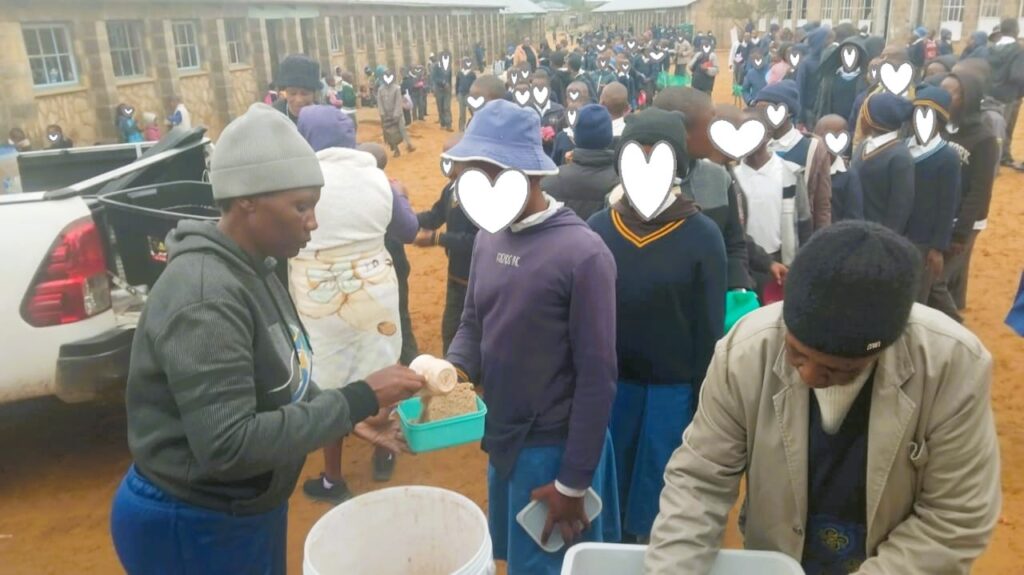
MASERU – Every morning at Motimposo Primary School, a queue of small feet is visible at the school kitchen. These young ones are clutching lunch boxes patiently awaiting their turn for a serving of warm soft porridge before they could start their classes.
For many of them, this is more than breakfast. It is their first meal in over 24 hours. While every Friday morning, the whole school gets served steamed bread with beans.
This initiative, facilitated by Motimposo Member of Parliament (MP) ‘Makatleho Motsoasele, follows a troubling series of incidents at the school, where hunger revealed its harsh reality recently.
Many learners fainted during school hours. Another reportedly vomited blood and investigations by teachers revealed prolonged hunger. The child reported that there was no food at home and only depended on the meal served at school.
The 2025 Lesotho Vulnerability Assessment Report indicates that over 524 000 Basotho face food insecurity during the 2025/2026 consumption year largely driven by El Nino- related drought, low agricultural production and high food prices.
For many children from disadvantaged families, the government’s school feeding programme which provides lunch is the only guaranteed meal of the day.
Recognising the urgency, Motsoasele stepped in. Using her own resources, she purchases ingredients and firewood to ensure that learners receive soft porridge before classes begin.
In an interview with Motimposo Primary School Principal, ‘Mabokang Lekhoeleha revealed that the situation had become alarming.
“We began noticing that some learners struggled to concentrate in class. Then came the fainting incident, followed by the case of a student who vomited blood.
That was when we realised this was not just about poverty in general, it was about children coming to school on completely empty stomachs. But at first, we thought they were possessed by the evil spirit because the fainting happened during assembly time.”
“When I spoke to the student who had vomited blood, it was on a Monday. She told me she suffers from ulcers and had not eaten anything the whole weekend, her last meal was at school on Friday. It was heart-breaking and I knew I had to act. I reported the situation to the Ministry of Education and to the priest overseeing the school, as it is a Catholic institution and to the MP for Motimposo constituency.
The priest then mobilised his friends and together we organised a back-to-school initiative where they donated sugar and mealie meal, ensuring that learners could at least have a warm serving of soft porridge each morning. This initiative started in February this year with supplies from the priest’s friends then afterwards the MP has been supporting it,” Lekhoeleha narrated.
The principal, however, expressed concern about the sustainability of the initiative, noting that the MP is currently funding it from her own pocket, with no certainty on how long the support will continue. She appealed to the Ministry of Education to consider introducing a formal feeding programme that would provide students with morning porridge, similar to what is already implemented in schools in the highlands.
Lekhoeleha also raised concern about how students cope over weekends, particularly those from households with little or no food. She expressed a wish for an initiative that could help bridge this gap and ensure learners have access to meals even outside the school week.
The situation reflects broader concerns captured in the African Charter on the Rights and Welfare of the Child, under the African Union (AU) which obliges member states to safeguard children’s rights to education, health and adequate nutrition.
At a regional level, the SADC Protocol on Education and Training of the Southern African Development Community further calls on countries to remove barriers to learning and improve access and retention, goals that remain difficult to achieve when learners attend school on empty stomachs.
Motimposo Primary principal further revealed that the school has a total enrolment of 1 601 students, of whom 393 have been identified as vulnerable through internal assessments. That the ministry of education visits time to time as follow up on the school’s report of hunger and wish to be assisted.
She described the MP’s intervention as timely and life-changing and expressed gratitude to MP Motsoasele.
“Learning cannot take place when a child is hungry. This morning soft porridge has already made a visible difference in attentiveness and attendance. The MP buys mealie meal, firewood, takes care of transport and people who work on that firewood from cutting it down to loading in on the truck. Where would we be without her?”
For one Grade 6 learner whose identity will not be disclosed, the daily soft porridge means more than just food. “Sometimes at home there is no breakfast. When I drink the porridge, I feel strong, I can listen to the teacher.”
A Medical Doctor, Dr Mojakisane Ramafikeng, confirmed that prolonged hunger can have serious health effects on learners, including dizziness, fainting and in severe cases vomiting blood due to stomach complications caused by going for long hours without eating. He stressed that proper nutrition is essential for children’s health, concentration and overall academic performance.
Teachers at Motimposo Primary have also observed the improvement. One teacher, ‘Matšepo Ntsoebea, noted that learners who previously appeared sluggish now participate more actively.
“You could see the hunger in their eyes before. Some would put their heads down on the desk. Now, after the porridge, they are more alert. It may seem like a small thing, but it is not small for these children as majority are from disadvantaged families,” she said.
She disclosed that some students are from child headed families as parents are working in South Africa while some are left with grandparents.
Motsoasele further said the decision to provide breakfast came from being approached by the principal with a report of children suffering due to hunger and from witnessing the community’s needs first-hand.
“As a leader, I could not sit back after hearing that children fainted because of hunger while another vomited blood. Government provides lunch and we appreciate that, we realised there was a gap in the morning because some students had their last meals the previous day at school, at home there is nothing. This is about protecting our children’s dignity and health.”
She emphasised that the initiative is not meant to replace government programmes but to complement them. “If we want better academic results, we must first make sure our children are well-nourished.”
Molikuoa ‘Mota-Sekhonyana, a spokesperson from the Ministry of Education and Training acknowledged that Motimposo primary reported incidents of hunger and fainting students. That while the national feeding programme focuses on lunch, food insecurity among vulnerable households remains a broader socio-economic challenge.
“The school feeding programme is intended to support learners throughout the school day. However, the Ministry is currently reviewing its plans to address the gap in providing breakfast, as only highland schools currently offer it.
This was introduced after it was found that due to the difficult terrain, learners in those areas walk long distances, sometimes three to four hours to reach schools.
We recognise that vulnerability is not limited to the highlands but also present in the lowlands and the ministry is working on addressing this. The government continues to explore ways to strengthen the welfare of learners,” she said.
The school feeding programme has been implemented as a steady feature of the primary education in Lesotho since 1961. The programme has been implemented through various models and with different partners including World Food Programme (WFP) whose support goes way back in 1965.
In 2000, when the government of Lesotho introduced Free-Primary Education, school feeding was implemented through two models; Catering model and WFP model. With Catering model, food was sourced by local caterers, prepared and transported to the school for learners to be served with at least one meal a day, while the WFP model served two meals; a mid-morning snack and lunchtime meal.
In 2015 the government approved a National School Feeding Policy setting into motion a number of changes in a way school feeding programme is to be delivered in public primary schools across the country.