‘I cried until I passed out’
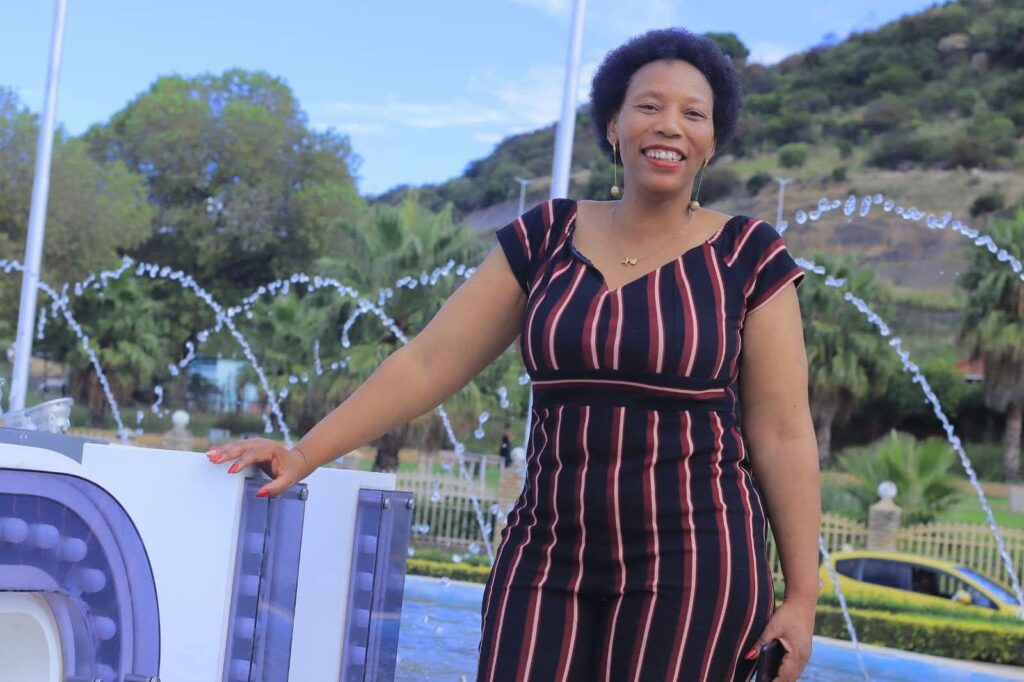
How love turned to torture – One woman’s fight for survival in a GBV crisis
RETHABILE MOHONO
Lerato Paanya endured years of emotional abuse, violent beatings, and a broken justice system. Her story is a mirror to a national emergency.
The first time Paanya saw her matrimonial bed in a suspicious state, she told herself she was imagining things. The second time, she found text messages on her husband’s phone warning another woman not to contact him on a Friday afternoon because his wife would be home at exactly noon.
That was the moment the dream of a loving marriage began to crack. But it would take nearly a decade of emotional torture, forced herbal concoctions, a miscarriage turned accusation, and a final savage beating with a stick before she understood a brutal truth – you cannot fix a man, and once he slaps you, run.
Paanya, popularly known as Lovy Paanya, is a 30-something woman from Ha Mabote, Maseru. Sitting in a small room, she speaks with a calm that belies the horror she survived. Her right arm still cannot carry anything heavy. Blood clots linger in her leg. Flashbacks ambush her without warning.
And yet, she says, “The fact that I am not breaking down says I am definitely healed – and I am happy.”
But her healing has come at a devastating price.
It began with a fairy-tale wish. In 2014, Paanya married the man she loved. The union was legally formalised in 2016. She was working in Welkom, South Africa, while he was unemployed.
“I didn’t have any problems with that,” she recalls, taking a deep breath.
“I believed one day there would be a breakthrough.”
Instead, the distance between them became a weapon. If she missed his calls, he would shout, accusing her of being with other men.
“When I missed his calls, I would be shouted at and be told I’m with men,” she says. The pressure mounted until, by 2015, she left her job and returned home to Lesotho, hoping her presence would restore peace.
“I had to leave my job to come and stay home so that there would be peace,” she says.
“Nothing changed.”
The accusations did not stop. Instead, they mutated. Paanya would return to their house to find the matrimonial bed disturbed, stained with what she suspected was semen.
She dismissed it as paranoia until she found the messages on his phone: a woman being told not to contact him from 12 noon on Friday because his wife would be home.
That Friday, Paanya walked in at exactly 12 o’clock.
When she confronted him, he did not apologise. He turned his actions on her, making her the villain.
“I was furious thinking how I work hard to get bread on the table and that’s what he does – and then he turned his actions to be mine,” she says.
The couple had no children. For Paanya, this became the epicentre of the storm. She was repeatedly blamed for not conceiving.
“The biggest challenge in my marriage was a child. I was accused of not giving him a child,” she says.
Against her will, she was taken to herbalists and forced to drink unknown substances. Nothing worked. She suggested he also get tested.
He refused at first, but eventually agreed to go to a men’s clinic – paid for by her. Tests showed she was scientifically fine. She conceived. Then she miscarried.
“That brought me hell,” she says, her voice steady but fragile.
“I was told that I made an abortion. It was very painful.”
She was mocked. Chased out of the bedroom. Her husband began cooking his own meals. They lived like strangers in the same house.
“The house was unbearable and toxic,” she says.
“We were staying like strangers.”
For years, the abuse had been emotional – gaslighting, isolation, false accusations. Then, in January 2023, it turned physical in a way she never imagined.
Paanya had bought a smart TV in town and hired a cab to bring it home. She also arranged for a shop technician to mount it on the wall. When the technician arrived, her husband was not home. But he returned shortly after and found another man inside his house.
“He didn’t say anything to ask what was happening. He started beating the boy with his stick,” she recalls.
The worker fled to a neighbour’s house. Her husband followed and continued the assault. Paanya stepped between them.
“He then beat me up with his stick,” she says.
A crowd gathered. Her husband called his elder brother, who, instead of asking questions, said, “He did a good job.”
Paanya later advised the technician to report the matter to the chief. The chief came with other men, but nothing changed.
“There was no communication from January until March,” she says.
In March 2023, her husband told her to leave the house. Another woman and a child would move in, he said. Paanya, exhausted, replied that it would be good – the house had been quiet too long. But when she tried to find her marriage certificate and lease agreement, they were gone.
Taken to her husband’s brother’s house.
She found his mother’s life insurance file and kept it as leverage, asking for her own documents in return. He left without answering. When he came back, he attacked her again.
“He started to brutally assault me with the stick,” she says.
After the beating, he locked her inside the house and left. Bleeding, barely conscious, she recorded a WhatsApp status video crying for help. Her brother saw it and came to her rescue.
She was admitted to Queen ‘Mamohato Memorial Hospital in 2023.
“My right arm could not function well. Until now I can’t carry anything heavy,” she says. She could not walk. She lost money hiring cabs.
“I had to beg to survive. One friend of mine even had to steal food for me to eat.”
Paanya reported the matter to the police in Mazenod. She was not satisfied. She submitted her medical form, but instead of an investigation, she received a call from a police officer saying her husband was apologetic and offering M1 500.
“I asked him, ‘Do I worth that amount?’ and he hung up,” she says.
The accused was briefly detained, then released after paying M2 500.
“I was left there without a car, even when I couldn’t walk. I had to find my way back,” she says.
“The court process was more like hell. I will never forget it. I feel that the justice system failed me.”
She continues to suffer from physical injuries: her knee, arm, head, left thigh, and blood clots in her leg. Emotionally, she has been suicidal.
“Every time all the flash of the incident came, I get triggered,” she says.
Lerato Paanya is not alone. Her story unfolds against a terrifying national backdrop. Lesotho has one of the highest rates of gender-based violence in the world.
According to Afrobarometer (2022), 44 percent of male prisoners in Lesotho are sexual offenders. The World Health Organization (2018) reported that 47 percent of murdered women in Lesotho are killed by intimate partners – far above the global average of 38 percent. More recent data for2024 paints an even grimmer picture: between January and September alone, 454 GBV cases involving adults were reported, including 266 sexual offences and 127 assault cases, most involving women attacked by partners.
At least 205 women were reported to have been subjected to sexual violence between January and August 2025, according to reports recorded by the Child and Gender Protection Unit (CGPU) of the Lesotho Mounted Police Service (LMPS).
The unit further reported that many of these women experienced violence at the hands of their intimate partners.
The 2023–2024 Health Survey further attested to the prevalence of violence against women, finding that 41.8 percent of women had experienced abuse and violence, with many experiencing it at the hands of their intimate partners. These figures cover women and girls between the ages of 15 and 59, while a significant number of survivors continue to suffer in silence.
The LMPS, through the CGPU, has urged women and other survivors of abuse in its various forms to report incidents so that their lives can be protected and perpetrators brought before the law.
During the 16 Days of Activism Against Gender-Based Violence in 2024, Assistant Commissioner of Police Tebello T’sepe presented police statistics covering January to September 2024. The figures showed that 454 GBV cases involving adults had been reported, including 266 classified as sexual offences and 126 cases of intimate-partner violence.
Gender-based violence (GBV) remains widespread among women in Lesotho, with two in three women reporting that they have experienced GBV at some point in their lives, according to the 2025 Lesotho GBV Indicators Follow-up Study by Gender Links Lesotho.
The study found that 66.7% of women had experienced GBV during their lifetime, a decline from 86% recorded in the 2013 study. It also found that 45.7% of women had experienced intimate partner violence (IPV), down from 62% in 2013.
The study further highlights changing attitudes towards wife-beating. Findings from the 2023–24 Lesotho Demographic and Health Survey (LDHS) show that attitudes justifying wife-beating have declined since 2004. About 25% of men and 19% of women said wife-beating was justified under at least one circumstance, compared with 51% of men and 48% of women previously.
However, attitudes towards domestic violence remain a concern. The 2022 Afrobarometer found that 53% of Basotho viewed domestic violence as a private family matter rather than a criminal issue.
Administrative data from the Child and Gender Protection Unit (CGPU) also showed high reported case volumes. During the first nine months of 2024, the CGPU recorded 454 adult GBV cases, including 266 sexual offences and 126 intimate partner violence cases. During the same period, 364 child GBV cases were recorded, including 284 sexual offences.
The study also found that intimate partners were responsible for at least 47% of murders of women in 2021, highlighting the link between intimate partner violence and the risk of femicide.
GBV also affects transgender people. The study cites THUSO (2026), which reported that 50% of transgender respondents had experienced GBV during the previous 12 months.
The 2025 study is a nationally representative survey covering all 10 districts of Lesotho. It examines the prevalence, effects, responses, support and prevention of GBV and builds on Gender Links Lesotho’s 2013 baseline study. The research was conducted in partnership with the Lesotho Bureau of Statistics and the Ministry of Gender, Youth and Social Development, with funding from the European Union through a grant to Gender Links.
Children are not spared, 364 reported incidents involving children, including 284 sexual offences.
These figures represent real women like Paanya – women who cry until they pass out, who are locked inside their own homes, who are offered M1 500 as compensation for their shattered bodies.
Paanya’s ordeal points to three urgent areas for action. Ending GBV in Lesotho requires more than statistics – it demands systemic change.
- Police and judicial reform
Paanya was failed at every step: a dismissive officer, a suspended perpetrator released on a small payment, a court process she describes as “hell.” Lesotho must implement specialised GBV units within the police force, trained in trauma-informed response. Bail for repeat or violent offenders must be denied. As Paanya says: “There should not be bail or sympathy for anyone who assaults or kills women. Lock them up.”
2. Expedited court processes
“Please don’t delay cases in your court. We want to be free from them,” Paanya pleads. Delays force survivors to relive their trauma, often while still living near or with the abuser. Dedicated GBV courts with fast-tracked dockets are essential.
3. Community and prevention
Red flags were there from the beginning: accusations, control, isolation, the destroyed bed. Paanya’s message to other women is direct: “Don’t ignore those red flags. You cannot fix a man, and once he slaps you, run.” But prevention also means teaching boys and men accountability. It means ending the culture where a brother praises a beating as “a good job.”
Additionally, safe houses and economic support for survivors must be funded. Paanya could not work. She begged. She relied on a friend who stole food for her. No woman should have to choose between hunger and her abuser.
Despite everything, Paanya is rebuilding. She draws strength from prayer and from speaking about her ordeal. “If I don’t have anyone to talk to, I stand in front of the mirror and talk – it helps,” she says.
She has not fully recovered physically. But emotionally, she says, “I am at peace. God is working hard behind the scenes, and I am grateful. I am working hard to rebuild my life.”
Her final appeal to authorities is simple yet profound: “When someone comes to seek protection, give protection. Show empathy. Women are not animals – they are humans.”
Paanya cried until she passed out.
But she did not die.
And now she is speaking so that other women might run before the first slap lands. The question is whether the country’s justice system, its police and its communities will finally listen.
If you or someone you know is experiencing gender-based violence – Key GBV reporting numbers in Lesotho:
GBV National Toll-Free Helpline: 80066666
Anti-GBV Hotline: 80004248
She-Hive Association: 22314531 or WhatsApp: 57075354
Department of Gender: 63274157 or 63372493
Beautiful Dream Society: 63423361 or 57332854
Additional Support:
Nokaneng App: Download the Nokaneng app for immediate access to services and information.
Police: Contact local Lesotho Mounted Police Service stations, which have dedicated units.
Workers’ Rights Watch: For assistance, you can contact them via phone – 80004248
Monday – Friday: 6:00 am – 7:00 pm
Saturdays and Holidays: 7:00 am – 12:00 pm
If you are in urgent need of protection, please contact the nearest police station immediately. No woman should have to beg for her life.