Blood, dignity and distance
In water-rich Lesotho, Ha Ralintši’s women still dig for a drop
MOSA MAOENG
As World Water Day spotlights gender, the irony cuts deep – the nation that feeds South Africa’s taps watches its own girls carry corpses from rivers – and walk four hours for what should flow at home.
The sun has not yet cleared the thornveld when ’Mateboho Nyapoli, 14, lifts a 20-litre plastic jerry can onto her head. She will walk two hours to the river, dig through sand for seepage, wait, fill and walk two hours back. If the river is high after rain, she will drink the same brown water pooling on the path. If she finds a dead dog floating, she will pull it out and fill her can anyway.
This is not a forgotten war zone.
This is Ha Ralintši, Qalabane, in the Mafeteng district – a village that has existed for generations without a single safe tap. And it sits in the heart of a country that, perennially, is called the “water tower of Southern Africa.”
For every drop that fills a reservoir in Gauteng, for every litre sold under the Lesotho Highlands Water Project (LHWP), a girl in Ha Ralintši misses school. A woman develops chronic back pain. A grandmother watches her grandchildren drink water that carries gonorrhea and diarrhea, and the memory of rotting animal flesh.
Today, on World Water Day 2025 – celebrated belatedly in this village last Friday under the theme “Water and Gender” with the slogan “Where water flows, equality grows” – the government and its partners have promised a reprieve. The Lesotho Lowlands Water Development Project (LLWDP) Phase II and III, together with the Lowlands Rural Water Supply and Sanitation Project, will finally reach Ha Ralintši.
But the pipes will not run until November. Seven more months of sand, corpses and walking.
“I cannot remember how many years,” says ’Matebatso Letsie, Area Chief of Ha Ralintši.
She is not old, but her eyes carry decades.
“We fetch water from the river. When it rains, we cannot go – the river floods. Then we drink the rain that falls on the ground. Sometimes we find corpses of dogs in the river. We take them out, and we continue collecting the same water.”
She pauses.
Her voice does not break; it hardens.
“The children get illnesses. You hear of a child sick, and you know why.”
Gonorrhea is typically sexually transmitted, but in communities without safe water, non-venereal transmission through contaminated towels, bedding, or even direct contact with infected water sources has been documented – a stark indicator of how far from dignity these families live.
The World Health Organization notes that inadequate water and sanitation can facilitate the spread of bacterial infections in ways urban clinics never see.
Chief Letsie adds that the distance itself is a thief.
“Girls must fetch water, then come home to cook, then try to study. Their learning is broken. By the time they sit down, they are too exhausted.”
Sekabo Nyapoli, a grandfather in the village, nods slowly when asked.
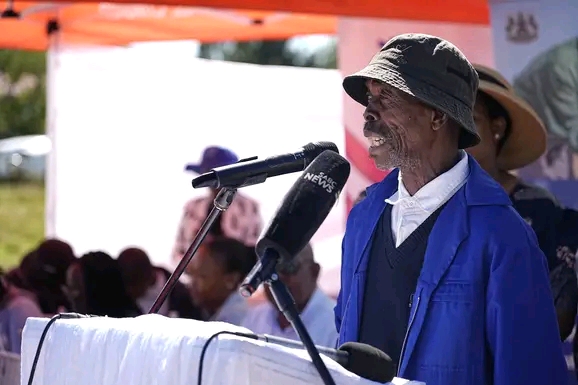
“I was born in this same environment. Now I watch my grandchildren live the same thing. The women walk too far. And the water is not clean. I thank the government for the promise. But we have heard promises before.”
The statistics behind his weariness are crushing. According to the Lesotho Demographic and Health Survey (LDHS) 2023-2024, while 82 percent of Basotho have access to at least basic drinking water services, that figure collapses to 73 percent in rural areas. For sanitation, only 46 percent of the entire nation has basic services. Hygiene coverage stands at a mere 28 percent.
In Ha Ralintši, those percentages mean nothing. Here, water is either too far, too dirty, or too dangerous.
Celebrated every year on March 22, World Water Day was created by the United Nations to draw attention to the importance of freshwater and to advocate for sustainable management. This year’s theme – “Water and Gender” – was chosen because, globally, women and girls are the primary water collectors in 80 percent of households without on-plot access.
For Lesotho, the day carries an uncomfortable irony. The country is blessed with abundant highland rainfall and river systems that feed the mighty Orange-Senqu basin. Through the LHWP, Lesotho supplies water to South Africa’s economic heartland, earning royalties and reinforcing its reputation as a regional water engine. Dams, tunnels, and hydroelectric plants hum with engineering success.
Yet, as the European Union Head of Delegation to Lesotho, Mette Sunnergren, noted at the Ha Ralintši commemoration, “This is not just a water crisis. It is a gender justice crisis.”
She gave numbers that landed like stones: women and girls in Lesotho spend up to four hours a day collecting water – time that could be spent in school, earning income, or caring for families. Girls are three times more likely to drop out when water sources are far from home. One in three women in rural Lesotho reports back pain, exhaustion, or injury from carrying heavy containers over long distances.
And then there is the shadow of violence. “Gender-based violence increases when women must travel far for water, especially in isolated areas,” Sunnergren said.
“When water is scarce, women and girls pay the highest price.”
Globally, women hold less than 17 percent of leadership roles in water utilities. Sunnergren challenged Lesotho to do better: “Studies show that when women participate in water committees, systems are 35 percent more likely to remain functional. They prioritise maintenance, hygiene, and community needs.”
A short walk from Ha Ralintši’s cluster of rondavels, the river is neither blue nor green. It is the colour of steeped tea. Women kneel on the banks, digging small pits with their hands. The water that seeps in is clearer than the flowing current, but it is not safe. There are no treatment facilities, no chlorine, no testing.
’Mamotebang Molise, a Village Health Worker, cannot do her job properly.
“I cannot offer services to the villagers because there is no water here. They collect from the river – water that is not even clean for drinking. We are truly grateful that the government will finally bring safe, clean water. It will ease my work and ensure a healthy life.”
Her frustration is professional and personal. Without water at the household level, hygiene promotion is a lecture without tools. Handwashing – the first defence against disease – becomes a luxury. Sanitation facilities go uncleaned. Menstrual hygiene becomes a source of shame and absence from school.
The LDHS2023-2024 confirms that progress in sanitation remains much slower than water access. Only 46 percent of Basotho have at least basic sanitation. In rural areas like Ha Ralintši, even that number is aspirational.
Lesotho is often called the “water tower of Southern Africa.” Its mountains capture moisture from the Indian Ocean, feeding rivers that flow year-round. The LHWPt Phase II is currently under construction, set to increase water transfers to South Africa while generating hydroelectric power for Lesotho.
By 2040, the country’s water infrastructure is projected to serve over 2 million people – nearly the entire population.
But abundance on a national scale does not automatically translate to taps in villages. The lowlands, where Ha Ralintši sits, have historically been underserved. The LLWDP Phase II and III is designed to change that, extending piped networks to unserved and underserved rural communities.
Upon completion, these projects will benefit over 1.1 million people, with projections reaching 2 million by 2040. They will supply water for domestic, institutional, and industrial use. They will reduce time spent fetching water, prevent waterborne diseases, integrate sanitation and hygiene education, and promote women’s leadership in water management.
But for the women of Ha Ralintši, the math is cruel: November is seven months away. Seven more months of walking. Seven more months of digging. Seven more months of pulling dead animals from the river and drinking anyway.
The government is not working alone. At the Ha Ralintši commemoration, development partners lined up behind the podium: European Union, European Investment Bank, World Bank, African Development Bank, United Nations Children’s Fund (UNICEF), and World Vision Lesotho (WVL).
James Chifwelu, WVL National Director, outlined what has already been achieved: “Between FY21 and FY25, World Vision has reached over 80 000 people with clean drinking water services. Over 2 250 households were supported with basic sanitation. Fifty-five schools were provided with access to safe drinking water, and improved sanitation was achieved in 94 schools.”
In Mafeteng, he added, World Vision has worked alongside communities for over 15 years, improving access to WASH services, strengthening resilience to climate change, and addressing drought.
Chifwelu reaffirmed World Vision’s commitment to “water systems that promote dignity, equality, protection and hope for every child” – and to contributing to the 2030 SDG Agenda, particularly SDG 4 (quality education), SDG 5 (gender equality), and SDG 6 (clean water and sanitation).
The EU, marking 50 years of partnership with Lesotho, has water at the centre. Sunnergren announced that Mafeteng and Mokhotlong districts have now been included in the Metsi a Lesotho financing agreement, which will improve WASH services in rural areas. The EU is also supporting the Integrated Catchment Management Programme – ReNoka Phase II, which previously worked in the Likhetla sub-catchment within Mafeteng.
“Two years ago, we signed the Metsi a Lesotho financing agreement,” Sunnergren said.
“Today we are proud to announce that Mafeteng and Mokhotlong districts have been included. You will see improved access to WASH services, especially in rural areas.”
She also pointed to policy progress: “Lesotho has already taken steps in the right direction. The WASH in Schools Guidelines, to be launched soon, will help keep girls in school by ensuring safe, private sanitation facilities – critical for menstrual hygiene management. The ReNoka programme has engaged women’s groups in catchment management, proving that local women are the best stewards of their own water resources.”
For a country that exports water, the inability to provide it to every citizen is a moral and developmental contradiction. The government of Lesotho has reaffirmed its commitment to gender-responsive water policies. Basotho are being called to support policies that improve opportunities for women, girls, and other vulnerable groups.
But policy is not a tap.
Guidelines are not a pipeline.
The LDHS 2023-2024 shows that while 65 percent of households report having sufficient drinking water when needed, that leaves 35 percent – more than one in three – without enough. And “sufficient” does not mean safe. It does not mean on premises. It does not mean the end of a four-hour walk.
At the Ha Ralintši commemoration, there was gratitude. Chief Letsie exchanged votes of thanks. Nyapoli said he hopes the project will change their lives for the better. Molise said she is truly grateful.
But gratitude, in a village that has waited for generations, is a complicated thing. It sits alongside exhaustion. It holds hands with skepticism. And it watches the calendar, counting days until November.
As the sun sets over Ha Ralintši, the women return from the river. Their jerrycans are full, but their backs ache. Their daughters walk beside them, silent, their schoolbooks replaced by plastic containers. Somewhere in the village, a child with diarrhoea cries. An old woman remembers the taste of water from a tap she saw once, in town, years ago.
World Water Day 2025 has come and gone. The theme – “Water and Gender” – has been spoken aloud, printed on banners, broadcast on radio. The slogan – “Where water flows, equality grows” – has been repeated.
But in Ha Ralintši, equality will not grow until the pipe does.
And so they walk. Four hours a day. Twenty-eight hours a week. Through mud, through heat, through fear. They walk because they have no choice. They walk because water, even dirty water, is life.
And they wait for November – when the government says the suffering will finally end.
For the sake of every girl who should be in school, every woman who should be free from back pain, every child who should not know the taste of a dog’s corpse in their drinking water – let the pipes run on time.