“We reclaim the land for the King, not for ourselves”
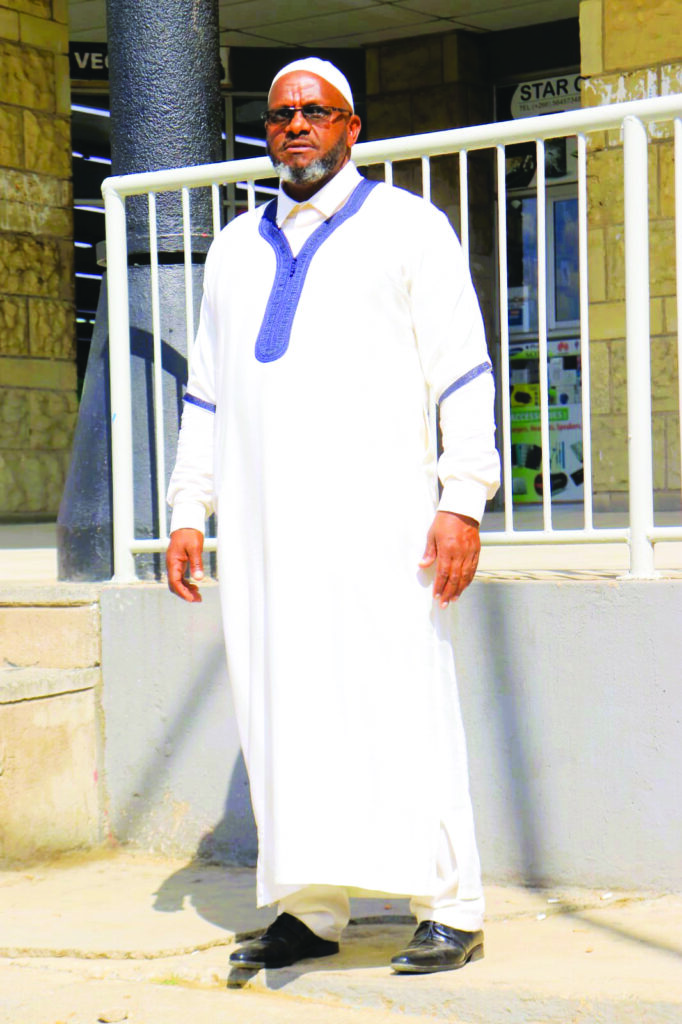
Says Abdulmalik Sekhonyana Molapo as he breaks away from BCM, launches BFF
In Lesotho, political parties emerge and fade with dizzying speed. For many, forming a party and securing a parliamentary seat has become the fastest route to political relevance – and employment. As the 2027 General Elections draw closer, Abdulmalik Sekhonyana Molapo (ASM), former deputy leader of the Basotho Covenant Movement (BCM) – from which he was ousted in January 2026 – is preparing to launch his own political vehicle. Like countless others before him, he insists his party will be different. While admitting that his political ambitions are fuelled by the land reclamation agenda popularized by his former party, Molapo says he is charting a distinctly different course. In this expansive interview with Public Eye’s Makoko Maeka (PE), Molapo paints his yet-to-be-launched Basutoland Freedom Front (BFF) as an eagle poised to sweep all before it in the 2027 elections.
PE: Tell us about who you are?
ASM: My full name is Hajj Abdulmalik Sekhonyana Molapo. The title “Hajj” means I have completed the fifth pillar of Islam – the pilgrimage to the Kingdom of Saudi Arabia, a duty every able Muslim must perform once in their lifetime. I am the second son of Chief Stanislus Kebeamang ‘SK’ Molapo, and ‘Mamoeketsane Adeline Molapo.
I trained as a police officer in 1984 and later worked with the National Security Service after the 1986 coup. That experience led me to join and fight alongside the African National Congress (ANC), where I rose to the level of military veteran. Though I never received financial benefits, I remain proud to have fought against apartheid.
PE: Take us through your political journey. Which parties have you belonged to, and what convinced you that reinventing yourself politically was necessary?
ASM: My political journey began in the Basotho National Party (BNP) of Dr Leabua Jonathan. When his government fell in 1980, I joined the Congress struggle – the fight of black people. In 1998, I joined the Marematlou Freedom Party, but that was a short stint. There was an unsuccessful attempt to remove the late party leader, Vincent Moeketse Malebo. I stayed with the party but remained politically low-key.
When Lesotho’s political direction changed around 2007 with the rise of the All Basotho Convention (ABC), I joined. But my time there was very brief. My political vision did not align with the ABC. Still, having reawakened my political activism, I sought a new home and joined the Lesotho Congress for Democracy, which later became the Democratic Congress.
Eventually, I realized that party was not open enough to my ideas. Some warned that my surname would be a liability – there is a belief that Congress parties do not welcome chiefs or chiefly surnames. I resigned.
When Tefo Mapesela formed the Basotho Patriotic Party, I joined and even contested a constituency election, though I lost. As a Muslim, I told myself better opportunities would come. Then the ruling Revolution for Prosperity (RFP) emerged like a strong wind. I joined from afar, not actively involved, but still considered myself a member.
Then Dr Tšepo Lipholo appeared. His message about Basotho land reignited an old desire I had carried since my days with Dr Mokhehle’s BCP — the fight for black people. I thought, “Here is a true party.” So I joined the BCM. I was deeply disturbed when a government minister said they would not support the BCM’s call because they are “friends with South Africa.” That was very disappointing.
PE: In simple terms, why did you break away from the BCM? What were the challenges?
ASM: The BCM had administrative problems. Some leaders, religious in nature, were problematic and often strayed beyond the party’s vision. As a collective, we advocated for a special conference to chart a clearer path.
When the BCM leader said he would choose between us and the religious leadership, those of us now seeking a different political home realized our future was bleak. Before we could respond, he chased us out in January. Personally, I was heavily attacked for being a son of a chief, an NSS sell-out and a Muslim.
There was a drive to discredit me. But I was instrumental in the movement, and people understood me. I was a threat because I spoke openly about the party deviating from its original plan to fight for Basotho land.
PE: Without delving too deep into BCM internal politics, was the path to reclaim the land properly laid out?
ASM: No. The administration was rigid. The general leadership was largely clueless on policy direction. We lacked a tangible constitution. The leader and his close executive dictated everything. The leader himself lost direction on how the population wanted to reclaim the land.
Bizarrely, he invented a country called “Basutoland,” complete with a flag and constitution. That was far from what we envisioned. He no longer wanted to be responsible to His Majesty the King. This same problem led to his conflict with the law and police. In our view, the BCM leader was promoting rebellion and hatred of chiefs and traditional leadership. That is where we parted ways.
PE: Rumours say after your ouster, you are forming a new party around the land issue. If true, what will be the glaring differences between your incoming party and the BCM?
ASM: The BCM’s approach was wholly erroneous – unconstitutional. The executive misled the leader, and when he got into trouble, they fled. The goal was to make people hate the RFP government, claiming it opposed land reclamation. At the time, I was oblivious.
I helped spread the lie that Dr Lipholo had made tremendous strides, all while he acted illegally – without an act of parliament. He wanted to establish a new country. But Lesotho already has a national anthem, constitution, and flag. When he started creating symbols for his “Basutoland,” we said: No more. He imagined himself as chief of a new country.
PE: Does the new party have a name and colours? Why that name?
ASM: Our focus is Malata-naha — the mind is the same, the difference is in the how, not the idea. Those still in the BCM are our relatives and friends. We await the day they realize the real movement for land reclamation is the party we will soon launch. We reclaim the land for Lesotho and for His Majesty, using all legal United Nations resolutions. We will not run against the law. Dr Lipholo sees himself as the next king of the land he wants to reclaim. We reclaim territories for His Majesty.
Our party is the Basutoland Freedom Front (BFF). We chose that name because the legal documents concerning the land are called Basutoland. Our colours are yet to be unveiled; we will wait for the Independent Electoral Commission’s approval. Until then, they remain a secret.
PE: Many parties disintegrate into minority factions with no real power. Will yours withstand that fate?
ASM: On the mushrooming of parties, the BFF will be different. Its mandate is people-oriented. We will make sweeping wins in the 2027 elections and rewrite history. The people want their land back – it is our economic future, our survival. When we speak about land, we will win uncontested.
Mark my words: BFF means freedom from all bondage to South Africa. By December, the entire political narrative will centre only on the BFF.
PE: Where does your party lean – National or Congress? And why?
ASM: Our vision is a national asset – a party owned by the people, one that helps people. Perhaps this will be the next party, after Dr Leabua’s BNP, to build houses for Basotho. We want an inclusive party where all are welcome.
PE: Do you anticipate greater support from chiefs and Basotho in general?
ASM: We already have support from chiefs and even police officers who say our ideas are politically correct. We are part of a coalition of organizations supporting Basotho chieftainship – Lesotho la Basotho, Bana ba Peete, Naka la Mohlomi, Lekhotla la Bafo, Mokhatlo oa Bakuena, Mokhatlo oa Baphuthi – all who aspire for the country to be reclaimed.
PE: How do you expect the government and parliament to react once your party is launched?
ASM: We hope the Basotho nation, once clear on our mandate, will choose us. We genuinely hope the government will help push our mandate. I once heard Prime Minister Ntsokoane Matekane say on radio, “tsa bo moshemane ha li jooe,” and I thought then: the PM is Lelata-naha. I expect his government to support our cause.
Once launched, the BFF will be the only option left. I credit Dr Lipholo for bringing this idea to light – he only lost his way halfway. Government should unreservedly help us now that we want to act legally.
PE: If the government threatens your party as it did the BCM, what will you do?
ASM: I don’t foresee any threat. We have no agenda against the government or the current establishment.
PE: You were arrested while with the BCM. Are you ready for a second arrest for the sake of Lesotho’s land?
ASM: I was arrested for violating the law. I will not go that route again. Under this new party, I don’t think I will be arrested. I am doing nothing untoward.
PE: The land issue is highly charged. Do you truly believe a greater Lesotho is possible?
ASM: Yes. We have campaigned in South Africa, and nothing major was done against us. The land issue is a bigger problem for all black people. We cannot be cowards. It is highly possible to have our country back. Botswana and eSwatini have been waiting. God is in control.
PE: They say believing in a politician is risky. Will your promises to Basotho be true and without self-interest?
ASM: I have always stayed true to my word. I am an ANC veteran and unit commander with commendable credentials. I fought white supremacy at the risk of my life. Everyone should believe me more than any other politician. Our manifesto will clearly spell out how we plan to reclaim the land and develop the country.
Once elected, I will use my Muslim connections to invite investors. We have abundant minerals left untouched. We can quicken development.
PE: If South Africa flatly refuses to return the land, what will your party advocate?
ASM: That is impossible. We do not want violence. If they refuse, we will go to the International Court of Justice. A legal fight – no guns, no bloodshed. We will invoke legal resolutions.
PE: Is the current government supportive of reclaiming Lesotho’s land?
ASM: No, they do not support it – except perhaps the prime minister’s personal sentiment. That may cost them votes. One minister said the government has friendship with South Africa (SA) and does not want to muddy the waters.
PE: What explains the government’s behaviour on this issue?
ASM: Ownership of South African identity documents. Some politicians have dual stay and SA IDs, making it difficult to oppose SA. Our constitution prohibits Members of Parliament from holding foreign IDs. But they have them, so they cannot fight for Lesotho’s interests. SA controls our politicians. That is it.
PE: Do you perhaps have the facts to speak to why Ntsu Mokhehle’s Basutoland Congress Party failed to reclaim the land, and why other parties have shied away from this issue for years?
ASM: I cannot say much with certainty about how and why Ntate Ntsu failed. There are rumours that he worked with Afrikaners at Vlakplaas, so I prefer not to dwell on his failure. What I can say is that his government was chaotic. They dismantled many pillars of the economy – Lesotho Airways, cooperatives, the Agricultural Bank, and more.
Nearly every structural configuration meant to advance the country was undone, starting from his administration and continuing through subsequent governments. As a result, the country has been left with very little. Lesotho began its path as a banana republic from his time right up to the present. Now is the time for us to work hard and advance the interests of this nation. But as for Ntate Ntsu’s government – it was chaotic. There’s little more to say.
Beyond that, the political climate at the time simply would not have favoured him. He was campaigning when white domination in South Africa was still very strong; the white minority government would have successfully opposed any serious attempt to reclaim the land. His own background would have worked against him as well. In my view, the fight – though not necessarily physical – would have required someone with a militant background, not a civilian.
Ntate Ntsu had very low revolutionary credentials. Moreover, the Basotho people back then were not ready to support such a course to the end. Politically, Basotho are far stronger-willed now than they were then, while South Africans are politically disorganized. The fact that South Africa is now in a so-called Government of National Unity (GNU) shows their disunity – and this is exactly the right time to strike. The time was not right for Ntate Ntsu to reclaim the land then. Now, the coast is clear.
PE: Ahead of the 2027 elections, what is your final message to voters?
ASM: Basotho must be careful and realize the power of their vote. Voting can change the country for good or bad. Voting BFF will change this country. Once in power, we will declare a 100-day amnesty: those who stole from the nation must return everything peacefully.
We will open the door for those who wronged the country to come clean. After that, we will tighten up to root out corruption.
We want all Basotho to vote for BFF – not because it is new, but because it is the mandate to rewrite Lesotho’s historical future. Depending on the West is dangerous. We must make our own things work. We will ensure equal pay scales with South Africa. Basotho have a choice come 2027. The BFF is here.