Building dignity, block by block

- rise International returns to Motimposo Primary to tackle sanitation crisis
- Volunteers, local community construct vital urinals, highlighting schools’ infrastructure challenges
TEBOHO KHATEBE MOLEFI
The vibrant sounds of children learning at Motimposo Primary School echoing across the school’s dusty grounds at Ha Tšosane, often masked a fundamental struggle – the daily battle for basic dignity and health. For over 1 000 learners, particularly boys, the lack of adequate sanitation facilities wasn’t just an inconvenience, it was a barrier to well-being, privacy and focused education.
Last week, the rhythmic pounding of spades on the ground and the focused collaboration of a diverse team signalled a tangible change. rise International is back, spearheading its transformative International Workshop, this time dedicated to constructing a dedicated urinal facility – a direct response to a critical need identified during their impactful work here just last year.
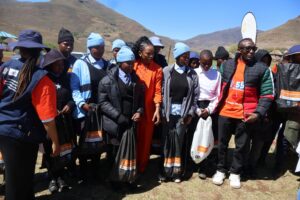
The scene is one of focused energy. Alongside the dedicated rise Lesotho team and local community volunteers, stand participants who have journeyed far, engineers from the globally renowned design and engineering firm ARUP, alongside a PhD student from University College London (UCL). They are united not just by spades, hammers and levels, but by a shared commitment to community-driven development.
Their mission is to build not just a structure, but a foundation for improved health, dignity and learning for hundreds of boys.
“This workshop embodies rise’s core ethos,” explains Reitumetse Nthako, Country Director at rise International, observing the bustling worksite.
“It’s about community-driven solutions, hands-on innovation in building methods, and creating a powerful learning-by-doing platform. Students and professionals from across the globe collaborate directly with local stakeholders.”
Nthako adds that “They gain invaluable real-world experience while contributing meaningfully to a community’s most pressing needs.”
The urgency for improved sanitation at Motimposo became starkly apparent during rise International’s previous intervention. Last year, the International Workshop focused on a different, yet equally vital. Challenge, the school’s inability to reliably feed its students.
With over 1 000 learners depending on it, the school struggled profoundly on rainy days. Without a proper, covered cooking space, the preparation of daily meals became impossible, leaving children hungry and unable to concentrate.
The 2023 workshop tackled this head-on. A diverse group of international volunteers and local community members designed and constructed a robust kitchen pavilion. The project was a resounding success, transforming the school’s feeding programme…rain or shine, children now receive their essential daily meals.
Thuto Mokhehle Ntšekhe, representing the Ministry of Education, highlighted the project’s significance: “Community participation was the cornerstone of the kitchen pavilion’s success. Local residents gave their time, energy, and expertise, ensuring it was completed efficiently and sustainably.”
Ntšekhe particularly emphasized the innovative material used: “The use of ICEB (Interlocking Compressed Earth Blocks), a highly durable and environmentally friendly building material, showcases the immense potential of sustainable architecture within our communities. This project ensures children’s meals are prepared safely and healthily, a fundamental requirement.”
It was amidst the success of building the kitchen, however, that the rise team and school leadership confronted another harsh reality: the dire state of the boys’ sanitation facilities. Overcrowded, dilapidated, and lacking privacy and basic hygiene, the existing setup was unsustainable and deeply problematic for the growing student body.
The need for a dedicated, hygienic urinal facility moved to the top of the priority list, setting the stage for this year’s return.
Motimposo Primary’s challenges are not isolated.
They reflect a widespread crisis affecting countless schools across the country. The lack of adequate Water, Sanitation, and Hygiene (WASH) facilities in educational institutions presents a complex web of interconnected problems.
Inadequate sanitation is a primary vector for disease. The absence of proper handwashing facilities and clean toilets significantly increases the risk of diarrhoeal diseases, intestinal worms, and other infections.
These illnesses lead to high absenteeism, stunting physical and cognitive development, and creating a vicious cycle that hinders educational attainment. Girls facing menstruation without private, clean facilities often miss school entirely during their periods.
Improperly managed human waste contaminates soil and water sources, especially in areas with high water tables or poor drainage. This pollution poses risks not only to the school community but also to surrounding villages relying on the same water sources for drinking, cooking, and washing.
Open defecation, often a last resort when facilities are unusable or absent, exacerbates this contamination severely.
Forcing children, especially adolescents, to use inadequate, overcrowded, or unsafe toilets is deeply demeaning. It robs them of privacy and basic dignity, contributing to stress, anxiety, and a sense of shame. This psychological burden directly impacts their ability to learn and feel safe within the school environment.
Time spent searching for a usable facility, waiting in long lines, recovering from illness, or – for girls – missing school during menstruation directly translates into lost learning hours. The focus shifts from education to managing a basic bodily function in challenging circumstances.
Even when facilities are built, a lack of resources, training, and community ownership often leads to rapid deterioration. Broken doors, absent water supplies, lack of cleaning materials, and blocked drains render many school toilets unusable shortly after construction.
Factors like harsh weather conditions, remote locations making material transport difficult and expensive, limited government budgets stretched thin across numerous priorities, and sometimes outdated infrastructure designs compound these problems significantly. The consequences ripple far beyond the school gates, affecting community health, environmental quality, and ultimately, the nation’s human capital development.
The work underway at Motimposo Primary, supported by rise International and its partners, demonstrates how targeted, collaborative interventions can begin to untangle this complex web of challenges.
The new urinal facility provides an immediate solution to a critical bottleneck. By offering dedicated, hygienic, and private spaces for boys, it drastically reduces health risks associated with poor sanitation and restores a fundamental sense of dignity – this translates directly into fewer illness-related absences and a more conducive learning environment.
Properly constructed and managed sanitation facilities prevent the contamination of soil and water sources surrounding the school. Containing and managing waste responsibly protects the local environment and community health downstream, and the use of sustainable materials like ICEB blocks further minimizes the environmental footprint of the construction itself.
rise’s model isn’t about dropping in a solution and leaving. The International Workshop is explicitly designed for collaboration. Local volunteers, community members, and school staff work shoulder-to-shoulder with international participants.
This hands-on involvement fosters a deep sense of ownership. Community members gain practical skills in sustainable construction techniques using locally adaptable materials (like ICEB), empowering them to maintain the facilities and potentially replicate or adapt the methods for other community needs.
“These are not just buildings,” emphasizes principal, ‘Mabokang Lehoeleha, her voice filled with gratitude, “they are solutions to real problems. Last year’s kitchen changed how we serve our learners. This year, the boys’ urinals will bring back dignity and improve hygiene for hundreds of our children.”
Utilizing ICEB blocks, as championed by the Ministry of Education representative, is significant. These blocks, made primarily from compressed local soil with a small amount of cement, are affordable, thermally efficient – keeping buildings cooler in summer, warmer in winter, fire-resistant, and have a much lower carbon footprint than fired bricks or concrete blocks.
Their use demonstrates that robust, durable, and healthy infrastructure can be built sustainably and affordably in the Lesotho context, providing a valuable model for other schools and communities.
The visibility and success of projects like the kitchen and now the urinals at a large school like Motimposo serve as powerful demonstrations. They show government officials, other NGOs and communities what is possible.
They highlight the tangible benefits of investing in school WASH infrastructure and can inspire replication and scaling of efforts elsewhere. The involvement of prestigious international partners like ARUP also lends technical credibility and draws broader attention to the cause.
The rise International Workshop is more than just a building project. As Nthako articulated, it’s a dynamic platform for exchange and learning. For the volunteers from ARUP and UCL, it’s immersion in real-world development challenges, demanding adaptive problem-solving, cross-cultural communication, and an understanding of working with limited resources. They bring technical expertise and fresh perspectives.
For the local community and rise Lesotho team, it’s an opportunity to share indigenous knowledge, develop new skills, and build confidence in implementing sustainable solutions. The workshop fosters mutual respect and breaks down barriers, proving that effective development is a partnership, not a handout.
For the children of Motimposo, seeing this diverse group of people united to improve their school sends a powerful message that their well-being matters, that their dignity is valued and that the world beyond their community cares.
While the completion of the urinal block will mark a significant victory for Motimposo Primary, the broader battle for adequate WASH facilities in Lesotho’s schools is far from over. The challenges are systemic and require sustained, multi-faceted efforts:
As the sun sets on another day of construction at Motimposo Primary, the progress on the new urinal block is clear. Each ICEB block laid represents a step towards a healthier, more dignified, and more conducive learning environment for hundreds of boys.
It stands as tangible proof of what collaboration, innovation, and unwavering commitment to community-driven solutions can achieve.
This project, building on the success of the kitchen pavilion, is more than just two structures. It’s a blueprint for addressing Lesotho’s school infrastructure crisis. It demonstrates that sustainable solutions exist, that communities are eager partners, and that targeted international support, when thoughtfully integrated, can catalyse profound local impact.
The sound of hammers at Motimposo is the sound of hope being built. It’s the sound of dignity being restored, and it’s a clarion call for sustained action to ensure that every child in the country, regardless of where they learn, has access to the safe, healthy, and dignified environment they deserve.
The journey is long, but rise International, alongside the community of Motimposo and its global partners, is laying the foundation, block by sustainable block.