The final mile: Lesotho is scaling mountains to reach every child with lifesaving vaccines
This story was produced with support from Paballo-ea-Bophelo
MOSA MAOENG
In the rugged highlands of Lesotho, where winding dirt roads dissolve into footpaths and stone-strewn hillsides, a quiet but relentless campaign is unfolding. It is a mission measured in kilometers walked, doors knocked, and tiny vials carried carefully in cold boxes.
Its goal is as simple as it is profound: to ensure that no child, no matter how remote their village, is left without the shield of vaccination.
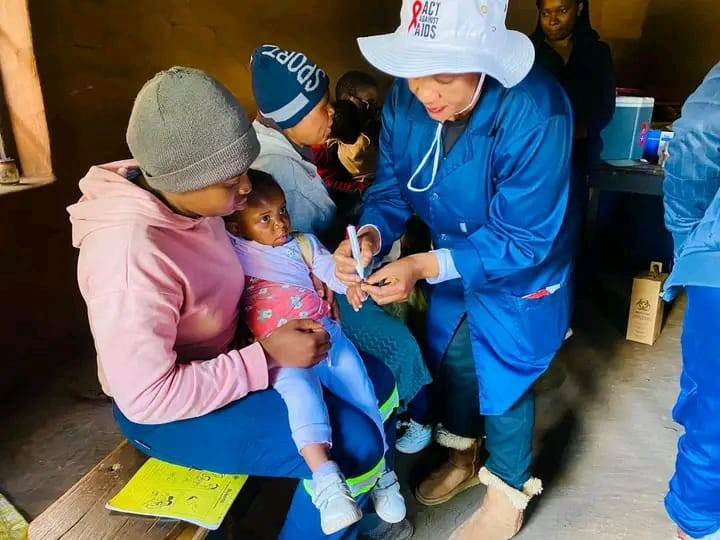
For ‘Mamojalefa Makhaola, a 58-year-old grandmother from Qobete in Mafeteng district, this shield now surrounds her three young granddaughters.
Her journey to secure their vaccinations was fraught with the hurdles that define life for many in Lesotho: daunting distance, prohibitive travel costs, and gaps in information. Yet, today, she speaks with the palpable relief of a guardian who has witnessed protection taking hold.
“I encourage all parents to give their children this opportunity,” she says firmly. “These vaccines protect our children from diseases. I have seen it, I believe it.” She recalls how her three-and-a-half-year-old granddaughter had a persistent rash before receiving her vaccines.
“After she was vaccinated, the rash faded.” Makhaola’s experience underscores a critical message: it is never too late. Her eldest granddaughter, who had missed earlier doses, received a catch-up injection the same day, highlighting the ongoing effort to reclaim children who have slipped through the cracks.
This sentiment is echoed in the voice of Moleboheng Mosebo, 40, whose four-year-old daughter is now fully immunized. “There were no complications, only peace of mind,” Mosebo shares. “I believe these vaccines guard against sicknesses like measles. It is a step every parent must take for their child’s life.”
These personal testimonies form the human heartbeat of a monumental national effort: the drive to eliminate “zero-dose” children – those who have never received a single vaccine – and to ensure every child completes the full immunization schedule. In a nation of breathtaking, yet isolating, mountainous terrain, this task demands both logistical grit and profound compassion.
According to the World Health Organization’s 2023 Country Disease Outlook, Lesotho has made significant strides, achieving about 90% coverage for the first dose of the measles-containing vaccine in 2021. National immunization days and routine services have built a bulwark against preventable killers like polio, measles, and diphtheria, saving countless young lives.
Yet, the final miles of this public health journey are often the hardest. The last 10 percent of children represent the most geographically and socially marginalized families. Puleng Limape, the Expanded Programme on Immunisation (EPI) Officer at the Ministry of Health, outlines the stubborn, interlocking challenges that persist.
“Our terrain is our first adversary,” she states plainly, referring to the kingdom’s dramatic landscape that renders countless villages remote. “Distance to health facilities is great, and the socio-economic status of many families means travel costs are prohibitive.”
She lists other critical gaps: health facilities operating on limited hours unsuitable for working parents or elderly caregivers; persistent myths and a lack of knowledge about vaccine safety and efficacy; and outreach services that are often sporadic, leaving communities isolated.
“Some children are left with grandmothers who, lovingly, cannot carry an 18-month-old toddler over hills to a clinic,” Limape explains, highlighting a poignant and practical dilemma at the core of the access problem.
To combat this, the EPI, bolstered by recent funding increases, is radically rethinking its approach to access. “We are spreading outreaches directly to communities,” Limape says. “We teach caregivers, we demystify vaccines, and we are advocating for facilities to open on weekends. The goal is to bring the service to the people.”
Bridging the chasm between government policy and a caregiver’s ability to reach a clinic is where a powerful coalition of partners steps in. World Vision Lesotho (WVL), mothers2mothers (m2m), and UNICEF are working in concert to turn the ideal of 100 percent coverage into a tangible reality on the ground.
World Vision Lesotho, a community-based organization with child well-being at its core, acts as a critical logistical and advocacy force. Mpai Putsoa, WVL Health and Nutrition Manager, details their multifaceted approach. “We support about 20 health facilities across five district area programmes – Mokhotlong, Leribe, Berea, Maseru, and Mafeteng,” she says.
Their support includes providing vehicles for outreach and transport, enabling health workers to conquer distance and mothers to bring their children in.
Their most targeted intervention is the zero-dose project. “We work with Village Health Workers to go door-to-door, registering every child under five,” Putsoa explains. This granular, community-level data reveals the exact location of every missed child, transforming an abstract problem into an actionable list. “After registration, we link these children to health facilities and follow up on newborns to ensure timely vaccination from the start.”
The statistics from their efforts are promising: through their area programmes, they have vaccinated 2 127 children, identifying only 54 as zero-dose – a sign of highly effective targeting. In a joint project with mothers2mothers, they had reached 320 previously zero-dose or under-immunised children by the end of August this year.
The partners have also moved beyond logistics to diagnose the deeper socio-economic drivers behind immunization gaps. Putsoa highlights districts like Maseru and Leribe, which are ringed by factories.
“Mothers work long, inflexible hours in these factories, and children are often left with grandparents who may be unable to travel for vaccines,” she notes. Other factors include the migration of parents in search of work, both within and outside Lesotho’s borders, leaving children in transient or unstable care situations.
The solution, they argue, requires systemic change and community-wide engagement. Putsoa is a strong advocate for involving men.
“Too much responsibility is placed on women. Education and action must involve both parents.” She also calls for extended health facility hours, quarterly vaccination campaigns held directly in villages, and a relentless public education drive leveraging social media, radio, and newspapers.
Complementing this logistical work is the trusted, peer-to-peer network of community health workers from mothers2mothers. As mentor mothers living within the communities they serve, they build deep trust, dispel fears rooted in misinformation, and provide relatable, peer-to-peer education on the importance of immunization.
This model proves particularly effective in engaging mothers who might be hesitant, overwhelmed, or simply unaware.
Funding and strategically coordinating this entire ecosystem is UNICEF. Thato Mochone, UNICEF Communications and Partnerships Specialist, underscores the universal right to health that underpins their mission.
“Measles and rubella continue to pose serious risks, especially where coverage is low,” she warns. “UNICEF partners with the government and organisations like WVL and m2m to extend vaccination services to the most remote and hard-to-reach communities. Our mission is to ensure no child is left behind.”
Vaccination, as Mochone concludes, remains one of the most effective public health interventions in history. In Lesotho, it is more than a medical procedure; it is a covenant—a national promise that every child, even in the most distant village cradled by mountains, will be given a fair chance at a healthy life, protected from preventable diseases.
The sheer scale of the remaining challenge is quantified in the WHO data: in 2021, an estimated 4 528 children in Lesotho were zero-dose, while a further 7 358 were under-immunised. Each number is not a statistic, but a child at risk, a story waiting to be changed.
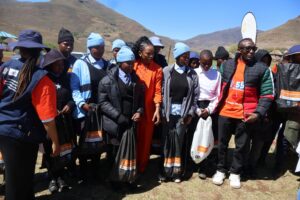
Yet, the story emerging from the mountains is ultimately one of determined progress, woven from countless individual acts of dedication. It is written in the relieved smiles of grandmothers like ‘Mamojalefa Makhaola, who now hold a well-filled health card as a badge of security. It is etched in the weary but determined footsteps of Village Health Workers like ‘Matšepo Lebopo from Qobete, who continues to climb hills to knock on one more door, identifying zero-dose children and persuading caregivers.
Lebopo speaks candidly of the challenges: “The reason why many children are zero-dose and under-immunised is the laziness of their parents. We try as much as possible to hold community gatherings to educate them.”
Yet, she immediately adds nuance, acknowledging the real constraints: “Most of the children are left with their grandparents who take care of them; therefore, it is usually a challenge for them to take their grandchildren to clinics.” Her work, and that of her colleagues, is defined by persistent follow-up, refusing to let these challenges be the final word.
This progress is sustained by the strategic partnership between a government programme that is continuously refining its approach and international NGOs providing the targeted, on-the-ground support to reach the very last child. It is a testament to what can be achieved when logistics meet humanity, when data guides boots on the ground, and when a nation’s health ambition leaves no valley overlooked.
The journey is not over. The mountains haven’t moved. But for thousands of Basotho children, the shield is now firmly in place. And for every health worker, every mentor mother, every driver navigating a rocky track, and every grandparent who made the journey, the work continues – one step, one vial, one child at a time – until that final mile is won.